







Question: The Fourier series of a complex function (,0 : (L, L) > C is defined as 00 $00 = Z cnei/L, where 1 L .
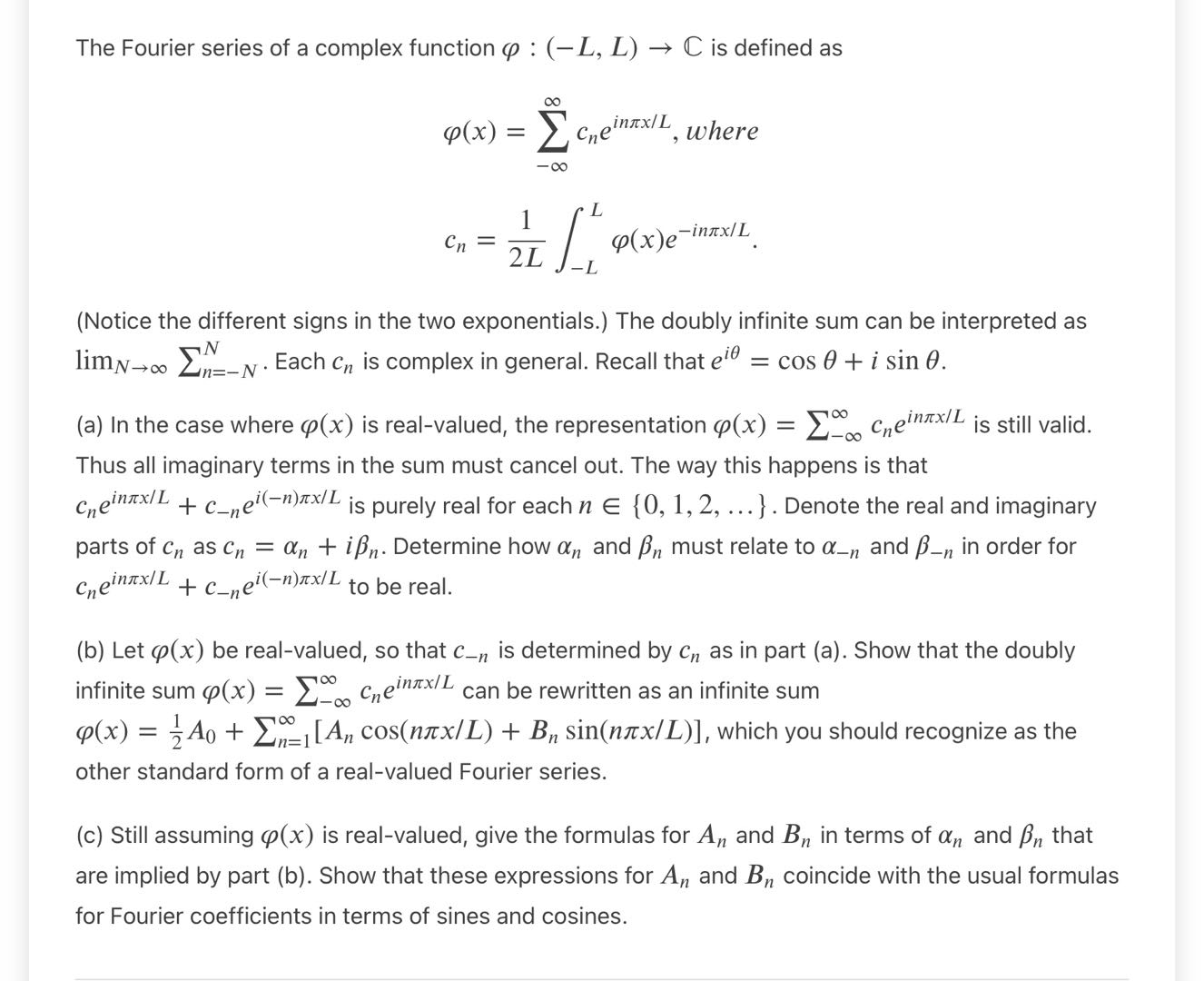
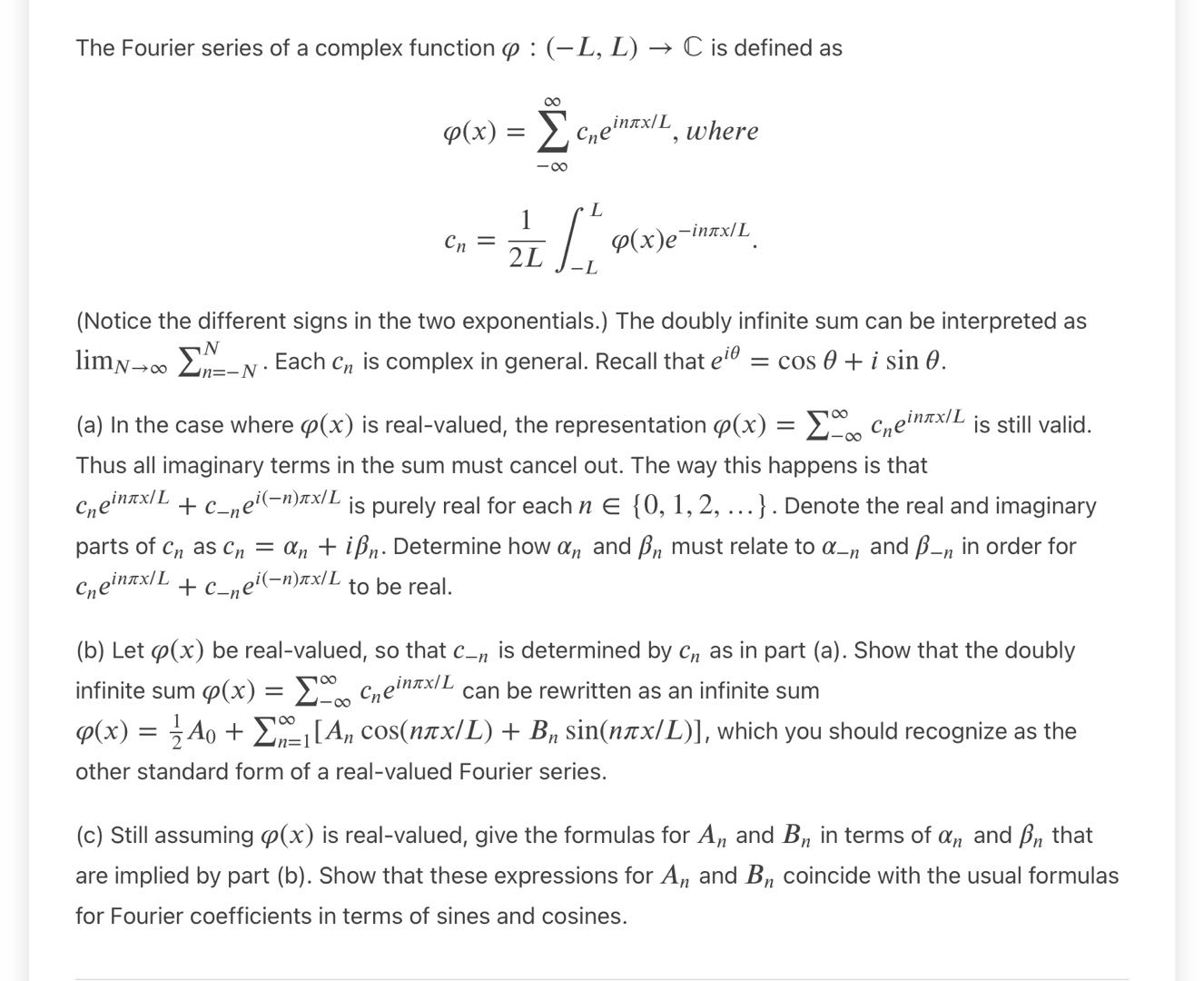
The Fourier series of a complex function (,0 : (L, L) > C is defined as 00 $00 = Z cnei"""/L, where 1 L . cn = E L (p(x)eim1rx/LI (Notice the different signs in the two exponentials.) The doubly infinite sum can be interpreted as limem 2;:_N. Each c\" is complex in general. Recall that e'9 = cos 6 + i sin 6. (a) In the case where (000 is real-valued, the representation @(x) = 2:; Chaim\" is still valid. Thus all imaginary terms in the sum must cancel out. The way this happens is that enema/L + c_nei(\")'\""L is purely real for each n E {0, 1, 2, ...}. Denote the real and imaginary parts of c\" as c\" = (1,, + in. Determine how an and [3,, must relate to or-\" and [3." in order for Cneim'x'q' + c_,,e'i('\")\"x"" to be real. (b) Let @(x) be realvalued, so that c-" is determined by c" as in part (a). Show that the doubly infinite sum (.000 = 2:0 enema/L can be rewritten as an infinite sum @(x) = %A0 + 2:1[An cos(mrx/L) + .3n sin(mrx/L)], which you should recognize as the other standard form of a realvalued Fourier series. (c) Still assuming (p(x) is realvalued, give the formulas for A" and B\" in terms of an and [3,, that are implied by part (b). Show that these expressions for A\" and En coincide with the usual formulas for Fourier coefficients in terms of sines and cosines
Step by Step Solution
There are 3 Steps involved in it

Get step-by-step solutions from verified subject matter experts
 Study Help