







Question: The function f has a negative average rate of change on every interval of x in the interval 0 The function f has a negative
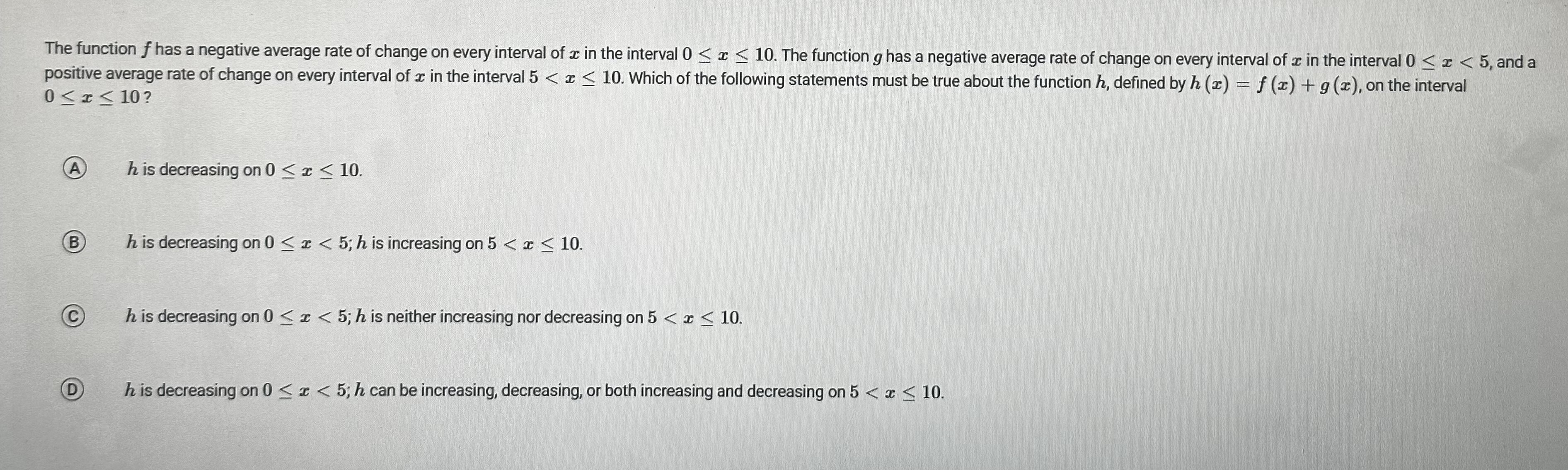
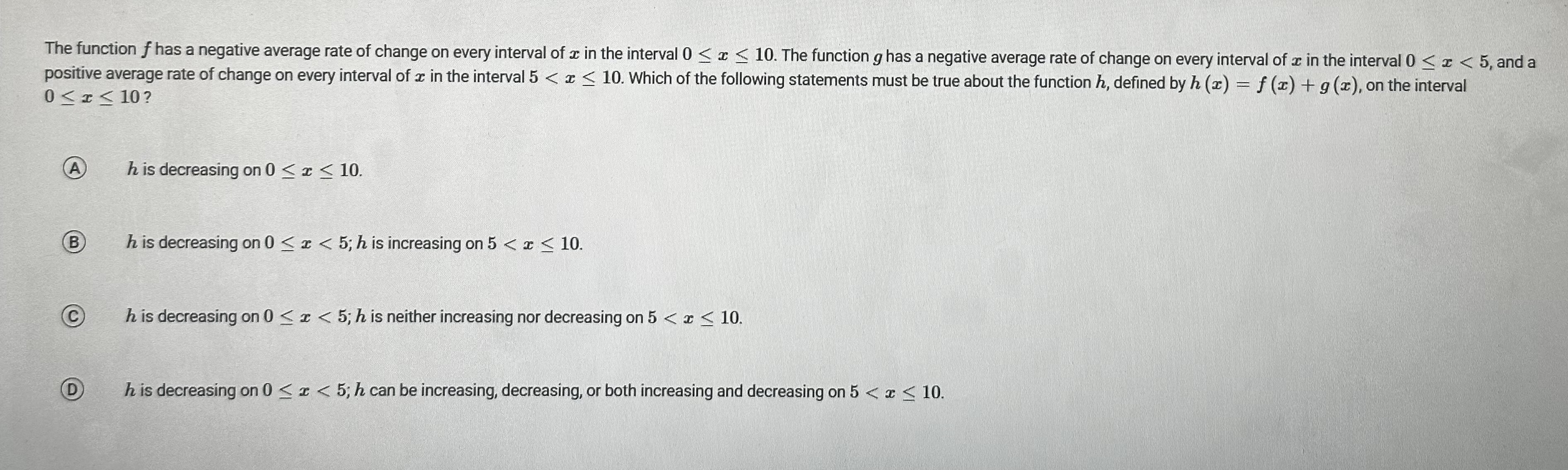
The function f has a negative average rate of change on every interval of x in the interval 0
The function f has a negative average rate of change on every interval of c in the interval 0 c 10. The function g has a negative average rate of change on every interval of in the interval 0 < c < 5, and a positive average rate of change on every interval ofc in the interval 5 < c 10. Which of the following statements must be 'true about the function h, defined by h (c) f (c) + g on the interval O < z < 10? h is decreasing on O c 10. h is decreasing on O c < 5; h is increasing on 5 < c 10. h is decreasing on O c < 5; h is neither increasing nor decreasing on 5 < c 10. h is decreasing on O c < 5; h can be increasing, decreasing, or both increasing and decreasing on 5 < c 10.
Step by Step Solution
There are 3 Steps involved in it

Get step-by-step solutions from verified subject matter experts
 Study Help