







Question: The function fib implemented the recurrence Fn. We can characterize the time taken by fib in terms of the number of additions (plusses) performed. We
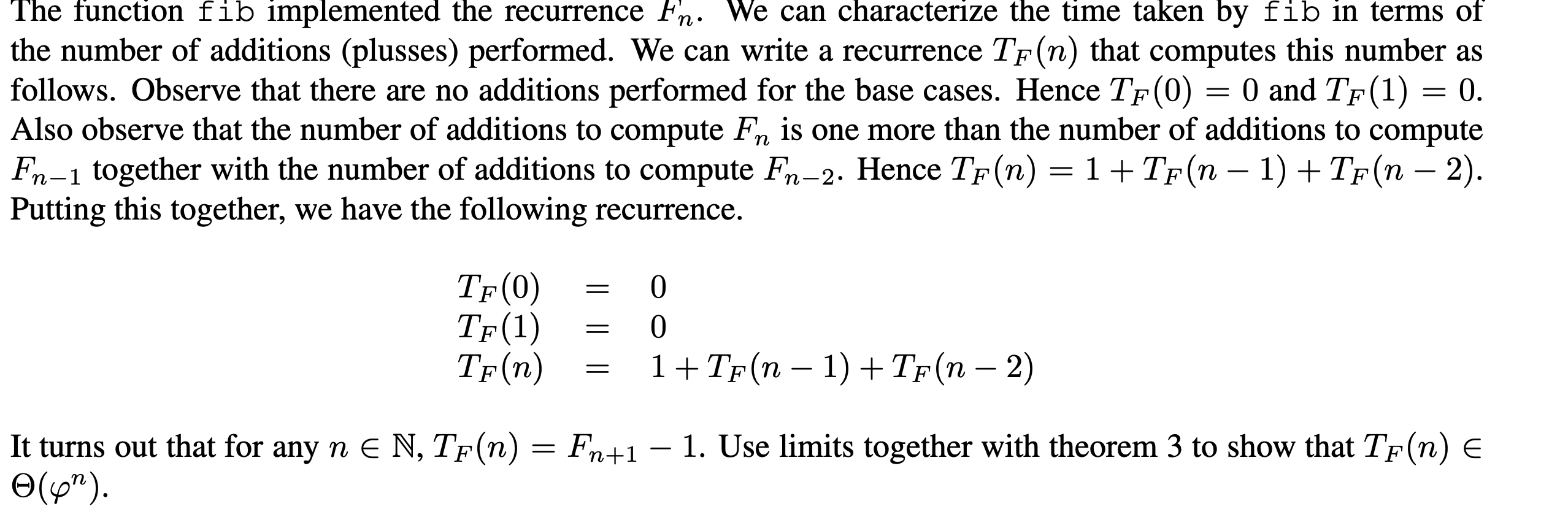
The function fib implemented the recurrence Fn. We can characterize the time taken by fib in terms of the number of additions (plusses) performed. We can write a recurrence TF(n) that computes this number as follows. Observe that there are no additions performed for the base cases. Hence Tf(0) = 0 and Tf(1) = 0. Also observe that the number of additions to compute Fn is one more than the number of additions to compute Fn-1 together with the number of additions to compute Fn-2. Hence TF(n) = 1 +Tf(n 1) + Tf(n 2). Putting this together, we have the following recurrence. = 0 TF(0) TF(1) Tf(n) = 0 1+TF(n 1) + TF(n 2) = It turns out that for any n E N, TF(n) = Fn+1 1. Use limits together with theorem 3 to show that TF(n) e O(6")
Step by Step Solution
There are 3 Steps involved in it

Get step-by-step solutions from verified subject matter experts
 Study Help