







Question: The Gamma function often appears in engineering applications and differential equations, including Laplace transforms. It is defined, for a > 0, by T(x) =
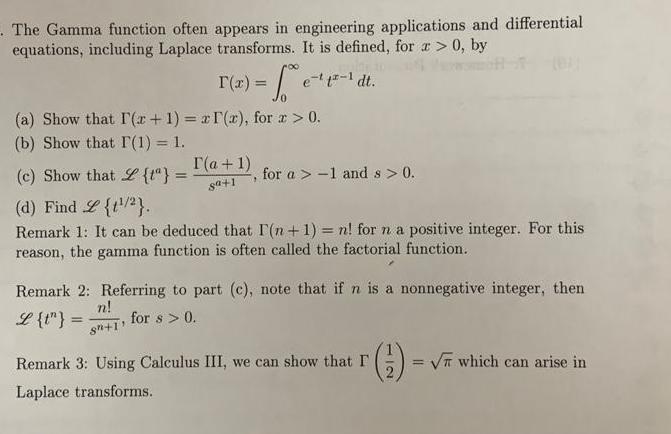
The Gamma function often appears in engineering applications and differential equations, including Laplace transforms. It is defined, for a > 0, by T(x) = e-- dt. (a) Show that I'(x + 1) = xF(x), for x > 0. (b) Show that I(1) = 1. (c) Show that {t } = r(a + 1) s+1 , for a > -1 and s> 0. (d) Find {1/2}. Remark 1: It can be deduced that I'(n+1) = n! for n a positive integer. For this reason, the gamma function is often called the factorial function. Remark 2: Referring to part (c), note that if n is a nonnegative integer, then n! for s> 0. 8"+1" Remark 3: Using Calculus III, we can show that I' Laplace transforms. () = which can arise in
Step by Step Solution
3.24 Rating (156 Votes )
There are 3 Steps involved in it
solution Given that D x et lalt ca Tex... View full answer

Get step-by-step solutions from verified subject matter experts
 Study Help