







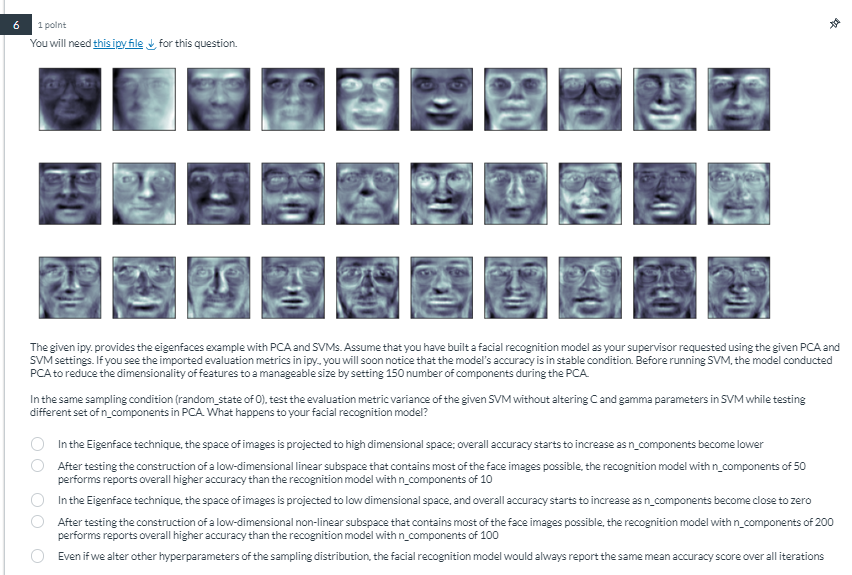
Question: The given ipy. provides the eigenfaces example with PCA and SVMs . Assume that you have built a facial recognition model as your supervisor requested
The given ipy. provides the eigenfaces example with PCA and SVMs Assume that you have built a facial recognition model as your supervisor requested using the given PCA and
SVM settings. If you see the imported evaluation metrics in ipy, you will soon notice that the model's accuracy is in stable condition. Before running SVM the model conducted
PCA to reduce the dimensionality of features to a manageable size by setting number of components during the PCA.
In the same sampling condition randomstate of O test the evaluation metric variance of the given SVM without altering C and gamma parameters in SVMile testing
different set of ncomponents in PCA. What happens to your facial recognition model?
In the Eigenface technique, the space of images is projected to high dimensional space; overall accuracy starts to increase as ncomponents become lower
After testing the construction of a lowdimensional linear subspace that contains most of the face images possible, the recognition model with ncomponents of
performs reports overall higher accuracy than the recognition model with ncomponents of
In the Eigenface technique, the space of images is projected to low dimensional space, and overall accuracy starts to increase as ncomponents become close to zero
After testing the construction of a lowdimensional nonlinear subspace that contains most of the face images possible, the recognition model with ncomponents of
performs reports overall higher accuracy than the recognition model with ncomponents of
Even if we alter other hyperparameters of the sampling distribution, the facial recognition model would always report the same mean accuracy score over all iterations
Step by Step Solution
There are 3 Steps involved in it
1 Expert Approved Answer
Step: 1 Unlock

Question Has Been Solved by an Expert!
Get step-by-step solutions from verified subject matter experts
Step: 2 Unlock
Step: 3 Unlock
 Study Help