







Question: The given table shows hypothetical data for five Potential Output Gap economies. Real GDP is measured in millions of dollars. Real GDP GDP (Y*) (%
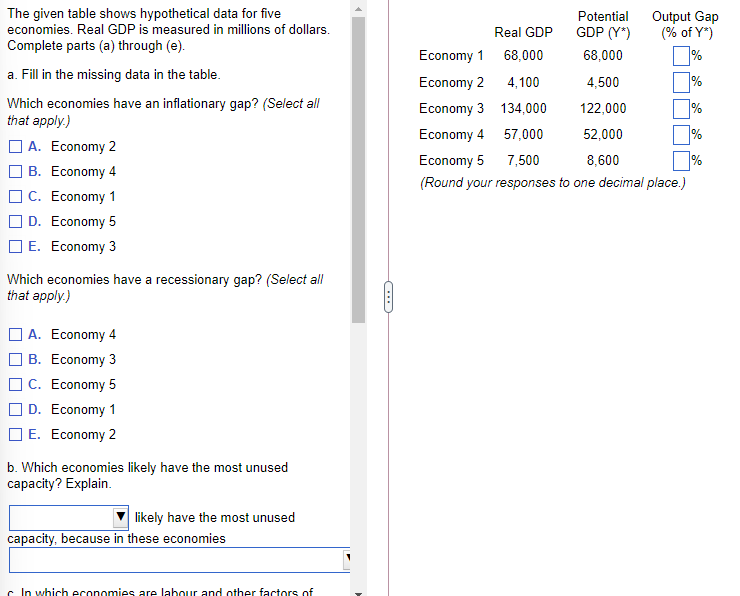
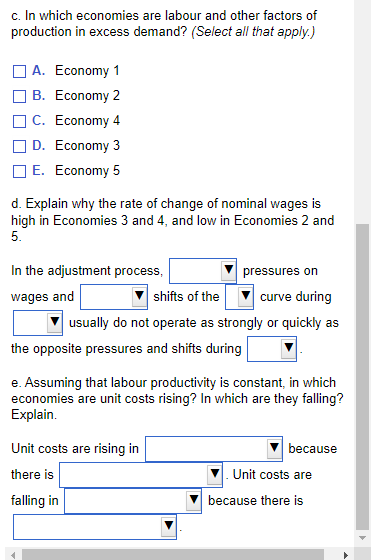
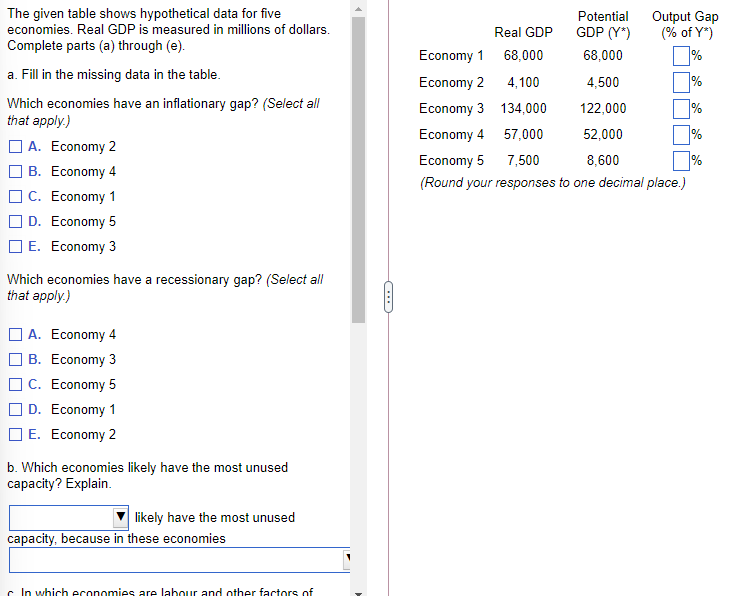
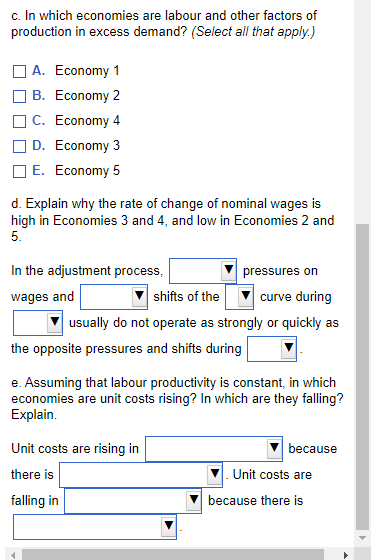
The given table shows hypothetical data for five Potential Output Gap economies. Real GDP is measured in millions of dollars. Real GDP GDP (Y*) (% of Y*) Complete parts (a) through (e). Economy 1 68,000 68,000 a. Fill in the missing data in the table. Economy 2 4, 100 4,500 Which economies have an inflationary gap? (Select all Economy 3 134,000 122,000 1% that apply.) Economy 4 57,000 52,000 % A. Economy 2 Economy 5 7,500 8,600 B. Economy 4 (Round your responses to one decimal place.) C. Economy 1 OD. Economy 5 DE. Economy 3 Which economies have a recessionary gap? (Select all that apply.) A. Economy 4 B. Economy 3 C. Economy 5 D. Economy 1 DE. Economy 2 b. Which economies likely have the most unused capacity? Explain. likely have the most unused capacity, because in these economiesc. In which economies are labour and other factors of production in excess demand? (Select all that apply.)A. Economy 1 B. Economy 2 C. Economy 4 D. Economy 3 E. Economy 5 d. Explain why the rate of change of nominal wages is high in Economies 3 and 4, and low in Economies 2 and 5. In the adjustment process, pressures on wages and shifts of the curve during usually do not operate as strongly or quickly as the opposite pressures and shifts during e. Assuming that labour productivity is constant, in which economies are unit costs rising? In which are they falling? Explain. Unit costs are rising in because there is Unit costs are falling in because there is
Step by Step Solution
There are 3 Steps involved in it

Get step-by-step solutions from verified subject matter experts
 Study Help