







Question: The Hard Rock Mining Company is developing cost formulas for management planning and decision-making purposes. The companys cost analyst has concluded that utilities cost is
The Hard Rock Mining Company is developing cost formulas for management planning and decision-making purposes. The companys cost analyst has concluded that utilities cost is a mixed cost, and he is attempting to find a base that correlates with the cost. The controller has suggested that tons mined might be a good base to use in developing a cost formula. The production superintendent disagrees; she thinks that direct labor-hours would be a better base. The cost analyst has decided to try both bases and has assembled the following information:
| Quarter | Tons Mined | Direct Labor-Hours | Utilities Cost | |||
| Year 1: | ||||||
| First | 31,000 | 6,600 | $ | 66,000 | ||
| Second | 20,000 | 4,600 | $ | 61,000 | ||
| Third | 36,000 | 5,600 | $ | 76,000 | ||
| Fourth | 28,000 | 7,600 | $ | 91,000 | ||
| Year 2: | ||||||
| First | 34,000 | 13,200 | $ | 116,000 | ||
| Second | 41,000 | 13,800 | $ | 121,000 | ||
| Third | 46,000 | 11,200 | $ | 101,000 | ||
| Fourth | 44,000 | 14,200 | $ | 136,000 | ||
Garrison 17e Rechecks 2020-13-10
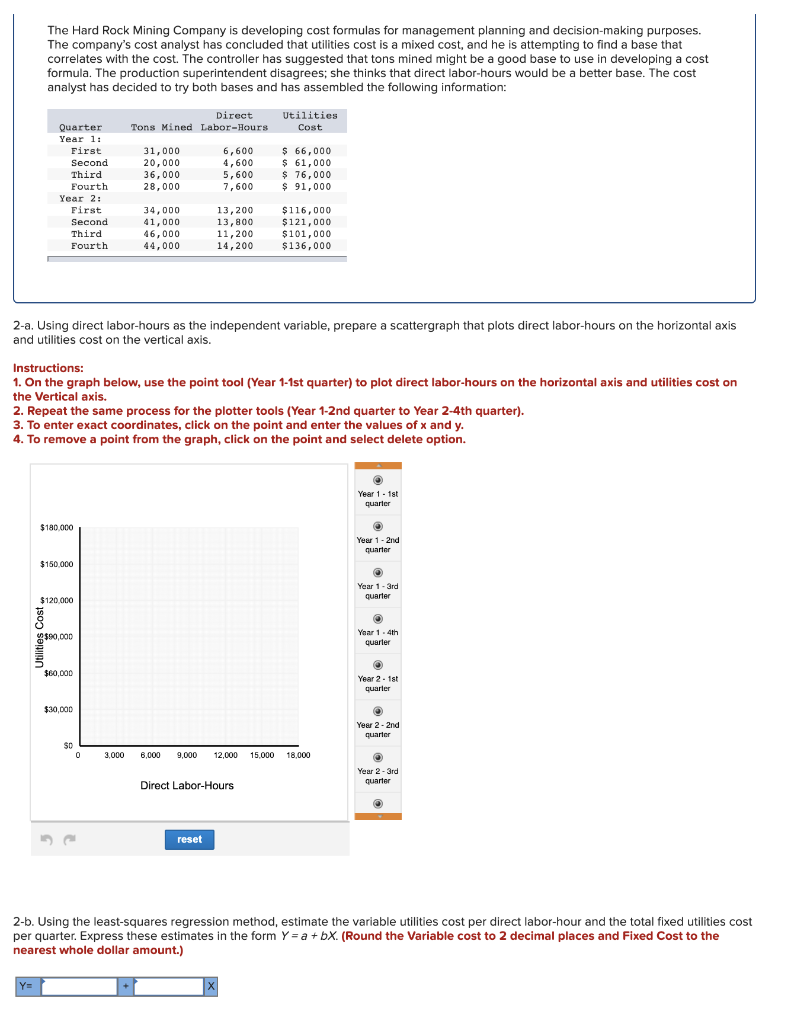
2-a. Using direct labor-hours as the independent variable, prepare a scattergraph that plots direct labor-hours on the horizontal axis and utilities cost on the vertical axis.
Instructions: 1. On the graph below, use the point tool (Year 1-1st quarter) to plot direct labor-hours on the horizontal axis and utilities cost on the Vertical axis. 2. Repeat the same process for the plotter tools (Year 1-2nd quarter to Year 2-4th quarter). 3. To enter exact coordinates, click on the point and enter the values of x and y. 4. To remove a point from the graph, click on the point and select delete option.
2-b. Using the least-squares regression method, estimate the variable utilities cost per direct labor-hour and the total fixed utilities cost per quarter. Express these estimates in the form Y = a + bX. (Round the Variable cost to 2 decimal places and Fixed Cost to the nearest whole dollar amount.)
The Hard Rock Mining Company is developing cost formulas for management planning and decision-making purposes. The company's cost analyst has concluded that utilities cost is a mixed cost, and he is attempting to find a base that correlates with the cost. The controller has suggested that tons mined might be a good base to use in developing a cost formula. The production superintendent disagrees; she thinks that direct labor-hours would be a better base. The cost analyst has decided to try both bases and has assembled the following information: Direct Tons Mined Labor-Hours Utilities Cost Quarter Year 1: First Second Third Fourth Year 2: First Second Third Fourth 31,000 20,000 36,000 28,000 6,600 4,600 5,600 7,600 $ 66,000 $ 61,000 $ 76,000 $ 91,000 34,000 41,000 46,000 44,000 13,200 13,800 11,200 14,200 $116,000 $121,000 $101,000 $136,000 2-a. Using direct labor-hours as the independent variable, prepare a scattergraph that plots direct labor-hours on the horizontal axis and utilities cost on the vertical axis. Instructions: 1. On the graph below, use the point tool (Year 1-1st quarter) to plot direct labor-hours on the horizontal axis and utilities cost on the Vertical axis. 2. Repeat the same process for the plotter tools (Year 1-2nd quarter to Year 2-4th quarter). 3. To enter exact coordinates, click on the point and enter the values of x and y. 4. To remove a point from the graph, click on the point and select delete option. Year 1 - 1st quarter $180.000 Year 1 - 2nd quarter $150 000 Year 1-3rd quarter $120.000 $90,000 Yaar 1.4th quarter $60,000 Year 2 - 1st quarter $30,000 Year 2 - 2nd quarter $0 0 3,000 6,000 9.000 12,000 15.000 18.000 Year 2 - 3rd quarter Direct Labor-Hours reset 2-b. Using the least-squares regression method, estimate the variable utilities cost per direct labor-hour and the total fixed utilities cost per quarter. Express these estimates in the form Y = a +bX. (Round the Variable cost to 2 decimal places and Fixed Cost to the nearest whole dollar amount.) Y= The Hard Rock Mining Company is developing cost formulas for management planning and decision-making purposes. The company's cost analyst has concluded that utilities cost is a mixed cost, and he is attempting to find a base that correlates with the cost. The controller has suggested that tons mined might be a good base to use in developing a cost formula. The production superintendent disagrees; she thinks that direct labor-hours would be a better base. The cost analyst has decided to try both bases and has assembled the following information: Direct Tons Mined Labor-Hours Utilities Cost Quarter Year 1: First Second Third Fourth Year 2: First Second Third Fourth 31,000 20,000 36,000 28,000 6,600 4,600 5,600 7,600 $ 66,000 $ 61,000 $ 76,000 $ 91,000 34,000 41,000 46,000 44,000 13,200 13,800 11,200 14,200 $116,000 $121,000 $101,000 $136,000 2-a. Using direct labor-hours as the independent variable, prepare a scattergraph that plots direct labor-hours on the horizontal axis and utilities cost on the vertical axis. Instructions: 1. On the graph below, use the point tool (Year 1-1st quarter) to plot direct labor-hours on the horizontal axis and utilities cost on the Vertical axis. 2. Repeat the same process for the plotter tools (Year 1-2nd quarter to Year 2-4th quarter). 3. To enter exact coordinates, click on the point and enter the values of x and y. 4. To remove a point from the graph, click on the point and select delete option. Year 1 - 1st quarter $180.000 Year 1 - 2nd quarter $150 000 Year 1-3rd quarter $120.000 $90,000 Yaar 1.4th quarter $60,000 Year 2 - 1st quarter $30,000 Year 2 - 2nd quarter $0 0 3,000 6,000 9.000 12,000 15.000 18.000 Year 2 - 3rd quarter Direct Labor-Hours reset 2-b. Using the least-squares regression method, estimate the variable utilities cost per direct labor-hour and the total fixed utilities cost per quarter. Express these estimates in the form Y = a +bX. (Round the Variable cost to 2 decimal places and Fixed Cost to the nearest whole dollar amount.) Y=
Step by Step Solution
There are 3 Steps involved in it

Get step-by-step solutions from verified subject matter experts
 Study Help