



Question: The idea of using repeated, simple arithmetic calculations to arrive at progressively better approximations to a more complicated function of a number (such as the
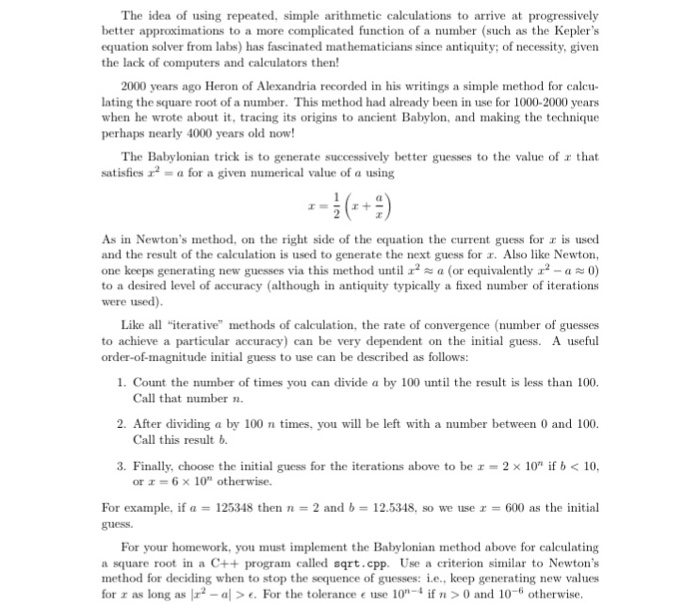
The idea of using repeated, simple arithmetic calculations to arrive at progressively better approximations to a more complicated function of a number (such as the Kepler's equation solver from labs) has fascinated mathematicians since antiquity: of necessity, given the lack of computers and calculators then! 2000 years ago Heron of Alexandria recorded in his writings a simple method for calculating the squareroot of a number. This method had already been in use for 1000-2000 years when he wrote about it, tracing its origins to ancient Babylon, and making the technique perhaps nearly 4000 years old now! The Babylonian trick is to generate successively better guesses to the value of x that satisfies x^2 = a for a given numerical value of a using x = 1/2 (x + a/x) As in Newton's method, on the right side of the equation the current guess for x is used and the result of the calculation is used to generate the next guess for x. Also like Newton, one keeps generating new guesses via this method until x^2 almostequalto a (or equivalently x^2 - a almostequalto 0) to a desired level of accuracy (although in antiquity typically a fixed number of iterations were used). Like all "iterative methods of calculation, the rate of convergence (number of guesses to achieve a particular accuracy) can be very dependent on the initial guess. A useful order-of-magnitude initial guess to use can be described as follows: 1. Count the number of times you can divide a by 100 until the result is less than 100. Call that number n. 2. After dividing a by 100 n times, you will be left with a number between 0 and 100. Call this result b. 3. Finally, choose the initial guess for the iterations above to be x = 2 times 10^n if b epsilon. e. For the tolerance epsilon use 10^n-4 if n > 0 and 10^-6 otherwise
Step by Step Solution
There are 3 Steps involved in it

Get step-by-step solutions from verified subject matter experts