



Question: The image below is simply produced with only typed characters of fixed width and should allow us to develop some understanding of how stereoscopic images
The image below is simply produced with only typed characters of fixed width and should allow us to develop some understanding of how stereoscopic images are constructed and how it is that our visual system fuses them.
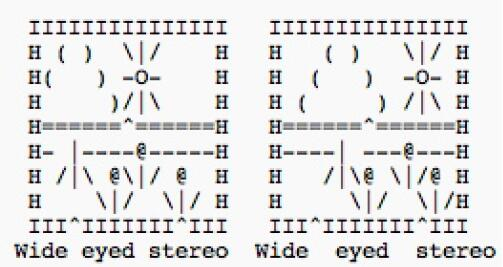
Each picture is meant to be a simple image of the same scene: a tree, some flowers, the sun, and the horizon through a window. (a) Although the image says wide eyed stereo, first try to fuse the image using the cross-eyed method. This will be simpler if you scale the images (e.g. in Acrobat Reader) to be large on your screen. When you have it right, there will be three images, the centre of which will be three dimensional. Once you have done this, in addition to seeing the scene in 3D, you will see the three words wide,eyed, and stereo floating below the picture. i. From closest to farthest to you, what is the order of these three floating words? ii. The scene viewed in this way wont be quite right (at least in the sense that it does not seem to correspond to nature). What do you see to be wrong with the scene?
(b) Now visually fuse the image using the wide-eyed method. This will be simpler if you scale the images (e.g. in Acrobat Reader) to be relatively small on your screen. Again, once you have done this, in addition to seeing the scene in 3D, you will see the three wordswide, eyed, and stereo floating below the picture. i. From closest to farthest to you, what is the order of these three floating words? ii. The scene viewed in this way should appear more natural and correct. What features of this scene are now right?
(c) By careful comparison of the characters in each image, how must the images have been constructed to allow us to fuse the images using the wide-eyed method?
(d) Why do these two images not fuse properly using the cross-eyed method? What simple change would you make to have them fuse using the cross-eyed method?
Step by Step Solution
There are 3 Steps involved in it

Get step-by-step solutions from verified subject matter experts