Question: The insert on pg 108 and 109 provides an outline of the different areas where hard and soft laws are in place. Briefly outline the
The insert on pg 108 and 109 provides an outline of the different areas where hard and soft laws are in place. Briefly outline the various acts, laws, etc. for each. Do not have to go into detail about the international laws.
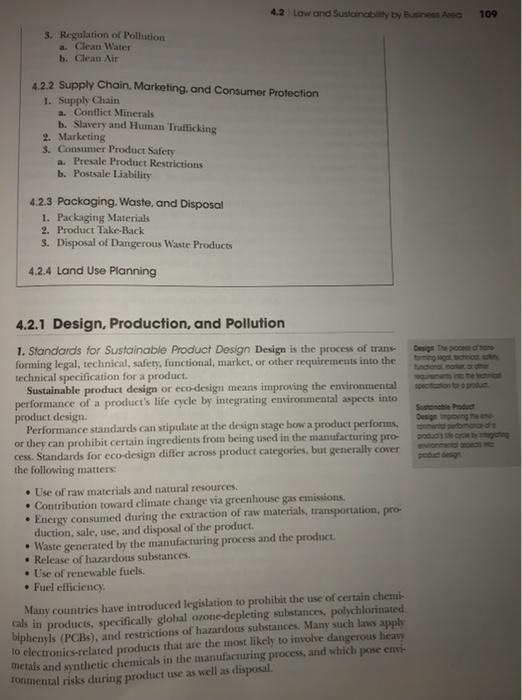
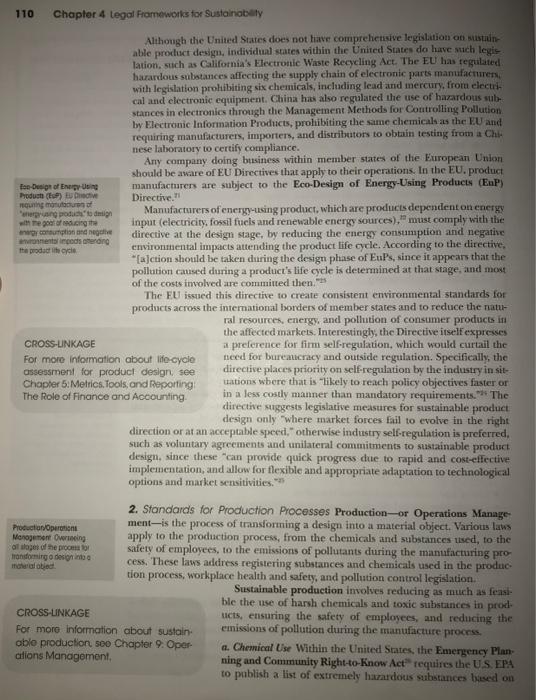
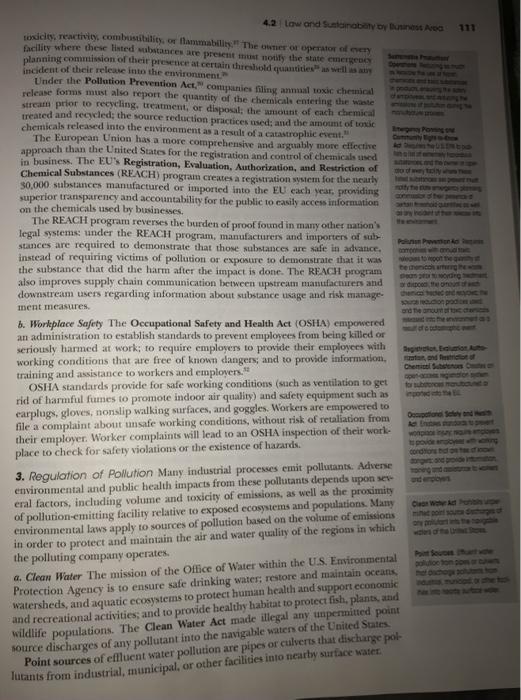
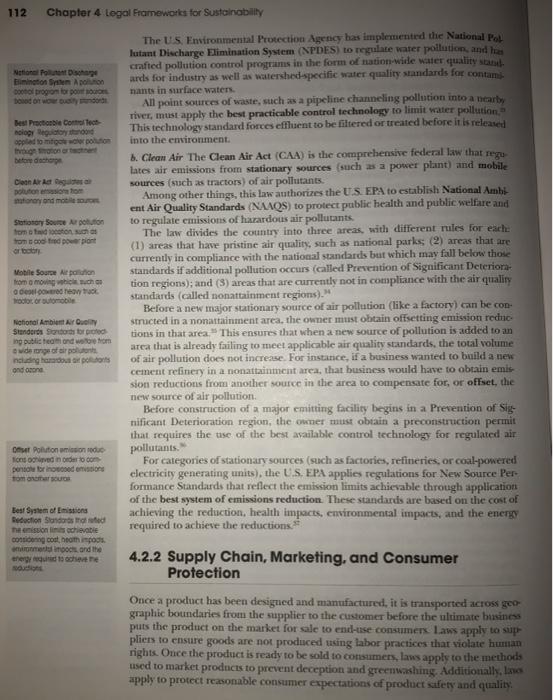
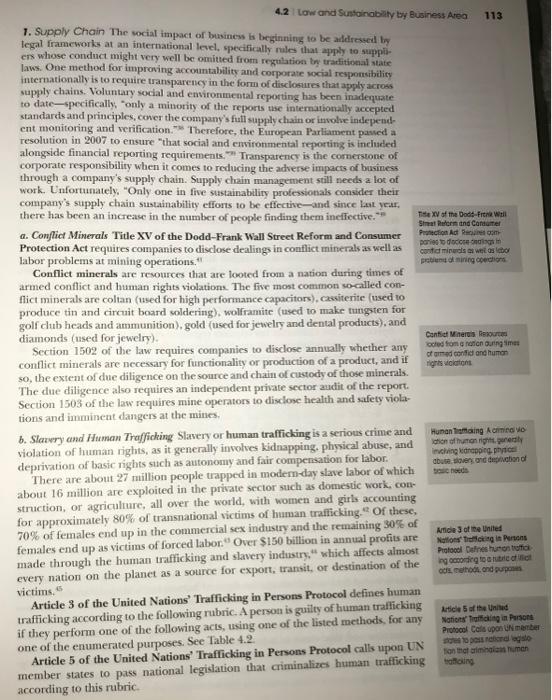
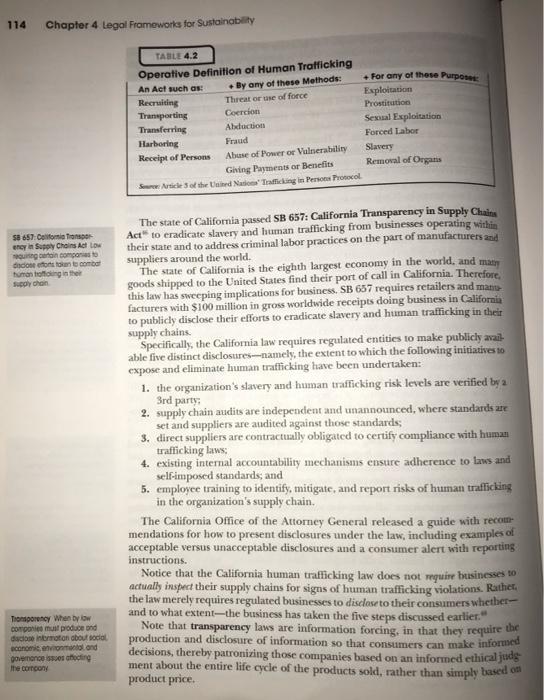
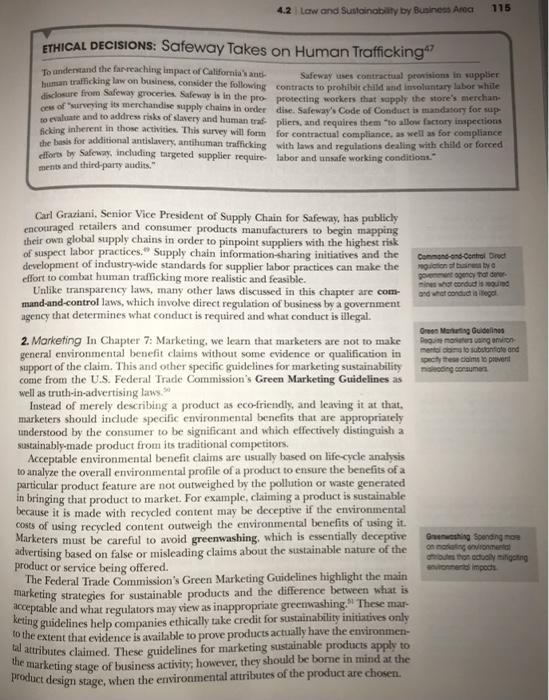
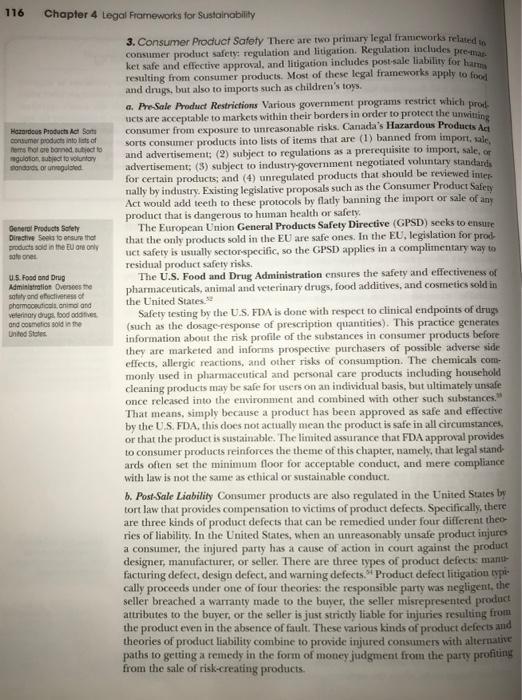
4.2 low and Sustainababy A 109 3. Regulation of Pollution a Clean Water b. Clean Air 42.2 Supply Chain Marketing and Consumer Protection 1. Supply Chain a. Conflict Minerals b. Slavery and Human Trafficking 2. Marketing 3. Consumer Product Safety a. Presale Product Restrictions b. Postsale Liability 4.2.3 Packaging. Waste and Disposal 1. Packaging Materials 2. Product Take Back S. Disposal of Dangerous Waste Products 4.2.4 Land Use Planning Desige The watch Sood Design 4.2.1 Design, Production, and Pollution 1. Standards for Sustainable Product Design Design is the process of trans- forming legal, technical, safety, functional, market, or other requirements into the technical specification for a product. Sustainable product design or eco design means improving the environmental performance of a product's life cycle by integrating environmental aspects into product design Performance standards can stipulate at the design stage how a product performs, or they can prohibit certain ingredients from being used in the manufacturing pro- cess. Standards for eco-design differ across product categories, but generally cover the following matters Use of raw materials and natural resources. Contribution toward climate change via greenhouse gas emissions Energy consumed during the extraction of raw materials, transportation, pro- duction, sale, use, and disposal of the product. Waste generated by the manufacturing process and the product Release of hazardous substances. . Use of renewable fuels. Fuel efficiency Many countries have introduced legislation to prohibit the use of certain chemi- cals in products, specifically global ozote depleting substances, polychlorinated biphenyls (PCBs), and restrictions of hazardous substances. Many such lanes apply to electronics-related products that are the most likely to involve dangerous heavy metals and synthetic chemicals in the manufacturing process, and which pose en Jonmental risks during product use as well as disposal. 110 Chapter 4 Legal Frameworks for Sustainably Although the United States does not have comprehensive legislation on sustain able product design, individual states within the United States do have much legis lation, such as California's Electronie Waste Recycling Act. The EU has regulated hazardous substances affecting the supply chain of electronic parts manufacturers with legislation prohibiting six chemicals, including lead and mercury, from electri. cal and electronic equipment. China has also regulated the use of hazardous sub stances in electronics through the Management Methods for Controlling Pollution by Electronic Information Products, prohibiting the same chemical as the EU and requiring manufacturers, importers, and distributors to obtain testing from a Chi nese laboratory to certify compliance. Any company doing business within member states of the European Union should be aware of EU Directives that apply to their operations. In the EU.product Fer-Dirof Enero manufacturers are subject to the Eco-Design of Energy-Using Products (EP) Product (t) Die Directive." pouring one of energruang potong Manufacturers of energy-using product, which are products dependent on energy we got a cing the Input (electricity, fossil fuels and renewable energy sources). must comply with the corption and negative directive at the design stage, by reducing the energy consumption and negative womentos eraino the productie environmental impacts attending the product life cycle. According to the directive, "[action should be taken during the design phase of EuPs, since it appears that the pollution caused during a product's life cycle is determined at that stage, and most of the costs involved are committed then." The EU issued this directive to create consistent environmental standards for products across the international borders of member states and to reduce the natu- ral resources, energy, and pollution of consumer products in the affected markets. Interestingly, the Directive itself expresses CROSS-UNKAGE a preference for firm self-regulation, which would curtail the For more information about life cycle need for bureaucracy and outside regulation. Specifically, the assessment for product design see directive places priority on self-regulation by the industry in sit- Chapter 5: Metrics. Tools and Reporting uations where that is likely to reach policy objectives faster or The Role of Finance and Accounting in a less costly manner than mandatory requirements. The directive suggests legislative measures for sustainable product design only "where market forces fail to evolve in the right direction or at an acceptable speed." otherwise industry self-regulation is preferred such as voluntary agreements and unilateral commitments to sustainable product design, since these can provide quick progress due to rapid and cost-effective implementation, and allow for flexible and appropriate adaptation to technological options and market sensitivities. *** 2. Standards for Production Processes Production-or Operations Manage: ment-is the process of transforming a design into a material object. Various laws Production Operation Morogement Owring apply to the production process, from the chemicals and substances used to the ages of the room safety of employees, to the emissions of pollutants during the manufacturing pro rondomingo designing morate cess. These laws address registering substances and chemicals used in the produc tion process, workplace health and safety, and pollution control legislation. Sustainable production involves reducing as much as feasi ble the use of harsh chemicals and toxic substances in prod CROSS UNKAGE ucts, ensuring the safety of employees, and reducing the For moro information about sustain: emissions of pollution during the manufacture process oblo production, seo Chapter 9. Oper a. Chemical Use Within the United States, the Emergency Plan- ations Management ning and Community Right-to-Know Act requires the US. EPA to publish a list of extremely hazardous substances based on DO di test 4.2 low and Suncobay by Best od 111 oddicts, reactivi combustibility or flammabilis." The owner or operator of every facility where these listed abstances are present must notify the state emergene planning commision of their presence at certain threshold quantities as well as my incident of their release into the environment Under the Pollution Prevention Act companies filing anmal toxic chemical release forms must also report the quantity of the chemical entering the waste stream prior to recycling, treatment, or disposal the amount of each chemical treated and recycled; the source reduction practices used; and the amount of tenke chemicals released into the environment as a result of a catastrophic esent." nego The European Union has a more comprehensive and arguably more effective approach than the United States for the registration and control of chemicals used in business. The EU'S Registration, Evaluation, Authorization, and Restriction of Chemical Substances (REACH) program creates a registration system for the nearly 30,000 substances manufactured or imported into the EU each year, providing superior transparency and accountability for the public to easily access information on the chemicals used by businesses, The REACH program reverses the burden of proof found in many other nation legal systems under the REACH program, manufacturers and importers of sub stances are required to demonstrate that those substances are safe in advance, instead of requiring victims of pollution or exposure to demonstrate that it was tomone the substance that did the harm after the impact is done. The REACH program tem also improves supply chain communication between upstream manufacturers and org downstream users regarding information about substance usage and risk manage- co cos podem ment measures and the num Workplace Safety The Occupational Safety and Health Act (OSHA) empowered ma an administration to establish standards to prevent employees from being killed or seriously harmed at work; to require employers to provide their employees with BE working conditions that are free of known dangers; and to provide information, Chemical training and assistance to workers and employers." OSHA standards provide for safe working conditions (such as ventilation to get rid of harmful fumes to promote indoor air quality and safety equipment such as earplugs, gloves, nonslip walking surfaces, and goggles. Workers are empowered to Options file a complaint about unsafe working conditions, without risk of retaliation from their employer. Worker complaints will lead to an OSHA inspection of their work place to check for safety violations or the existence of hazards. cordion 3. Regulation of Pollution Many industrial processes emit pollutants. Adverse environmental and public health impacts from these pollutants depends upon ser eral factors, including volume and toxicity of emissions, as well as the proximity We of pollution-emitting facility relative to exposed ecosystems and populations. Many environmental laws apply to sources of pollution based on the volume of emissions in order to protect and maintain the air and water quality of the regions in which the polluting company operates. a. Clean Water The mission of the Office of Water within the US. Environmental Protection Agency is to ensure safe drinking water: restore and maintain oceans watersheds, and aquatic ecosystems to protect human health and support economic and recreational activities, and to provide healthy habitat to protect fish, plants, and wildlife populations. The Clean Water Act made illegal any unpermitted point source discharges of any pollutant into the navigable waters of the United States Point sources of effluent water pollution are pipes or culverts that discharge pol- lutants from industrial, municipal, or other facilities into nearby surface water 112 Chapter 4 Logal Frameworks for Sustainability National Page Elinton Sen Apron Dono progon for portion Door Woord Best Praction Connect molectory soord oppled to me werpolo the tota before decor Clean Air data polutones money and more Stotisory Source Apoio tomondoton suot from ind power plant arbon Mobile Source Albion com o moving on a rentru octor or Sutomobile The US Environmental Protection Agency has implemented the National Pol lutant Discharge Elimination System (NPDES) to regulate water pollution, and he crafted pollution control programs in the form of nation-wide water quality start ards for industry as well as watershed-specific water quality standards for contam nants in surface waters. All point sources of waste, such as a pipeline channeling pollution into a nearby river, must apply the best practicable control technology to limit water pollution This technology standard forces effluent to be filtered or treated before it is released into the environment. 1. Clean Air The Clean Air Act (CAA) is the comprehensive federal law that regu lates air emissions from stationary sources (such as a power plant) and mobile sources (such as tractors) of air pollutants. Among other things, this law authorizes the U.S. EPA to establish National Ambi ent Air Quality Standards (NAAQS) to protect public health and public welfare and to regulate emissions of hazardous air pollutants. The law divides the country into three areas, with different rules for each (1) areas that have pristine air quality, such as national parks (2) areas that are currently in compliance with the national standards but which may fall below those standards if additional pollution occurs (called Prevention of Significant Deteriora tion regions); and (3) areas that are currently not in compliance with the air quality standards (called nonattainment regions). Before a new major stationary source of air pollution (like a factory) can be con structed in a nonattainment area, the owner must obtain offsetting emission redno tions in that area. This ensures that when a new source of pollution is added to an area that is already failing to meet applicable air quality standards, the total volume of air pollution does not increase. For instance, if a business wanted to build a new cement refinery in a nonattainment area, that business would have to obtain emis sion reductions from another source in the area to compensate for, or offset, the new source of air pollution Before construction of a major cmitting facility begins in a Prevention of Sig- nificant Deterioration region, the owner must obtain a preconstruction permit that requires the tise of the best available control technology for regulated air pollutants. For categories of stationary sources (such as factories, refineries, or coal-powered clectricity generating units), the U.S. EPA applies regulations for New Source Per formance Standards that reflect the emission limits achievable through application of the best system of emissions reduction. These standards are based on the cost of achieving the reduction, health impacts, environmental impacts, and the energy required to achieve the reductions, National Ambienter Quality Standards Soortstore in public tomond webom wide range of air poloh including hando polos and on Our Portonomicondu Tonton onder to com pontor forintodis Best System of Emission Reduction Soncorso fed the mission is achieve cong cost, hoods. mooch, and the energrund 13 ochette Routions 4.2.2 Supply Chain, Marketing, and Consumer Protection Once a product has been designed and manufactured, it is transported across geo graphic boundaries from the supplier to the customer before the ultimate business puts the product on the market for sale to end-use consumers Laws apply to sup pliers to ensure goods are not produced using labor practices that violat human rights. Once the product is ready to be sold to consumers, laws apply to the methods used to market products to prevent deception and greenwashing. Additionally, lo apply to protect reasonable consumer expectations of product safety and quality Tise of the Dodd-Frank Wil Pencion Ad Rom octed from con un mes 4.2 low and Sustainability by Business Area 113 1. Supply Chain The social impact of business is beginning to be addressed by legal frameworks at an international level. specifically rules that apply to suppli- ers whose conduct might very well be omitted from regulation by traditional state laws. One method for improving accountability and corporate social responsibility internationally is to require transparency in the form of disclosures that apply across supply chains. Voluntary social and environmental reporting has been inadequate to date-specifically, only a minority of the reports use internationally accepted standards and principles, cover the company's full supply chain or involve independ ent monitoring and verification. Therefore, the European Parliament paned a resolution in 2007 to ensure that social and environmental reporting is included alongside financial reporting requirements. Transparency is the cornerstone of corporate responsibility when it comes to reducing the adverse impacts of business through a company's supply chain. Supply chain management still needs a lot of work. Unfortunately, "Only one in five sustainability professionals consider their company's supply chain sustainability efforts to be effective and since last year. there has been an increase in the number of people finding them ineffective. ** Simatuon and Conduite a. Conflict Minerals Title XV of the Dodd-Frank Wall Street Reform and Consumer Protection Act requires companies to disclose dealings in conflict minerals as well as ponie to dodo labor problems at mining operations." contid minus wel os Conflict minerals are resources that are looted from a nation during times of armed conflict and human rights violations. The five most common so-called con- flict minerals are coltan (used for high performance capacitors), cassiterite used to produce tin and circuit board soldering), wolframite (used to make tungsten for golf club heads and ammunition) gold (used for jewelry and dental products), and diamonds (used for jewelry). Cantil Mineru Section 1502 of the law requires companies to disclose annually whether any conflict minerals are necessary for functionality or production of a product, and if famed confid and human Tigris to so, the extent of due diligence on the source and chain of custody of those minerals. The due diligence also requires an independent private sector audit of the report Section 1503 of the law requires mine operators to disclose health and safety viola tions and imminent dangers at the mines, b. Slavery and Human Trafficking Slavery or human trafficking is a serious crime and Hunan Taming Amino ction of human righ predly violation of human rights, as it generally involves kidnapping, physical abuse, and inching dropping physical deprivation of basic rights such as autonomy and fair compensation for labor. There are about 27 million people trapped in modem-day slave labor of which about 16 million are exploited in the private sector such as domestic work, con- struction, or agriculture, all over the world, with women and girls accounting for approximately 80% of transnational victims of human trafficking. Of these, 70% of females end up in the commercial sex industry and the remaining 30% of Article 3 of the United females end up as victims of forced labor. Over $150 billion in annual profits are Nationen i Persons Prool Disnes huontoffici made through the human trafficking and slavery industry," which affects almost Inging to tell every nation on the planet as a source for export, transit, or destination of the victims Article 3 of the United Nations' Trafficking in Persons Protocol defines human Articles of the United trafficking according to the following rubric. A person is guilty of human trafficking Nations Trafficking in Parsons if they perform one of the following acts, using one of the listed methods for any Protocol Cols upon UN member one of the enumerated purposes. See Table 4.2. Dragalo upon UN Article 5 of the United Nations' Trafficking in Persons Protocol calls on the immen tanong member states to pass national legislation that criminalizes human trafficking according to this rubric dus oond den code methods and purpos 114 Chapter 4 Legal Frameworks for Sustainability TABLE 4.2 Operative Definition of Human Trafficking An Act such as: By any of these Methods: For any of these Purpose Exploitation Recruiting Threat or use of force Prostitution Transporting Coercion Sexual Exploitation Transferring Abduction Forced Labor Harboring Fraud Receipt of Persons Abuse of Power or Vulnerability Slavery Removal of Organs Giving Payments or Benefits Serie 3 of the lined Na Tracking in Personal Protocol S8 657 Colomino ency in Say Chain At Low on companies dados estan como turn toffing in the cych The state of California passed SB 657: California Transparency in Supply Chaita Aa" to eradicate slavery and human trafficking from businesses operating within their state and to address criminal labor practices on the part of manufacturers and suppliers around the world. The state of California is the eighth largest economy in the world, and many goods shipped to the United States find their port of call in California. Therefore, this law has sweeping implications for business. SB 657 requires retailers and man facturers with $100 million in gross worldwide receipts doing business in California to publicly disclose their efforts to eradicate slavery and human trafficking in their supply chains Specifically , the California law requires regulated entities to make publicly avail. able five distinct disclosures--namely, the extent to which the following initiatives to expose and eliminate human trafficking have been undertaken: 1. the organization's slavery and human trafficking risk levels are verified by a 3rd party: 2. supply chain audits are independent and unannounced, where standards are set and suppliers are audited against those standards 3. direct suppliers are contractually obligated to certify compliance with human trafficking laws; 4. existing internal accountability mechanisms ensure adherence to laws and self-imposed standards, and 5. employee training to identify, mitigate and report risks of human trafficking in the organization's supply chain. The California Office of the Attorney General released a guide with recom mendations for how to present disclosures under the law, including examples of acceptable versus unacceptable disclosures and a consumer alert with reporting instructions. Notice that the California human trafficking law does not mquire businesses to actually inspect their supply chains for signs of human trafficking violations. Rather, the law merely requires regulated businesses to disclose to their consumers whether and to what extent--the business has taken the five steps discussed earlier." Note that transparency laws are information forcing, in that they require the production and disclosure of information so that consumers can make informed decisions, thereby patronizing those companies based on an informed ethical jude ment about the entire life cycle of the products sold, rather than simply based on product price Transpory When by w componimul produce and de normation about social economic environment and Domonosoting the corcony 4.2 low and Sustainability by Business Ana 115 ETHICAL DECISIONS: Safeway Takes on Human Trafficking To understand the far-reaching impact of California' and Safeway wes contractual provisions in supplier human trafficking law on business, consider the following contracts to prohibit child and involuntary labor while disclosure from Safeway groceries Safeway is in the pro protecting workers that supply the store's merchan ocus of "surveying its merchandise supply chains in order die Safeway's Code of Conduct is mandatory for sup to evaluate and to address risks of slavery and human trat pliers, and requires them to allow factory inspections ficking inherent in those activities. This survey will form for contractual compliance, as well as for compliance the basis for additional antislavery, antihuman trafficking with laws and regulations dealing with child or forced efforts by Safeway, including targeted supplier require labor and unsafe working condition." ments and third-party audits." Com-on-Control red Ministry potency Thor who condus and recorded in gol Ore Manting Guidelines Demongono mentional bone and spechytenio prevent mising consumers Carl Graziani. Senior Vice President of Supply Chain for Safeway, has publicly encouraged retailers and consumer products manufacturers to begin mapping their own global supply chains in order to pinpoint suppliers with the highest risk of suspect labor practices. Supply chain information sharing initiatives and the development of industry wide standards for supplier labor practices can make the effort to combat human trafficking more realistic and feasible. Unlike transparency laws, many other laws discussed in this chapter are com mand-and-control laws, which involve direct regulation of business by a government agency that determines what conduct is required and what conduct is illegal. 2. Marketing In Chapter 7: Marketing, we learn that marketers are not to make general environmental benefit claims without some evidence or qualification in support of the claim. This and other specific guidelines for marketing sustainability come from the U.S. Federal Trade Commission's Green Marketing Guidelines as well as truth-in-advertising laws. Instead of merely describing a product as eco-friendly, and leaving it at that. marketers should include specific environmental benefits that are appropriately understood by the consumer to be significant and which effectively distinguish a sustainably-made product from its traditional competitors. Acceptable environmental benefit claims are usually based on life-cycle analysis to analyze the overall environmental profile of a product to ensure the benefits of a particular product feature are not outweighed by the pollution or waste generated in bringing that product to market. For example, claiming a product is sustainable because it is made with recycled content may be deceptive if the environmental costs of using recycled content outweigh the environmental benefits of using it. Marketers must be careful to avoid greenwashing, which is essentially deceptive advertising based on false or misleading claims about the sustainable nature of the product or service being offered. The Federal Trade Commission's Green Marketing Guidelines highlight the main marketing strategies for sustainable products and the difference between what is acceptable and what regulators may view as inappropriate greenwashing. These mar- keting guidelines help companies ethically take credit for sustainability initiatives only to the extent that evidence is available to prove products actually have the environmen- tal attributes claimed. These guidelines for marketing sustainable products apply to the marketing stage of business activity; however, they should be borne in mind at the product design stage, when the environmental attributes of the product are chosen. Og spending mo og mer stonday nigong ed impos 116 prod Chapter 4 Legal Frameworks for Sustainability 3. Consumer Product Safety There are two primary legal frameworks related to consumer product safety regulation and litigation. Regulation includes pre-mas. ket safe and effective approval, and litigation includes post-sale liability for ham, resulting from consumer products. Most of these legal frameworks apply to food and drugs, but also to imports such as children's toys. a. Pre-Sale Product Restrictions Various government programs restrict which tacts are acceptable to markets within their borders in order to protect the unwitting Hazardous Products Act Sorte consumer from exposure to unreasonable risks. Canada's Hazardous Products Ad consumer products into lids of Mors that re banned subject to sorts consumer products into lists of items that are (1) banned from import, sale magulo se to voluntary and advertisement; (2) subject to regulations as a prerequisite to import, sale, or sands or unregled advertisement; (3) subject to industry-government negotiated voluntary standards for certain products and (4) unregulated products that should be reviewed inter nally by industry. Existing legislative proposals such as the Consumer Product Safety Act would add teeth to these protocols by flatly banning the import or sale of any product that is dangerous to human health or safety General Products Safety The European Union General Products Safety Directive (GPSD) seeks to ensure Directive Seels to ensure the products sold in the Eur only that the only products sold in the EU are safe ones. In the EU legislation for prod sonet uct safety is usually sectorspecific, so the GPSD applies in a complimentary way to residual product safety risks. U.S. Food and Drug The U.S. Food and Drug Administration ensures the safety and effectiveness of Administration Oversees the stoly and efectiveness of pharmaceuticals, animal and veterinary drugs, food additives, and cosmetics sold in phormooni animal and the United States. Veterinary dups, food add five Safety testing by the U.S. FDA is done with respect to clinical endpoints of drugs and comes sold in the (such as the dosage-response of prescription quantities). This practice generates United States information about the risk profile of the substances in consumer products before they are marketed and informs prospective purchasers of possible adverse side effects, allergic reactions, and other risks of consumption. The chemicals com monly used in pharmaceutical and personal care products including household cleaning products may be sale for users on an individual basis, but ultimately unsafe once released into the environment and combined with other such substances. That means, simply because a product has been approved as safe and effective by the U.S. FDA, this does not actually mean the product is safe in all circumstances, or that the product is sustainable. The limited assurance that FDA approval provides to consumer products reinforces the theme of this chapter, namely, that legal stand- ards often set the minimum floor for acceptable conduct, and mere compliance with law is not the same as ethical or sustainable conduct. b. Post-Sale Liability Consumer products are also regulated in the United States by tort law that provides compensation to victims of product defects. Specifically, there are three kinds of product defects that can be remedied under four different theo ries of liability. In the United States, when an unreasonably unsafe product injures a consumer, the injured party has a cause of action in court against the product designer, manufacturer, or seller. There are three types of product defects man facturing defect, design defect, and warning defects. Product defect litigation typi cally proceeds under one of four theories: the responsible party was negligent, the seller breached a warranty made to the buyer, the seller misrepresented product attributes to the buyer, or the seller is just strictly liable for injuries resulting from the product even in the absence of fault. These various kinds of product defects and theories of product liability combine to provide injured consumers with alternative paths to getting a remedy in the form of money judgment from the party profung from the sale of risk-creating products. 4.2 tow and Sustainability by Business Area 117 Manufacturing defects are where the product departs from its intended design, even if the manufacturer exercised all possible care for product quality and safety Mangeeth We The glass Coke bottle that explodes because it was manufactured with a hairline the power consum crack is an example of this type of defect. Between the manufacturer who did the word deur coute best they could to design a safe product, and the innocent consumer injured by the departure of that product from its intended design, product liability law shifts the sufen If a customer was unreasonably misusing the product in such a way as to cause cost of manufacturing defects onto the manufacturer in order to protect consumer the injury (such as using the Coke bottle as a drum-stick), they might fail in their claim for compensation, even if they can prove the product was defective. Design Defect Porte of Tomy pod rendersity which could hom tom Golded by doing som sobie moedig Woning Detected section that create product bly when the bor sodbless of tom pored by prout could how boon reduced by providing reasonable in tions of woming them to of which the product Stay Design defects are the foreseeable risk of harm created bwa product that en ders it unreasonably safe, which risks could have been avoided by adopting some reasonable alternative design. A child's crib designed to be collapsible by pressing a button accessible from inside the cribs is an example of this kind of defect. The risk of harm to a child trapped inside a collapsed erib are foreseeable, and the risk could have been avoided by adopting an alternative design that wouldn't be prohibitively expensive or frustrate the purpose of the product. Alternatively, a kitchen knife may injure a consumer if it cuts their hand, however , the risk of being art by the knife does not render the product defective because there is no reasonable alternative design of a cutting utensil that completely avoids the risk of cutting the user. Warning defects, or inadequate user instructions, can create product liability when the foresceable risks of harm posed by a product could have been reduced by providing reasonable instructions or warnings, the omission of which renders the product unreasonably risky. Failing to warn a consumer that a hair blow dryer can cause clectric shock if used in the bath-tub could create liability for a defective warn- ing because it is foreseeable that some consumers might attempt to multi-task in the bathroom, or may have the blowfryer perched close to the bathtub when plugged in, Adequate warning labels function as an "I told you sol" that product manufactur ens can use to avoid liability when a consumer is injured by the warned-against product use. Negligence in this context means a company breaches their legal duty to exercise ordinary care, resulting in physical injury to a foreseeable victim. An example could be failing to inspect products off the assembly line before selling them, failing to adequately train employees to properly care for a customer, or failure to prepare and enforce appropriate operating procedures, resulting in injury to a consumer. If a nursing home hires a caretaker with a criminal record for violence, without con- ducting a proper background check, and that person intentionally injures a client, then the nursing home may be liable for negligent hire. Breach of warranty means the seller's failure to fulfill the terms of a representa tion made regarding the quality of the product sold. Even in the absence of a writ- ten contract, the law implies the warranty on the part of the seller that the goods sold are fit for the ordinary purposes for which they are to be used. The law assumes that sellers of goods provide to buyers the generic warranty that the sold items are of similar quality and value as similar items sold under similar circumstances. When be liable for breach of warranty, even if the driver was never told explicitly that the breaks would function properly, because the law implies such a warranty in the Misrepresentation Negligence when company broaches the legal cuyo i ordinary con in physical into a fost Breach of Warranty The seller toute to fill them son momegarding the Quality of the product said the breaks on a car fail, leading to the injury of the driver, the car manufacturer may Mimpiesemeten when the slovene teollygarding produd so for instance by intention conocer los wm llement that were ed upon by the consume transaction tilse security regarding product safety, for instance by intentionally concealing can be a source of liability when the seller gave consumers potential hazards with statements that were relied upon by the consumer. For 118 Chapter 4 Legal Frameworks for Sustainability instance, if the salesperson tells the consumer that a plastic container is safe or microwaveable, and then the consumer is injured when the explodes in the microwave, the seller may be liable for misrepresentation het buity lowony inned by mu to Strict liability allows anyone injured by a product to sue the manufacturer can prove the product was defective, which defect caused the injury, and which memory tot dered the product unreasonably dangerous according to reasonable con prove the product who expectations. This cause of action does not require any fault on the part of the which defect code nunc on which the manufacturer. For example, if a company is engaged in hazardous activities, such products on the use of explosives, or the keeping of wild animals, and someone is injured 02 coording to compete result of the explosion, or because of the escaped tiger, then the company is strict liable for those injuries, even if they did everything possible to prevent the Extended Producer Responsi billy equin moutochto tole poly or the dispone of waste from their products 4.2.3 Packaging, Waste, and Disposal The sheer volume of consumer goods being shipped internationally due to increased Internet sales and the internationalization of consumer demand has led to unsustainable rate of waste generation, meaning obsolete products and discarded product packaging exceeds waste disposal capacity. Per capita consumption of pack aging is increasing in all developed countries, and single serving packages (when compared to bulk purchases more common to large families) are on the rise, lead ing to dramatic increases in the amount of paper and plastic waste being gener ated. The short life span of consumer electronics such as cellular phones and personal computers also lead to a boom in electronic waste. Extended producet responsibility (EPR) requires manufacturers to take responsibility for the disposal of waste from their products, which creates the incentives necessary to encourage producers to reduce the volume of packaging and to substitute the material used, 1. Packaging Materials Although the United States does not have comprehen sive legislation regarding product packaging material or quantity, various states and local governments have taken leadership on this front. The state of California intro duced a plastic bag law to require retail stores of certain sizes to provide customers with bins to collect plastic bags, The store is required to collect, transport, and recycle the bags in order to reduce the overall volume of plastic bag waste litter ing streets, filling up garbage dumps, and contaminating California's famous shore lines. Other cities are considering or have imposed plastic bag taxes that apply to the customer at the point of sale to encourage consumers to bring their own shop ping bags, with fees going to local environmental cleanup efforts. Two provinces in Canada have taken measures to reduce product waste and to compensate municipal governments for the expense of recycling. Printing compa nies, publishers, and the packaging industry abide by a cost recovery fee structure to ensure the recovery of 50% of their products. The European Union has long maintained a product packaging waste directive to prevent barriers to trade that might arise with a variety of different requirements between member states. The packaging waste directive sets the priorities of redue ing the amount of packaging used and increasing the reuse of packaging through better recovery and recycling. 2. Product Take-Back The European Union and Japan were among the first governments to introduce requirements for manufacturers to plan financially and physically to ensure that obsolete products and their containers are collected and processed, rather than simply sent to landfills. Although recycling of cans and responsibility 4.2 Low and Sustainability by Business Area 119 bande is common, the growing concern with extended producer responsibility is in the electronics sector because of the expanding volume of product offering the hot life cycle of these products (sometimes called planned obsolescence). Bund the any of waste streams generated by their use for instance, it is not just the cell phone box, but also the battery, the plastic case, the charge cord, and the headset cameras, GPS systems, and the like are top sellers, and each year they are replaced with newer models, leading to the discard of millions of tons of electronic waste cuchycar. Landfills and incinerators are commonly filled with these waste items leading to practical capacity issues among governments. The United States has yet to pass legislation requiring extended producer respon ability for electronic waste, however over a dozen states have passed laws to create dectronic waste recycling programs at the state level. cither through producer Producer Responsibility or through recovery fees. the one wrong The European Union has enacted the Waste Electrical and Electronic Equipment programs who remont WEEE) directive to reduce waste from this sector, increase recovery and recycling to pay rates, improve environmental performance throughout the life cycle of these prod- Recovery fresco ucts, and to extend producer responsibility over their disposal. Porcing programs when the come po 3. Disposal of Dangerous Waste Products The Resource Conservation and Wos Electrical and Elect Recovery Act" governs the generation, transportation, treatment, storage, and dis Equipment Direto posal of hazardous waste, which is solid waste that is potentially dangerous to human waste from the electronica do health or the environment." This law bans the disposal of hazardous wastes in land- non cery ndoding hot moment ilk or in deep underground injection wells unless the waste has been pretreated to performance throughout semove its harardous characteristics. The Resource Conservation and Recovery yole of these products on to and producent Act also creates a cause of action in federal court for citizens to enforce the law coer Thomas when it has been violated in such a way as to pose an imminent and substantial endangerment to public health or the environment Resource Conservation and Recovery Act on the Similarly, the Oil Pollution Act creates liability for parties responsible for an oil peneration, transporto spill. Each responsible party for a vessel or facility from which oil is discharged into en storage and disposa navigable waters or shorelines is liable for the cost of removal of the oil as well as of solid waste, in parcuarto doud would resulting damages. Damages recoverable under this law include natural resource damages, damages to real and personal property, loss of subsistence uses of natural Os Pollution Act Cros resources, loss of tax and other revenue, increased costs of public services, and loss for portes sponsoren of profits or earning capacity. When British Petroleum was charged under the Oil Pollution Act for the 2010 Deepwater Horizon explosion and oil spill in the Gulf of Mexico, the company paid $4.5 billion in criminal penalties, and created a $20 bil- lion compensation fund for fishing companies, coastal hotels, and restaurants impacted by the spill. See the Harvard Business Review case for more on this sub- ject, in Further Research 4.2.4 Land Use Planning In the United States, land is subject to a variety of controls to facilitate the rational Lout of industrial, commercial, and residential uses. Local governments typically une land use plans in the form of zoning districts that may require land developers loobtain a permit for new construction projects before they break grotnd. Further Care, come state governments as well as major metropolitan areas such as New York Evlenmental importe ment que he goes openg alond permeson to the onducten Dodge pound changed City have environmental impact statement (EIS) requirements. Els programs require the leading government agency to publish a record of the social, economic, and totumental impacts, both positive and negative, of a proposed change in land use. 120 National Environmental Policy Aol Foral major todorol action Dignionyffecting the quality of the human environment, federal agencies must ponadtoled statement on the environmental impact of the proposed action Chapter 4 Legal Frameworks for Sustainability Failure to prepare an adequate environmental impact statement can lead to costly delays. In New York State, the gas industry has waited for several years the New York State Department of Environmental Conservation has published equate draft after draft of the environmental impacts associated with developing the Marcellus Shale through the use of the controversial gas extraction techno pik lic policy experts as well as the regulated industry to develop the EIS. One could that the environmental law is the cause of the delay, but it may be more appropriate to say that the industry's reluctance to provide complete information to the regul tory body is the reason for the delay When the first EIS draft was published, environmental activists pounced on the deficiencies and oversights of the study, challenging its adequacy under the se law. This led to a reset, where the EIS process began all over again. If all of the major impacts had been disclosed in the first draft, the drilling may have already begun However, New York State is yet to tap its shale formation, in large part becauses the ongoing environmental review process. Currently, the health impacts of the proposed shale development are being studied. Activists wonder why it has taken so many years for the lead agency to finally require health impacts to be consid ered-indeed, if they had been addressed from the get go, drilling might already be underway. EIS requirements at the state and local level reflect the requirements placed on the federal government by the National Environmental Policy Act, or NEPAS For all major federal actions significantly affecting the quality of the human environment, federal agencies must prepare a detailed statement on the ens ronmental impacts of the proposed action. For example, the company Trans- Canada has planned since 2008 to build a pipeline, known as the Keystone XL connecting the tar sands of Alberta, Canada, to a refinery and export terminal in the Gulf of Mexico along the coast of Texas. In order to do so, the company needed the approval of the United States Department of State, because it is a project crossing U.S. borders. Therefore, the proposal implicated the National Environmental Policy Act, because the approval of the Keystone XL pipeline would constitute a "major federal action significantly affecting the quality of the human environment." The entire project was put on hold for several years as the Department of State prepared an Environmental Impact Statement describing the social, economic and environmental impacts the project would create. In the mean time, protesters ral- lied in Washington, D.C. against the project and lobbyists sought its approval, nak ing it one of the most high-profile environmental controversies of the decade. NEPA states that the federal government, in cooperation with state and local got ernments and other concemed public and private organizations, shall use all prae ticable means to foster and promote the general welfare; develop conditions for the harmonious coexistence of people and nature, and fulfill the social, economic and other requirements of present and future generations. Despite this lofty language, the law is actually procedural only, meaning it provides for a process to be followed but does not require any particular substantive outcomes. In order words, once the environmental impacts have been published, even if they are tremendous, the fede eral agency can still approve the project. All that NEPA requires is that the impact be identified ahead of time. Sometimes, however, delay is all that environmental activists need if the project is delayed for several years, financing may fall through and the project proposal may be withdrawn despite the fact that the leading agency was poised to approve it









 Study Help