



Question: The IRR evaluation method assumes that cash flows from the project are reinvested at the same rate equal to the IRR. However, in reality the

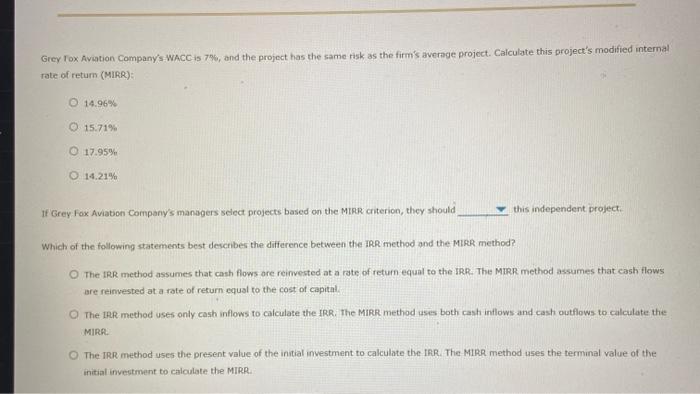
The IRR evaluation method assumes that cash flows from the project are reinvested at the same rate equal to the IRR. However, in reality the reirvested cash flows may not necessarily generate a return equal to the IRQ. Thus, the modified tRik approach makes a more reasonable assumption other than the project's IRR. Consider the following situstions: Grey Fox Aviation Company is analyzing a groject that requires an initial investment of $600,000. The project's expected cash flows are: Grey Fox Aviation Company's WACC is 7%; and the project has the same risk as the firm's average project. Calculate this project's moditied internal rate of return (MIRR): 14.96%6 15.71% 17.95% 14.21% Grey 10x Avation Company's WACC is 7 hs, and the project has the same risk as the firm's average project. Caiculate this project's modified internal rate of retum (MIRR): 14.96% 15.718e 17.95% 14.21% If Grey fax Aviaton Company's managers select projects based on the Mtak criterion, they should this independent project. Which of the following statements best describes the difference between the BRR method and the MIRR method? The tRR method assumes that cash flows are reinvested at a rate of return equal to the IRR. The MTRR. method assumes that eash flows are reinvested at a rote of rerum equal to the cost of capital. The LRR method uses only cash inflows to calculate the IRR. The MiRR method ases both cash inflows and cash outflows to calculate the MIRR The IRR method uses the present value of the instial investment to calculate the IRR. The MIRR method uses the terminal value of the initial investment to calculate the MIRR
Step by Step Solution
There are 3 Steps involved in it

Get step-by-step solutions from verified subject matter experts