







Question: The IRS wants to develop a method for detecting whether individuals have overstated their deductions for charitable contributions on their tax returns. To assist in
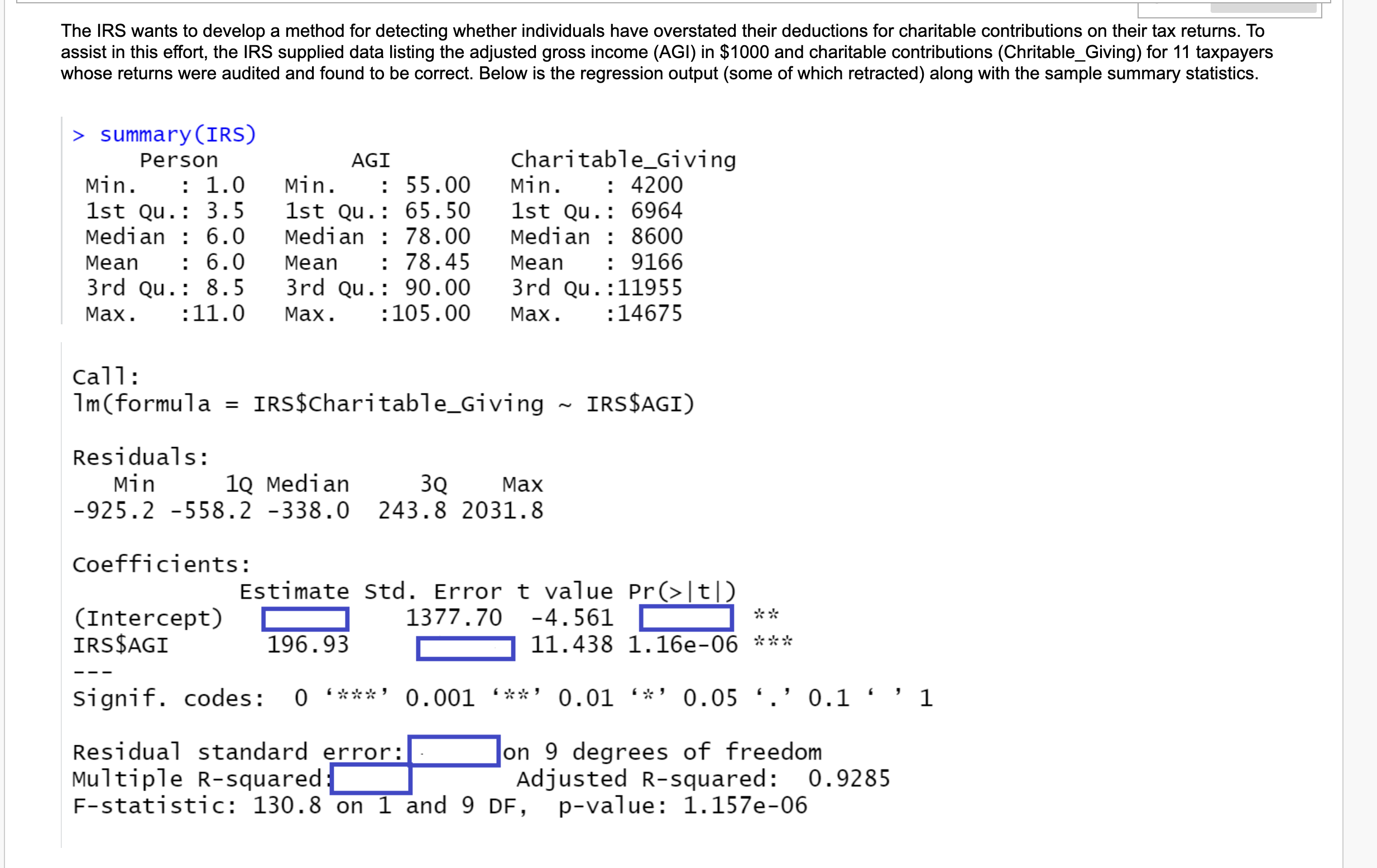


The IRS wants to develop a method for detecting whether individuals have overstated their deductions for charitable contributions on their tax returns. To assist in this effort, the IRS supplied data listing the adjusted gross income (AGI) in $1000 and charitable contributions (Chritable_Giving) for 11 taxpayers whose returns were audited and found to be correct. Below is the regression output (some of which retracted) along with the sample summary statistics. > summary (IRS) Person AGI Charitable_Giving Min. : 1.0 Min. : 55 . 00 Min. : 4200 1st Qu. : 3.5 1st Qu. : 65. 50 1st Qu. : 6964 Median : 6.0 Median : 78.00 Median : 8600 Mean 6.0 Mean : 78 .45 Mean : 9166 3rd Qu. : 8.5 3rd Qu. : 90.00 3rd Qu. : 11955 Max . : 11.0 Max. : 105.00 Max. : 14675 Call : 1m(formula = IRS$Charitable_Giving ~ IRS$AGI) Residuals : Min 1Q Median 3Q Max -925.2 -558.2 -338.0 243.8 2031.8 Coefficients : Estimate Std. Error t value Pr(>|t|) (Intercept) 1377 . 70 -4.561 * * IRS$AGI 196.93 11. 438 1. 16e-06 * * * Signif. codes: 0 '***' 0.001 '**' 0.01 '*' 0.05 '.' 0.1 ' ' 1 Residual standard error: on 9 degrees of freedom Multiple R-squared Adjusted R-squared: 0.9285 F-statistic: 130.8 on 1 and 9 DF, p-value: 1.157e-06You want to conduct a hypothesis test (at a=5% level) for the significance of the regression equation's intercept. State the null and alternative hypotheses. Based on the above regression output, what would you conclude about the intercept? The null hypothesis is rejected. The intercept is significant. O The null hypothesis is not rejected. The intercept is not significant
Step by Step Solution
There are 3 Steps involved in it

Get step-by-step solutions from verified subject matter experts
 Study Help