



Question: The Izhikevich Model addresses this issue by reducing the effective dynamics of neurons to two equations: (1) a quadratic LIF-like model for the membrane potential
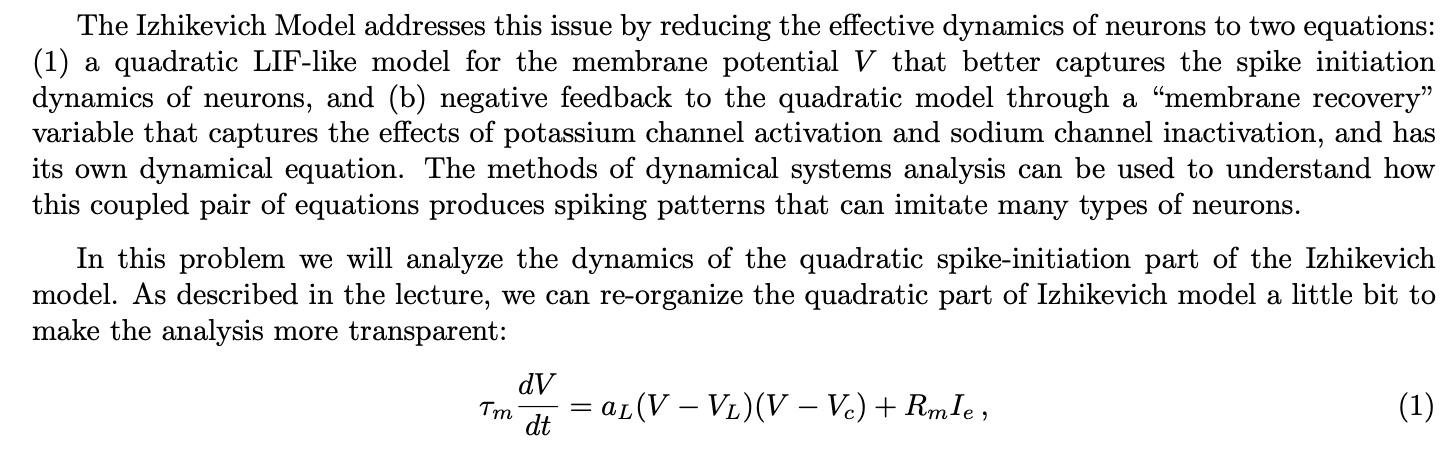
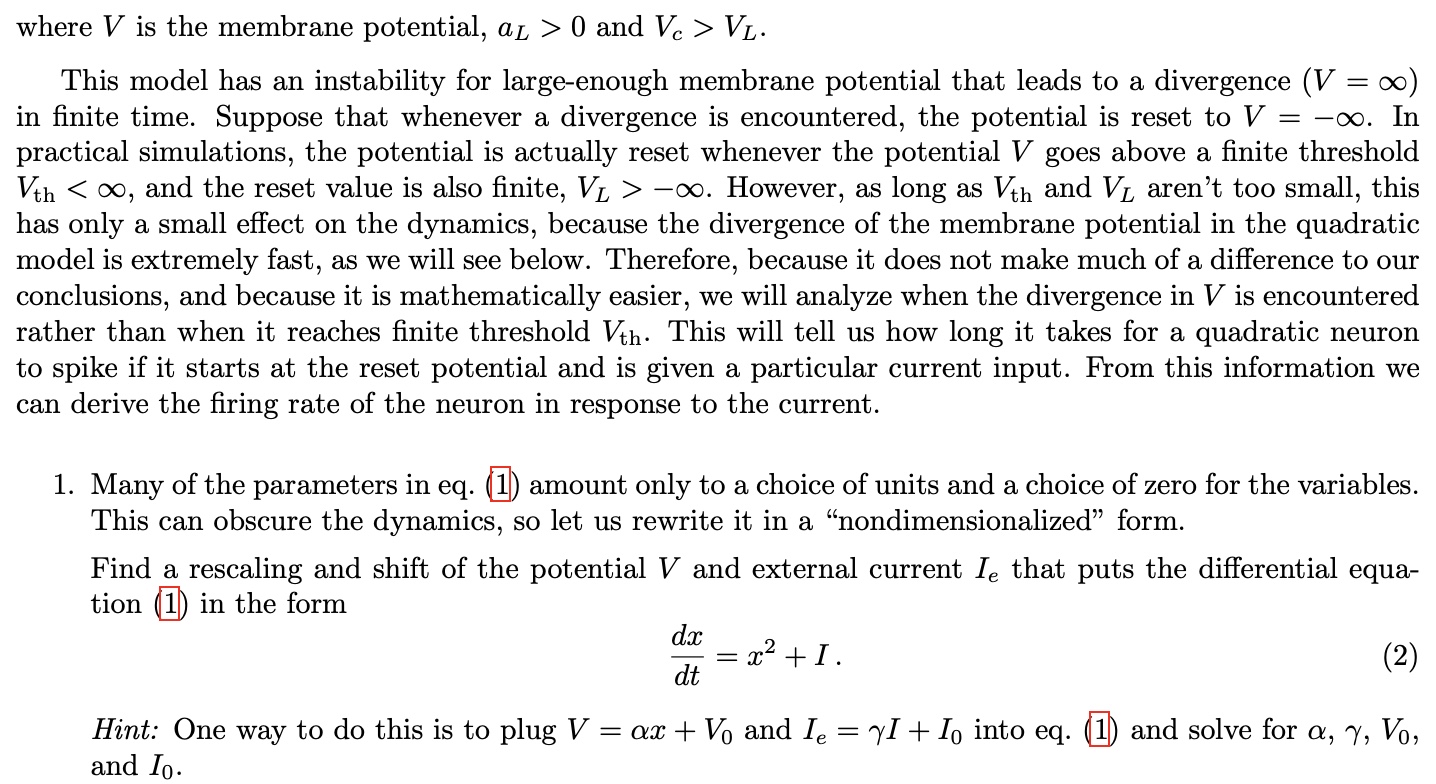
The Izhikevich Model addresses this issue by reducing the effective dynamics of neurons to two equations: (1) a quadratic LIF-like model for the membrane potential V' that better captures the spike initiation dynamics of neurons, and (b) negative feedback to the quadratic model through a \"membrane recovery\" variable that captures the effects of potassium channel activation and sodium channel inactivation, and has its own dynamical equation. The methods of dynamical systems analysis can be used to understand how this coupled pair of equations produces spiking patterns that can imitate many types of neurons. In this problem we will analyze the dynamics of the quadratic spike-initiation part of the Izhikevich model. As described in the lecture, we can re-organize the quadratic part of Izhikevich model a little bit to make the analysis more transparent: dav TmE ZGL(VVL)(VVC)+RmIe, (l) where V' is the membrane potential, ay > 0 and V., > V. This model has an instability for large-enough membrane potential that leads to a divergence (V = o0) in finite time. Suppose that whenever a divergence is encountered, the potential is reset to V = co. In practical simulations, the potential is actually reset whenever the potential V' goes above a finite threshold Vin oo. However, as long as V;;, and V, aren't too small, this has only a small effect on the dynamics, because the divergence of the membrane potential in the quadratic model is extremely fast, as we will see below. Therefore, because it does not make much of a difference to our conclusions, and because it is mathematically easier, we will analyze when the divergence in V' is encountered rather than when it reaches finite threshold Vi,. This will tell us how long it takes for a quadratic neuron to spike if it starts at the reset potential and is given a particular current input. From this information we can derive the firing rate of the neuron in response to the current. 1. Many of the parameters in eq. ) amount only to a choice of units and a choice of zero for the variables. This can obscure the dynamics, so let us rewrite it in a \"nondimensionalized\" form. Find a rescaling and shift of the potential V' and external current I. that puts the differential equa- tion in the form dr 5 = T 2 Hint: One way to do this is to plug V = ax + Vy and I, = vI + I, into eq. and solve for , v, Vp, and
Step by Step Solution
There are 3 Steps involved in it

Get step-by-step solutions from verified subject matter experts