







Question: The joint probability mass function (pmf) of random variables X and Y is p(x, y) = c (xy^2 + 1) , x = 1,2,4, y
The joint probability mass function (pmf) of random variables X and Y is p(x, y) = c (xy^2 + 1) , x = 1,2,4, y = ?1,2.
a) Determine the value of c that makes p(x, y) a valid joint pmf. Arrange p(x, y) in a table.
b) Find P(X + Y
c) Are X and Y independent? Explain.
d) Find the conditional expectation and the conditional variance of X given Y = 2.
e) Find the conditional expectation and the conditional variance of Y given X = 2.
f) Find E(2^XY)
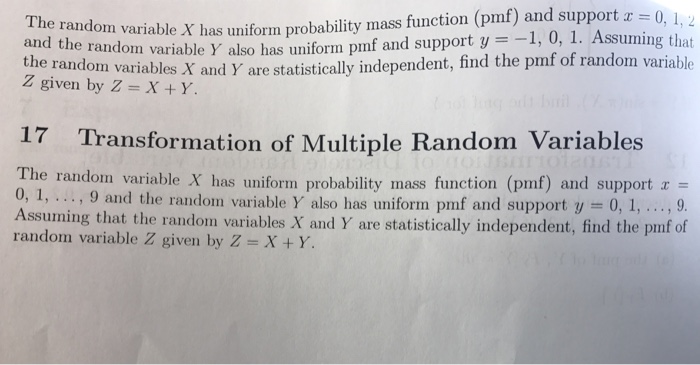
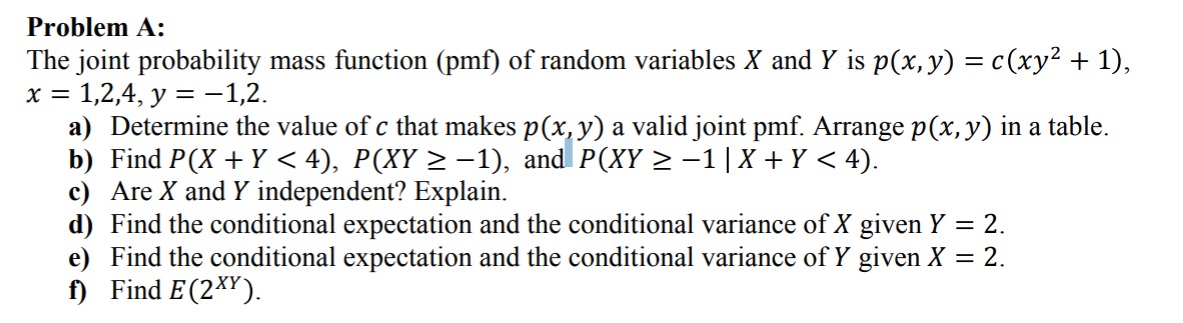
The random variable X has uniform probability mass function (pmf ) and support r = 0. ], and the random variable Y also has uniform pmf and support y = -1, 0, 1. Assuming that the random variables X and Y are statistically independent, find the pmf of random variable Z given by Z = X + Y. Jag and bail 17 Transformation of Multiple Random Variables The random variable X has uniform probability mass function (pmf) and support x = 0, 1, . . ., 9 and the random variable Y also has uniform pmf and support y = 0, 1, ..., 9. Assuming that the random variables X and Y are statistically independent, find the pmf of random variable Z given by Z = X + Y.Problem A: The joint probability mass function (pmf) of random variables X and Y is p(x, y) = c(xy + 1), x = 1,2,4, y = -1,2. a) Determine the value of c that makes p(x, y) a valid joint pmf. Arrange p(x, y) in a table. b) Find P(X + Y -1), and P(XY 2 -1 |X +Y
Step by Step Solution
There are 3 Steps involved in it

Get step-by-step solutions from verified subject matter experts
 Study Help