







Question: The Julia Set in the Complex Plane. The Julia set Je is defined as follows. Let f(z) 22 c. Apply f repeatedly to a complex
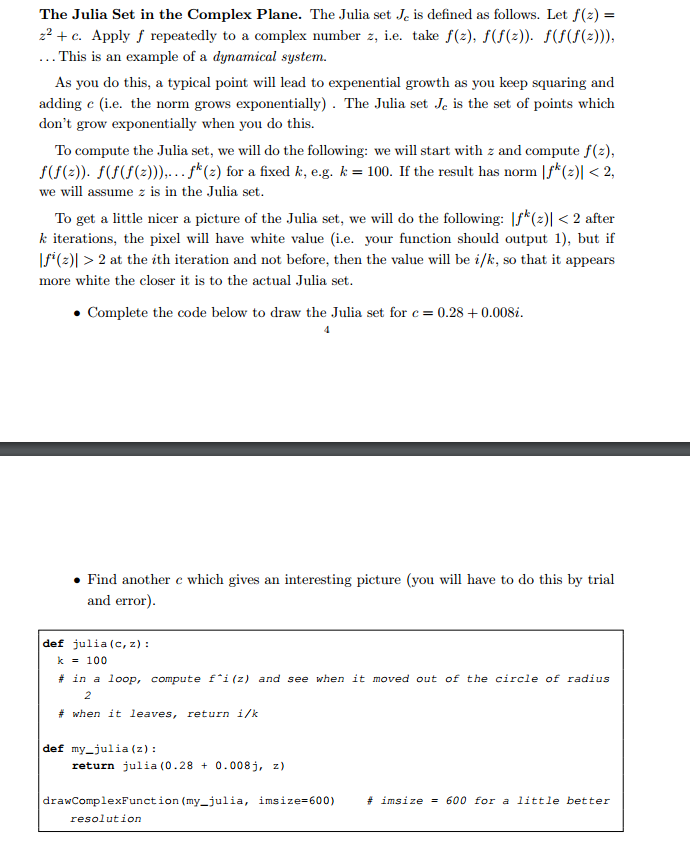
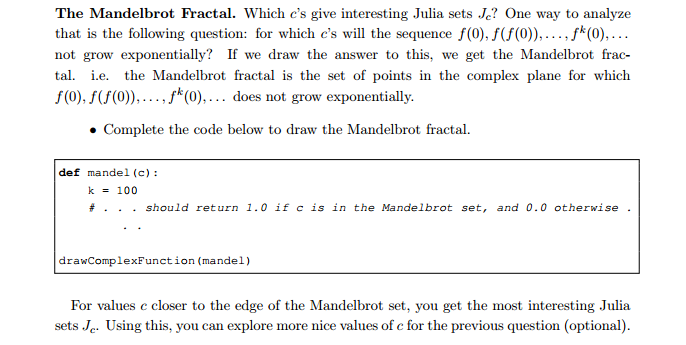
The Julia Set in the Complex Plane. The Julia set Je is defined as follows. Let f(z) 22 c. Apply f repeatedly to a complex number 2, i e. take f(z), f(f(2)). f f(f(z))), This is an example of a dynamical system. As you do this, a typical point will lead to expenential growth as you keep squaring and adding c (i.e. the norm grows exponentially) The Julia set Jc is the set of points which don't grow exponentially when you do this. To compute the Julia set, we will do the following: we will start with z and compute f(z), f(f (z)). f(f f(z))),...fk(z) for a fixed k, e.g. k 100. If the result has norm lfk(z)I 2, we will assume 2 is in the Julia set. To get a little nicer a picture of the Julia set, we will do the following: If (z) 2 after k iterations, the pixel will have white value (i.e. your function should output 1), but if lfi(2)I> 2 at the ith iteration and not before, then the value will be i/k, so that it appears more white the closer it is to the actual Julia set. Complete the code below to draw the Julia set for c 0.28 0.008i. Find another c which gives an interesting picture (you will have to do this by trial and error def julia (c, z k 100 in a loop, compute f i (z) and see when it moved out of the circle of radius when it leaves return i/k f def my ia (z) return julia 0.28 0.008 j, z) drawComplexFunction (my julia, imsize 600) f imsize 600 for a little better resolution The Julia Set in the Complex Plane. The Julia set Je is defined as follows. Let f(z) 22 c. Apply f repeatedly to a complex number 2, i e. take f(z), f(f(2)). f f(f(z))), This is an example of a dynamical system. As you do this, a typical point will lead to expenential growth as you keep squaring and adding c (i.e. the norm grows exponentially) The Julia set Jc is the set of points which don't grow exponentially when you do this. To compute the Julia set, we will do the following: we will start with z and compute f(z), f(f (z)). f(f f(z))),...fk(z) for a fixed k, e.g. k 100. If the result has norm lfk(z)I 2, we will assume 2 is in the Julia set. To get a little nicer a picture of the Julia set, we will do the following: If (z) 2 after k iterations, the pixel will have white value (i.e. your function should output 1), but if lfi(2)I> 2 at the ith iteration and not before, then the value will be i/k, so that it appears more white the closer it is to the actual Julia set. Complete the code below to draw the Julia set for c 0.28 0.008i. Find another c which gives an interesting picture (you will have to do this by trial and error def julia (c, z k 100 in a loop, compute f i (z) and see when it moved out of the circle of radius when it leaves return i/k f def my ia (z) return julia 0.28 0.008 j, z) drawComplexFunction (my julia, imsize 600) f imsize 600 for a little better resolution
Step by Step Solution
There are 3 Steps involved in it

Get step-by-step solutions from verified subject matter experts
 Study Help