



Question: The Knowles / Armitage ( KA ) group at Merrill Lynch advises clients on how to create a diversified investment portfolio. One of the investment
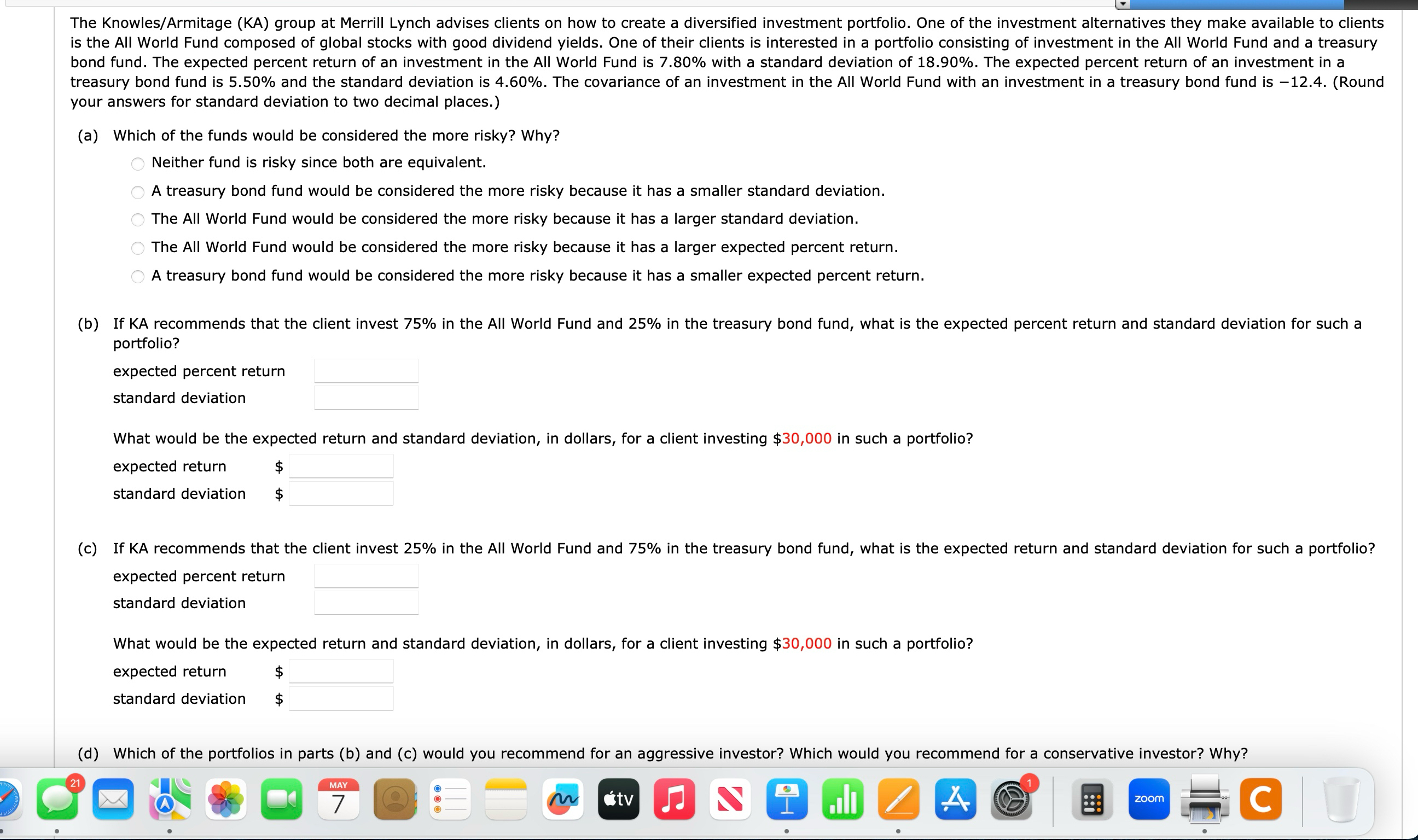
The KnowlesArmitage KA group at Merrill Lynch advises clients on how to create a diversified investment portfolio. One of the investment alternatives they make available to clients is the All World Fund composed of global stocks with good dividend yields. One of their clients is interested in a portfolio consisting of investment in the All World Fund and a treasury bond fund. The expected percent return of an investment in the All World Fund is with a standard deviation of The expected percent return of an investment in a treasury bond fund is and the standard deviation is The covariance of an investment in the All World Fund with an investment in a treasury bond fund is Round your answers for standard deviation to two decimal places.
a Which of the funds would be considered the more risky? Why?
Neither fund is risky since both are equivalent.
A treasury bond fund would be considered the more risky because it has a smaller standard deviation.
The All World Fund would be considered the more risky because it has a larger standard deviation.
The All World Fund would be considered the more risky because it has a larger expected percent return.
A treasury bond fund would be considered the more risky because it has a smaller expected percent return.
b If KA recommends that the client invest in the All World Fund and in the treasury bond fund, what is the expected percent return and standard deviation for such a portfolio?
expected percent return
standard deviation
What would be the expected return and standard deviation, in dollars, for a client investing $ in such a portfolio?
expected return $
standard deviation $
c If KA recommends that the client invest in the All World Fund and in the treasury bond fund, what is the expected return and standard deviation for such a portfolio? expected percent return
standard deviation
What would be the expected return and standard deviation, in dollars, for a client investing $ in such a portfolio?
expected return $
standard deviation $$
d Which of the portfolios in parts b and c would you recommend for an aggressive investor? Which would you recommend for a conservative investor? Why?
Step by Step Solution
There are 3 Steps involved in it
1 Expert Approved Answer
Step: 1 Unlock

Question Has Been Solved by an Expert!
Get step-by-step solutions from verified subject matter experts
Step: 2 Unlock
Step: 3 Unlock