







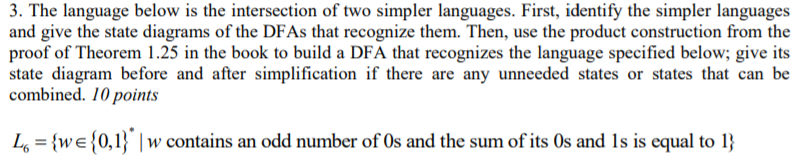
Question: The language below is the intersection of two simpler languages. First, identify the simpler languages and give the state diagrams of the DFAs that recognize
The language below is the intersection of two simpler languages. First, identify the simpler languages and give the state diagrams of the DFAs that recognize them. Then, use the product construction from the proof of Theorem 1.25 in the book to build a DFA that recognizes the language specified below; give its state diagram before and after simplification if there are any unneeded states or states that can be combined
In the textbook, Theorem 1.25 states:
The class of regular languages is closed under the union operation. In other words, if A1 and A2 are regular languages, so is A1 A2.
Proof:
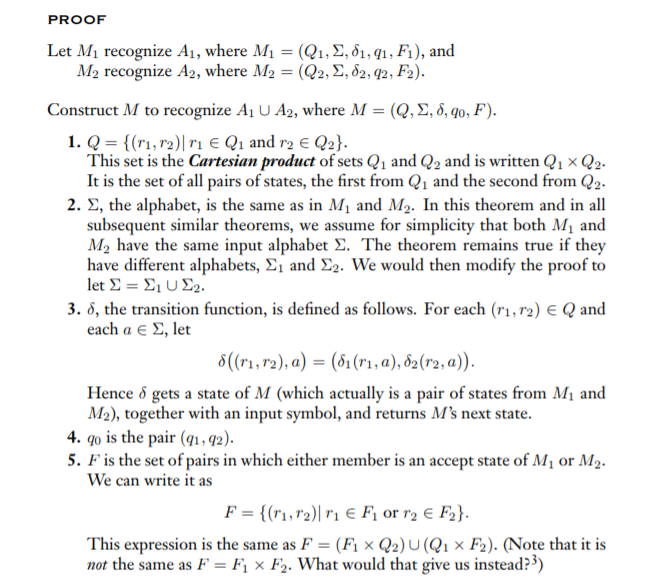
3. The language below is the intersection of two simpler languages. First, identify the simpler languages and give the state diagrams of the DFAs that recognize them. Then, use the product construction from the proof of Theorem 1.25 in the book to build a DFA that recognizes the language specified below; give its state diagram before and after simplification if there are any unneeded states or states that can be combined. 10 points L,-we l0,1 w contains an odd number of Os and the sum of its Os and Is is equal to I, PROOF Let M recognize A1 , where M1-(A , , , q , Fi ), and M2 recognize A2, where M2 (Q2, 2 2, q2, F2). Construct M to recognize Al U A2, where M-(Q, , , 40, F). This set is the Cartesian product of sets 1 and Q2 and is written Q1 x Q2 It is the set of all pairs of states, the first from Q1 and the second from Q2 2. , the alphabet, is the same as in M, and M2. In this theorem and in all subsequent similar theorems, we assume for simplicity that both Mi and M2 have the same input alphabet 2. The theorem remains true if they have different alphabets, and 2. We would then modify the proof to 3. , the transition function, is defined as follows. For each (r1,T2) E Q and each a E , let Hence gets a state of M (which actually is a pair of states from M and M2), together with an input symbol, and returns M's next state. 4. go is the pair (,2) 5. F is the set of pairs in which either member is an accept state of M1 or M2 We can write it as This expression is the same as F-(A Q2) U (Qi F2). (Note that it is not the same as F-F1 F2. What would that give us instead? 3)
Step by Step Solution
There are 3 Steps involved in it

Get step-by-step solutions from verified subject matter experts
 Study Help