







Question: The language is Python 3. Please Help! If the pictures are hard to see, control+scroll to see them. I don't know why they are small.
The language is Python 3. Please Help! If the pictures are hard to see, control+scroll to see them. I don't know why they are small. thanks!
 Also, why is Chegg reduced the number of questions (Expert Q and A) to 15 instead of 20 like last month for the standard plan without notifying anyone?
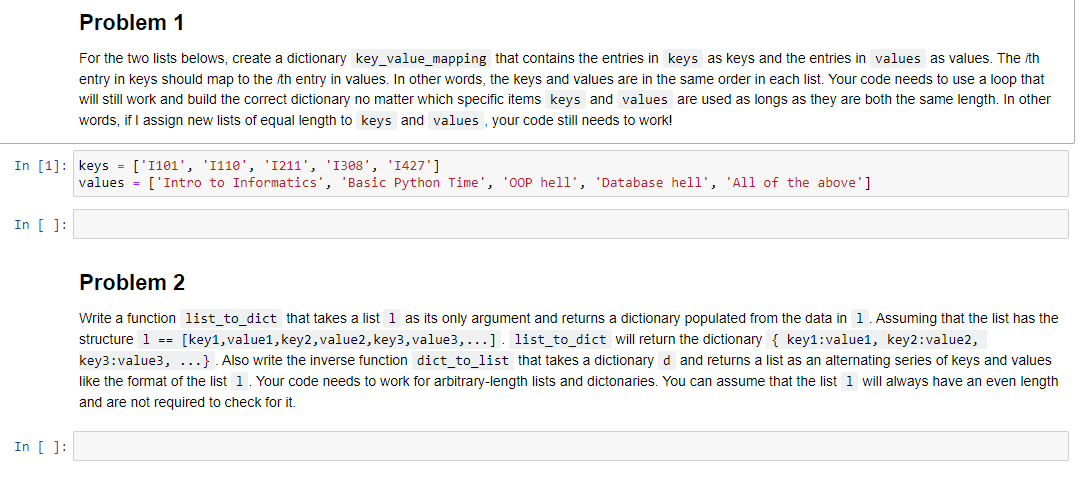
Problem 1 For the two lists belows, create a dictionary key_value_mapping that contains the entries in keys as keys and the entries in values as values. The ith entry in keys should map to the ith entry in values. In other words, the keys and values are in the same order in each list. Your code needs to use a loop that will still work and build the correct dictionary no matter which specific items keys and values are used as longs as they are both the same length. In other words, if I assign new lists of equal length to keys and values , your code still needs to work! In [1]: keys = ['1101', '1110', '1211', '1308', '1427'] values = ['Intro to Informatics', 'Basic Python Time', 'OOP hell', 'Database hell', 'All of the above'] In [ ]: Problem 2 Write a function list_to_dict that takes a list 1 as its only argument and returns a dictionary populated from the data in 1 . Assuming that the list has the structure 1 == [key1, value1, key2, value2, keys, value3, ...]. list_to_dict will return the dictionary { key1:value1, key2:value2, key3:value3, ...} Also write the inverse function dict_to_list that takes a dictionary d and returns a list as an alternating series of keys and values like the format of the list 1. Your code needs to work for arbitrary-length lists and dictonaries. You can assume that the list 1 will always have an even length and are not required to check for it. In [ ]
Step by Step Solution
There are 3 Steps involved in it

Get step-by-step solutions from verified subject matter experts
 Study Help