







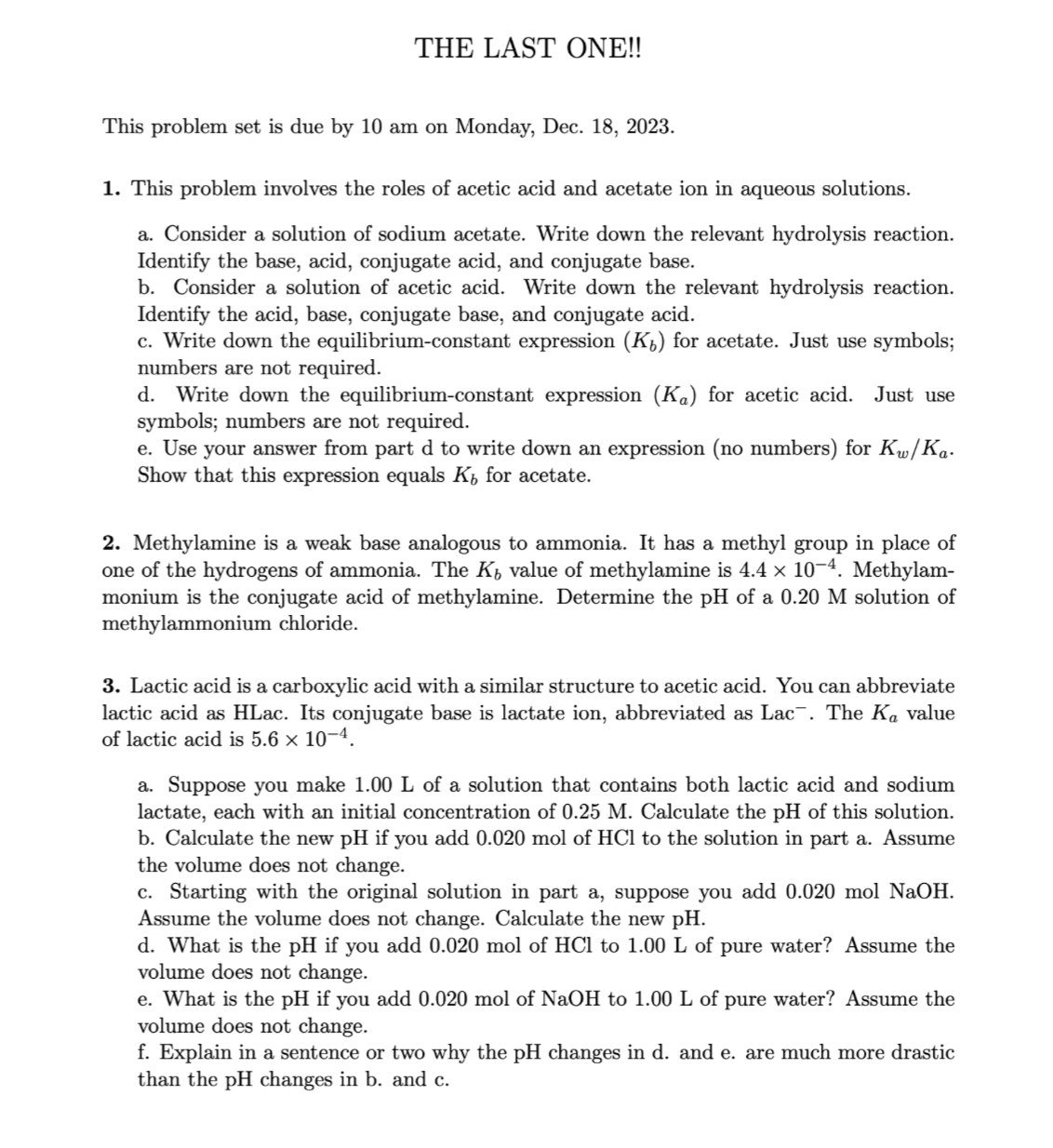
Question: THE LAST ONE!! This problem set is due by 1 0 am on Monday, Dec. 1 8 , 2 0 2 3 . This problem
THE LAST ONE!!
This problem set is due by am on Monday, Dec.
This problem involves the roles of acetic acid and acetate ion in aqueous solutions.
a Consider a solution of sodium acetate. Write down the relevant hydrolysis reaction.
Identify the base, acid, conjugate acid, and conjugate base.
b Consider a solution of acetic acid. Write down the relevant hydrolysis reaction.
Identify the acid, base, conjugate base, and conjugate acid.
c Write down the equilibriumconstant expression for acetate. Just use symbols;
numbers are not required.
d Write down the equilibriumconstant expression for acetic acid. Just use
symbols; numbers are not required.
e Use your answer from part to write down an expression no numbers for
Show that this expression equals for acetate.
Methylamine is a weak base analogous to ammonia. It has a methyl group in place of
one of the hydrogens of ammonia. The value of methylamine is Methylam
monium is the conjugate acid of methylamine. Determine the of a solution of
methylammonium chloride.
Lactic acid is a carboxylic acid with a similar structure to acetic acid. You can abbreviate
lactic acid as HLac. Its conjugate base is lactate ion, abbreviated as The value
of lactic acid is
a Suppose you make of a solution that contains both lactic acid and sodium
lactate, each with an initial concentration of Calculate the of this solution.
b Calculate the new if you add mol of to the solution in part a Assume
the volume does not change.
c Starting with the original solution in part a suppose you add molNaOH.
Assume the volume does not change. Calculate the new
d What is the if you add mol of to of pure water? Assume the
volume does not change.
e What is the if you add mol of NaOH to of pure water? Assume the
volume does not change.
f Explain in a sentence or two why the changes in d and e are much more drastic
than the changes in and
Step by Step Solution
There are 3 Steps involved in it
1 Expert Approved Answer
Step: 1 Unlock

Question Has Been Solved by an Expert!
Get step-by-step solutions from verified subject matter experts
Step: 2 Unlock
Step: 3 Unlock
 Study Help