


Question: The local university has developed an eight-step process for screening the thousands of admissions applications it gets each year. The provost has decided that the
The local university has developed an eight-stepThe local university has developed an eight-step

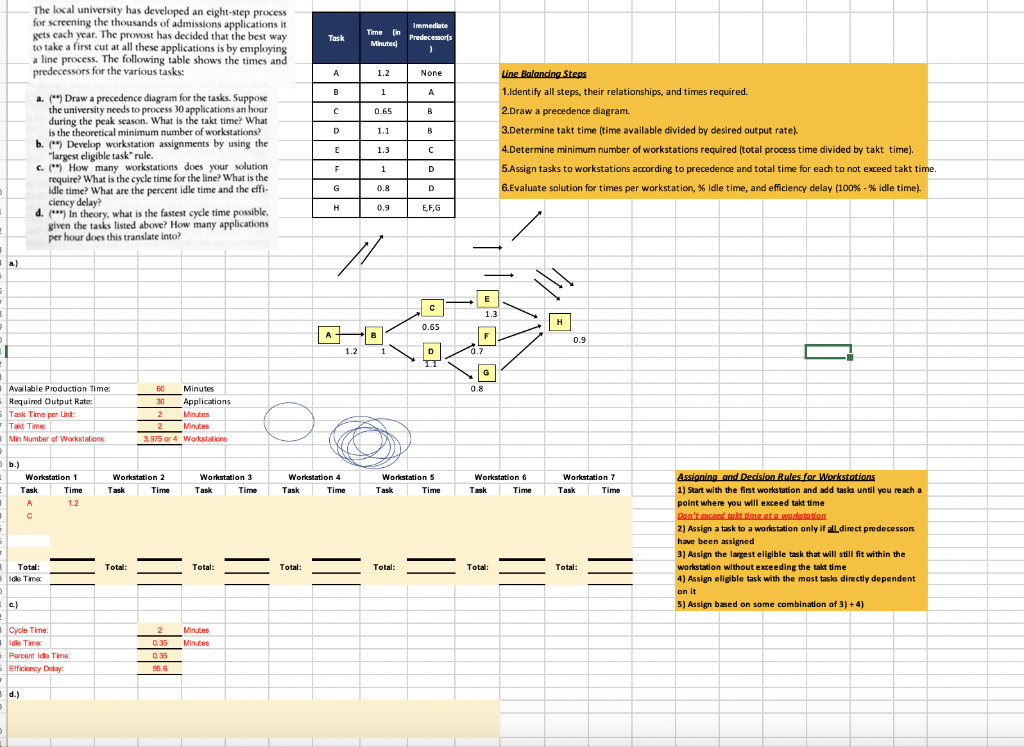
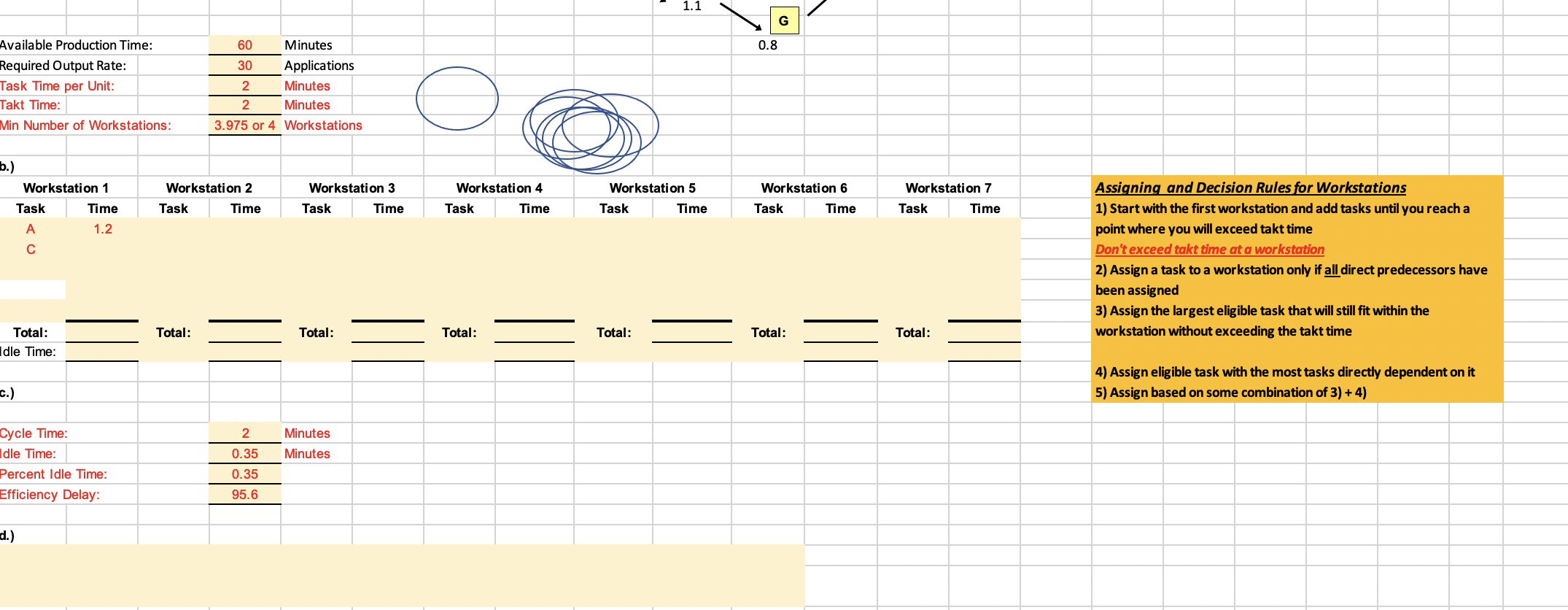
The local university has developed an eight-step process for screening the thousands of admissions applications it gets each year. The provost has decided that the best way to take a first cut at all these applications is by employing a line process. The following table shows the times and predecessors for the various tasks: Task Time (in Minutes! Immediate Predecessors ) A 1.2 None 1 A A 0.65 B D 1.1 B Line Balancing Steps 1.Identify all steps, their relationships, and times required. 2.Draw a precedence diagram. 3.Determine takt time (time available divided by desired output rate). 4.Determine minimum number of workstations required (total process time divided by takt time). 5.Assign tasks to workstations according to precedence and total time for each to not exceed takt time. 6.Evaluate solution for times per workstation, % idle time, and efficiency delay (100% -% idle time). E 1.3 a. (**) Draw a precedence diagram for the tasks. Suppose the university needs to process 30 applications an hour during the peak season. What is the takt time? What is the theoretical minimum number of workstations? b. (**) Develop workstation assignments by using the "largest eligible taskrule. c. (**) How many workstations does your solution require? What is the cycle time for the line? What is the idle time? What are the percent idle time and the effi- ciency delay? d. (**) in theory, what is the fastest cycle time possible, given the tasks listed above? How many applications per hour does this translate into? F 1 G 0.8 H 0.9 EFG // a) E C 3 1.3 0.65 H B IF 0.7 0.9 1.2 1 D 1.1 G 0.8 Available Production Time Required Output Rate: Task Time per Unit: Takt Time Min Number of Workstations 60 Minutes 30 Applications 2 Minutes 2 Minutes 3.975 or 4 Workstations o b.) Workstation 1 Task Time 1.2 C Workstation 2 Task Time Workstation 3 Task Time Workstation 4 Task Time Workstations Task Time Workstation 6 Task Time Workstation 7 Task Time 3 Assigning and Decision Rules for Workstations 1) Start with the first workstation and add tasks until you reach a point where you will exceed takt time Don't exceed takt meat workstation 2) Assign a task to a workstation only if all direct predecessors have been assigned 3) Assign the largest eligible task that will still fit within the workstation without exceeding the takt time 4) Assign eligible task with the most tasks directly dependent Total: Total: Total: Total: Total: Total: Total: Idle Time on it c) 5) Assign based on some combination of 3) + 4) Minutes Minutes Cycle Time: Ide Times Percent Ide Time: Efficiency Delay 0.35 0.35 96.6 d.) 1.1 G 0.8 Available Production Time: Required Output Rate: Task Time per Unit: Takt Time: Min Number of Workstations: 60 Minutes 30 Applications 2 Minutes 2 Minutes 3.975 or 4 Workstations Workstation 1 Task Workstation 2 Task Time Workstation 3 Task Time Workstation 4 Task Time Workstation 5 Task Time Workstation 6 Task Time Workstation 7 Task Time Time A 1.2 Assigning and Decision Rules for Workstations 1) Start with the first workstation and add tasks until you reach a point where you will exceed takt time Don't exceed takt time at a workstation 2) Assign a task to a workstation only if all direct predecessors have been assigned 3) Assign the largest eligible task that will still fit within the workstation without exceeding the takt time Total: Total: Total: Total: Total: Total: Total: Idle Time: 4) Assign eligible task with the most tasks directly dependent on it 5) Assign based on some combination of 3) + 4) c.) Minutes Cycle Time: Idle Time: Percent Idle Time: Efficiency Delay: 2 0.35 0.35 Minutes 95.6 d.)

Step by Step Solution

There are 3 Steps involved in it

1 Expert Approved Answer
Step: 1 Unlock blur-text-image

Question Has Been Solved by an Expert!

Get step-by-step solutions from verified subject matter experts

Step: 2 Unlock
Step: 3 Unlock

Students Have Also Explored These Related General Management Questions!