







Question: the long-FlPH return, rs, must be greater than unless a company's growth rate is expected to remain constant in the future. This condition almost never
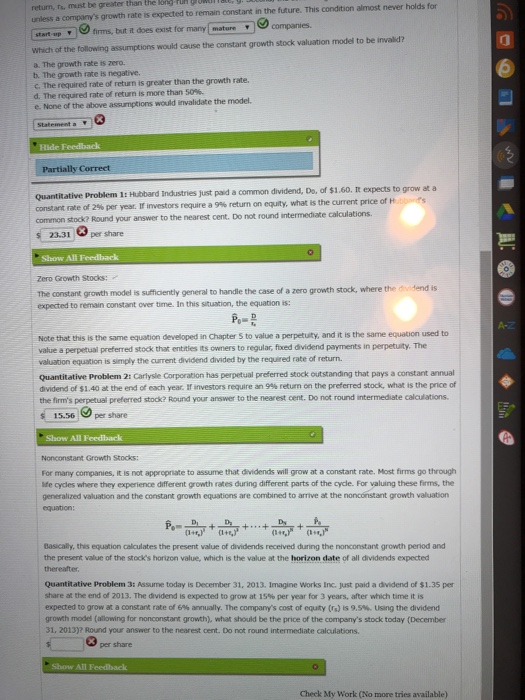
the long-FlPH return, rs, must be greater than unless a company's growth rate is expected to remain constant in the future. This condition almost never holds for start up firms, but it does exist for many maturecompanies. Which of the following assumptions would cause the constant growth stock valuation model to be invald? a. The growth rate is zero. b. The groth rate is negative. c. The required rate of return is greater than the growth rate d. The required rate of return is more than 506 e. None of the above assumptions would invalidate the model. Hide Feedback Partially Correct Problem 1: Hubbard industries just paid a common dividend, Do, of $1.60. It expects to grow at a constant rate of 2% per yea. If investors require a 9% return on equity, what is the current price or Hutpfs common stock? Round your answer to the nearest cent. Do not round intermediate calculations s23.31per share Show Alt Feedback Zero Growth Stocks: constant growth model is sufficiently general to handle the case of a zero growth stock, where the dividend is expected to remain constant over time. In this situation, the equation is: A-Z Note that this is the same equation developed in Chapter 5 to value a perpetuity, and it is the same equation used to value a perpetual preferred stock that entities its owners to regular, fixed dividend payments in perpetuity valuation equation is simply the current dividend divided by the required rate of return. Quantitative Problem 2: Carlysle Corporation has perpetual preferred tock outstanding dividend of $1.40 at the end of each year. rrvestors require an 9% return on the preferred stock, what is the price of the firm's perpetual preferred stock? Round your answer to the nearest cent. Do not round intermediate calculations. that pays a constant annual 5.56 per share Show All Feedback Nonconstant Growth Stocks For many companies, it is not appropniate to assume that dividends will grow at a constant rate. Most firms go through fe cydles where they experience different growth rates during different parts of the cycle. For valuing these firms, the generalized valuation and the constant growth equations are combired to arrive at the nonconstant growth valuabon equation: Basically, this equation calculates the present value of dividends received during the nonconstant growth period and the present value of the stock's horizon value, which is the value at the horizon date of all dividends expected thereafter Quantitative Problem 3: Assume today is December 31, 2013. Imagine Works Inc. just paid a dividend of $1.35 per stare at the end of 2013. The dividend is expected to grow at 15% per year for 3 years, after which time it is expected to grow at a constan rate of 6% annually. The company's cost of equty (rs) is 9.5% using the dividend growth mode (allowing for nonconstant growth), what should be the price of the company's stock today (December 31, 2013)? Round your answer to the nearest cent. Do not round intermediate calculations. per share Show All Feedback Check My Work (No more tries available) the long-FlPH return, rs, must be greater than unless a company's growth rate is expected to remain constant in the future. This condition almost never holds for start up firms, but it does exist for many maturecompanies. Which of the following assumptions would cause the constant growth stock valuation model to be invald? a. The growth rate is zero. b. The groth rate is negative. c. The required rate of return is greater than the growth rate d. The required rate of return is more than 506 e. None of the above assumptions would invalidate the model. Hide Feedback Partially Correct Problem 1: Hubbard industries just paid a common dividend, Do, of $1.60. It expects to grow at a constant rate of 2% per yea. If investors require a 9% return on equity, what is the current price or Hutpfs common stock? Round your answer to the nearest cent. Do not round intermediate calculations s23.31per share Show Alt Feedback Zero Growth Stocks: constant growth model is sufficiently general to handle the case of a zero growth stock, where the dividend is expected to remain constant over time. In this situation, the equation is: A-Z Note that this is the same equation developed in Chapter 5 to value a perpetuity, and it is the same equation used to value a perpetual preferred stock that entities its owners to regular, fixed dividend payments in perpetuity valuation equation is simply the current dividend divided by the required rate of return. Quantitative Problem 2: Carlysle Corporation has perpetual preferred tock outstanding dividend of $1.40 at the end of each year. rrvestors require an 9% return on the preferred stock, what is the price of the firm's perpetual preferred stock? Round your answer to the nearest cent. Do not round intermediate calculations. that pays a constant annual 5.56 per share Show All Feedback Nonconstant Growth Stocks For many companies, it is not appropniate to assume that dividends will grow at a constant rate. Most firms go through fe cydles where they experience different growth rates during different parts of the cycle. For valuing these firms, the generalized valuation and the constant growth equations are combired to arrive at the nonconstant growth valuabon equation: Basically, this equation calculates the present value of dividends received during the nonconstant growth period and the present value of the stock's horizon value, which is the value at the horizon date of all dividends expected thereafter Quantitative Problem 3: Assume today is December 31, 2013. Imagine Works Inc. just paid a dividend of $1.35 per stare at the end of 2013. The dividend is expected to grow at 15% per year for 3 years, after which time it is expected to grow at a constan rate of 6% annually. The company's cost of equty (rs) is 9.5% using the dividend growth mode (allowing for nonconstant growth), what should be the price of the company's stock today (December 31, 2013)? Round your answer to the nearest cent. Do not round intermediate calculations. per share Show All Feedback Check My Work (No more tries available)
Step by Step Solution
There are 3 Steps involved in it

Get step-by-step solutions from verified subject matter experts
 Study Help