





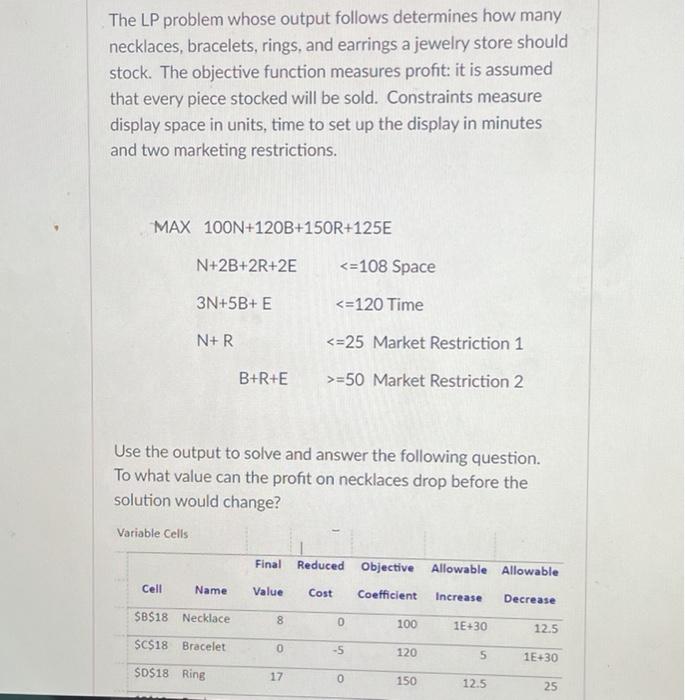
Question: The LP problem whose output follows determines how many necklaces, bracelets, rings, and earrings a jewelry store should stock. The objective function measures profit: it
The LP problem whose output follows determines
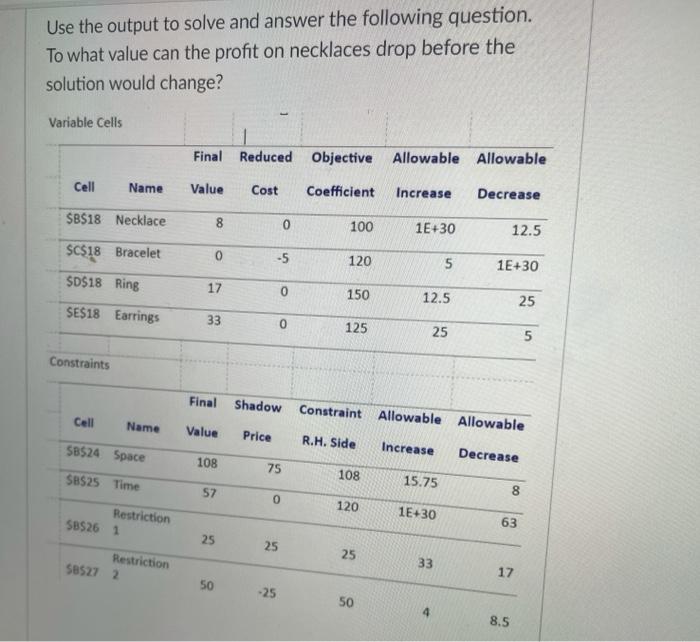
The LP problem whose output follows determines how many necklaces, bracelets, rings, and earrings a jewelry store should stock. The objective function measures profit: it is assumed that every piece stocked will be sold. Constraints measure display space in units, time to set up the display in minutes and two marketing restrictions. MAX 100N+120B+150R+125E N+2B+2R+2E =50 Market Restriction 2 Use the output to solve and answer the following question. To what value can the profit on necklaces drop before the solution would change? Variable Cells Final Reduced Objective Allowable Allowable Cell Name Value Cost Coefficient Increase Decrease $B$18 Necklace 8 0 100 1E+30 12.5 $C$18 Bracelet 0 -5 120 5 1E+30 $D$18 Ring 17 150 12.5 25 Use the output to solve and answer the following question. To what value can the profit on necklaces drop before the solution would change? Variable Cells Final Reduced Objective Allowable Allowable Cell Name Value Cost Coefficient Increase Decrease SB$18 Necklace 8 0 100 1E+30 12.5 SCS18 Bracelet 0 -5 120 5 1E+30 $D$18 Ring 17 0 150 12.5 25 SE$18 Earrings 33 0 125 25 5 Constraints Final Shadow Constraint Allowable Allowable Cell Name Value Price R.H. Side $B$24 Space Increase Decrease 108 75 $B$25 Time 108 15.75 57 8 0 120 Restriction SBS 26 1 1E+30 63 25 25 25 Restriction 585272 33 17 50 -25 50 8.5

Step by Step Solution

There are 3 Steps involved in it

1 Expert Approved Answer
Step: 1 Unlock blur-text-image

Question Has Been Solved by an Expert!

Get step-by-step solutions from verified subject matter experts

Step: 2 Unlock
Step: 3 Unlock

Students Have Also Explored These Related General Management Questions!