



Question: The Mandrill and Baboon are two fictitious problems that accept a weight graph and return an integer Consider the reduction below, which reduces the Mandrill
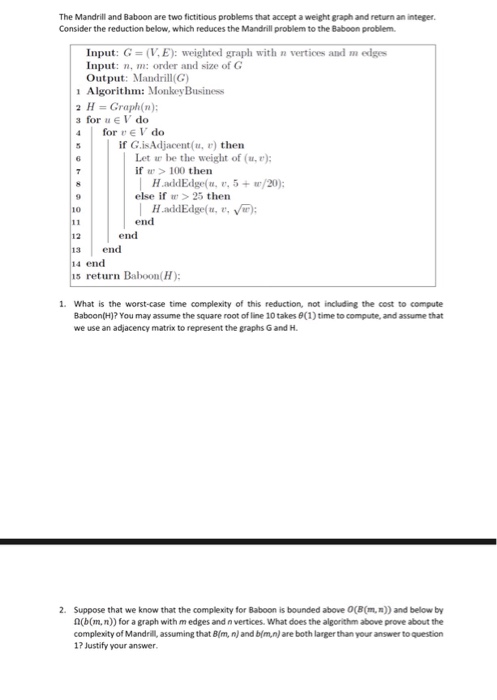
The Mandrill and Baboon are two fictitious problems that accept a weight graph and return an integer Consider the reduction below, which reduces the Mandrill problem to the Baboon problem Input: G = (V. E): weighted graph with n vertices and m edges Input:, m: order and size of G Output: Mandrill G) 1 Algorithm: Monkey Business 2 H = Graph(n): s for u E V do 4 for reV do if G.isAdjacent(u, e) then Let r be the weight of (u,): if w100 then HaddEdge(u, v, 5 +/20) else if 25 then HaddEdge(u, e, 10 end end 13 end 14 end 1s return Baboon(H); 1. What s the worst-case time complexity of this reduction, not including the cost to compute Baboon(H)? You may assume the square root of line 10 takes (1) time to compute, and assume that we use an adjacency matrix to represent the graphs G and H. 2. Suppose that we know that the complexity for Baboon is bounded above O(B()and below by A(D(m, n)) for a graph with m edges and n vertices, what does the algorithm above prove about the complexity of Mandrill, assuming that B/m, n) and bm,njare both larger than your answer to question 1? Justify your
Step by Step Solution
There are 3 Steps involved in it

Get step-by-step solutions from verified subject matter experts