







Question: In this lab you will use a browser-based Mass and Spring simulation that realistically represents the most fundamental features of the real system: https://phet.colorado.edu/sims/html/masses-and-springs/latest/masses-and-springs_en.html
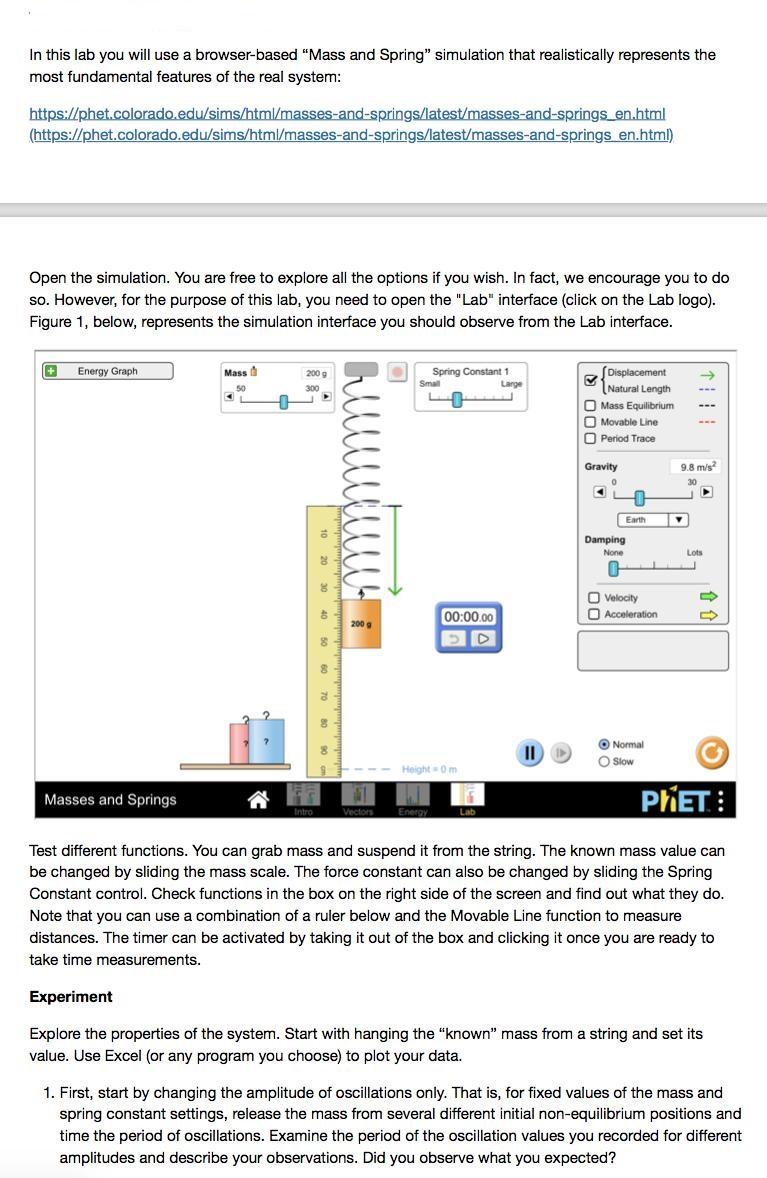
In this lab you will use a browser-based Mass and Spring simulation that realistically represents the most fundamental features of the real system: https://phet.colorado.edu/sims/html/masses-and-springs/latest/masses-and-springs_en.html (https://phet.colorado.edu/sims/html/masses-and-springs/latest/masses-and-springs en.html) Open the simulation. You are free to explore all the options if you wish. In fact, we encourage you to do so. However, for the purpose of this lab, you need to open the Lab interface (click on the Lab logo). Figure 1, below, represents the simulation interface you should observe from the Lab interface. + Energy Graph Mass 50 Masses and Springs H 200 g 300 2 Intro 8 8 8 200 g Vectors Spring Constant 1. Small Energy 00:00.00 ED Height 0 m Large II Displacement Natural Length Mass Equilibrium Movable Line Period Trace Gravity Damping None 0 M Earth Velocity Acceleration Normal Slow 9.8 m/s 30 Y PHET: Test different functions. You can grab mass and suspend it from the string. The known mass value can be changed by sliding the mass scale. The force constant can also be changed by sliding the Spring Constant control. Check functions in the box on the right side of the screen and find out what they do. Note that you can use a combination of a ruler below and the Movable Line function to measure distances. The timer can be activated by taking it out of the box and clicking it once you are ready to take time measurements. Experiment Explore the properties of the system. Start with hanging the known mass from a string and set its value. Use Excel (or any program you choose) to plot your data. Lots 1. First, start by changing the amplitude of oscillations only. That is, for fixed values of the mass and spring constant settings, release the mass from several different initial non-equilibrium positions and time the period of oscillations. Examine the period of the oscillation values you recorded for different amplitudes and describe your observations. Did you observe what you expected?
Step by Step Solution
3.44 Rating (167 Votes )
There are 3 Steps involved in it

Get step-by-step solutions from verified subject matter experts
 Study Help