







Question: The ( mathrm { I } ^ { 2 } mathrm { ~S } ) - LWR design considered in P
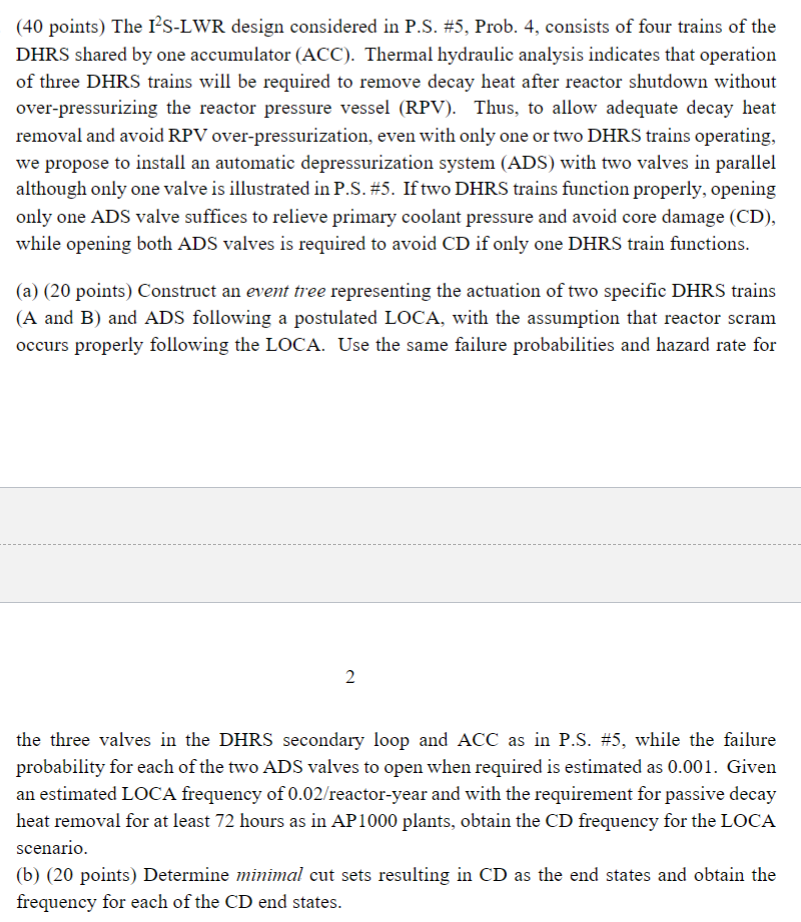
The mathrmImathrm~SLWR design considered in PS# Prob. consists of four trains of the DHRS shared by one accumulator ACC Thermal hydraulic analysis indicates that operation of three DHRS trains will be required to remove decay heat after reactor shutdown without overpressurizing the reactor pressure vessel RPV Thus, to allow adequate decay heat removal and avoid RPV overpressurization, even with only one or two DHRS trains operating, we propose to install an automatic depressurization system ADS with two valves in parallel although only one valve is illustrated in PS# If two DHRS trains function properly, opening only one ADS valve suffices to relieve primary coolant pressure and avoid core damage CD while opening both ADS valves is required to avoid C D if only one DHRS train functions.
a points Construct an event tree representing the actuation of two specific DHRS trains A and B and ADS following a postulated LOCA, with the assumption that reactor scram occurs properly following the LOCA. Use the same failure probabilities and hazard rate for
the three valves in the DHRS secondary loop and ACC as in PS# while the failure probability for each of the two ADS valves to open when required is estimated as Given an estimated LOCA frequency of reactoryear and with the requirement for passive decay heat removal for at least hours as in AP plants, obtain the CD frequency for the LOCA scenario.
b points Determine minimal cut sets resulting in CD as the end states and obtain the frequency for each of the CD end states.
Step by Step Solution
There are 3 Steps involved in it
1 Expert Approved Answer
Step: 1 Unlock

Question Has Been Solved by an Expert!
Get step-by-step solutions from verified subject matter experts
Step: 2 Unlock
Step: 3 Unlock
 Study Help