







Question: The McGee Corporation finds it is necessary to determine its marginal cost of capital. McGees current capital structure calls for 45 percent debt, 20 percent
The McGee Corporation finds it is necessary to determine its marginal cost of capital. McGees current capital structure calls for 45 percent debt, 20 percent preferred stock, and 35 percent common equity. Initially, common equity will be in the form of retained earnings (Ke) and then new common stock (Kn). The costs of the various sources of financing are as follows: debt (after-tax), 6.2 percent; preferred stock, 9.0 percent; retained earnings, 8.0 percent; and new common stock, 9.2 percent.
a. What is the initial weighted average cost of capital? (Include debt, preferred stock, and common equity in the form of retained earnings, Ke.) (Do not round intermediate calculations. Input your answers as a percent rounded to 2 decimal places.)
b. If the firm has $28.0 million in retained earnings, at what size capital structure will the firm run out of retained earnings? (Enter your answer in millions of dollars (e.g., $10 million should be entered as "10").)
c. What will the marginal cost of capital be immediately after that point? (Equity will remain at 35 percent of the capital structure, but will all be in the form of new common stock, Kn.) (Do not round intermediate calculations. Input your answer as a percent rounded to 2 decimal places.)
d. The 6.2 percent cost of debt referred to above applies only to the first $45 million of debt. After that, the cost of debt will be 8.5 percent. At what size capital structure will there be a change in the cost of debt? (Enter your answer in millions of dollars (e.g., $10 million should be entered as "10").)
e. What will the marginal cost of capital be immediately after that point? (Consider the facts in both parts c and d.) (Do not round intermediate calculations. Input your answer as a percent rounded to 2 decimal places.)
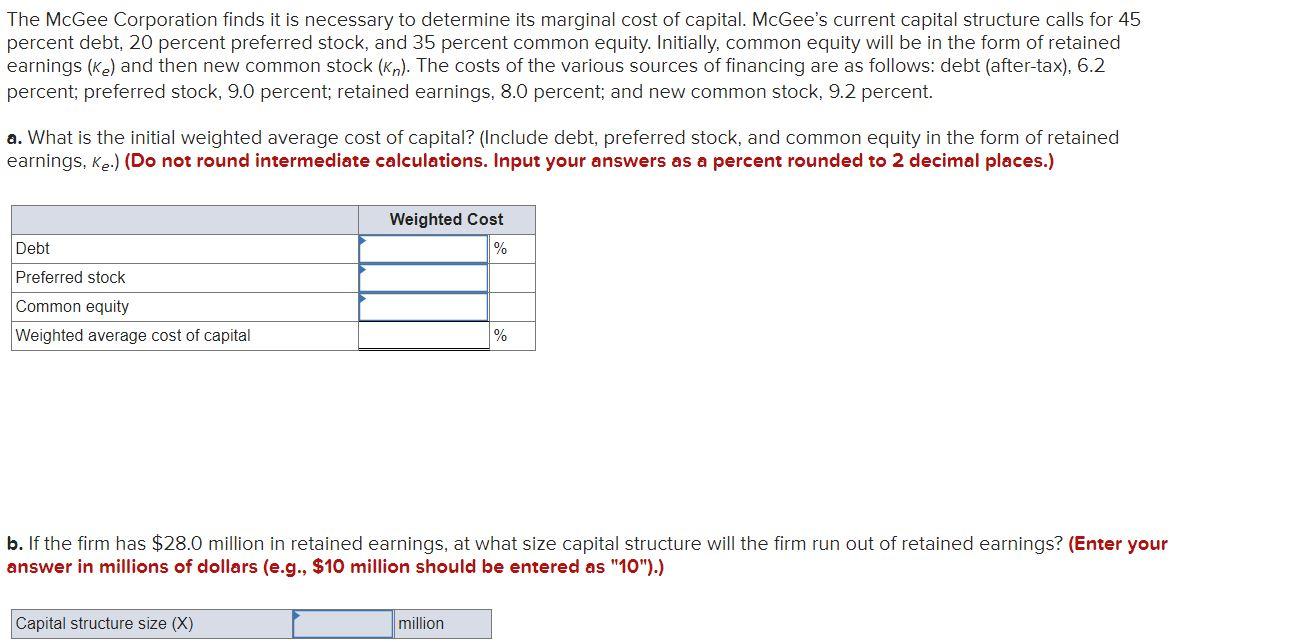
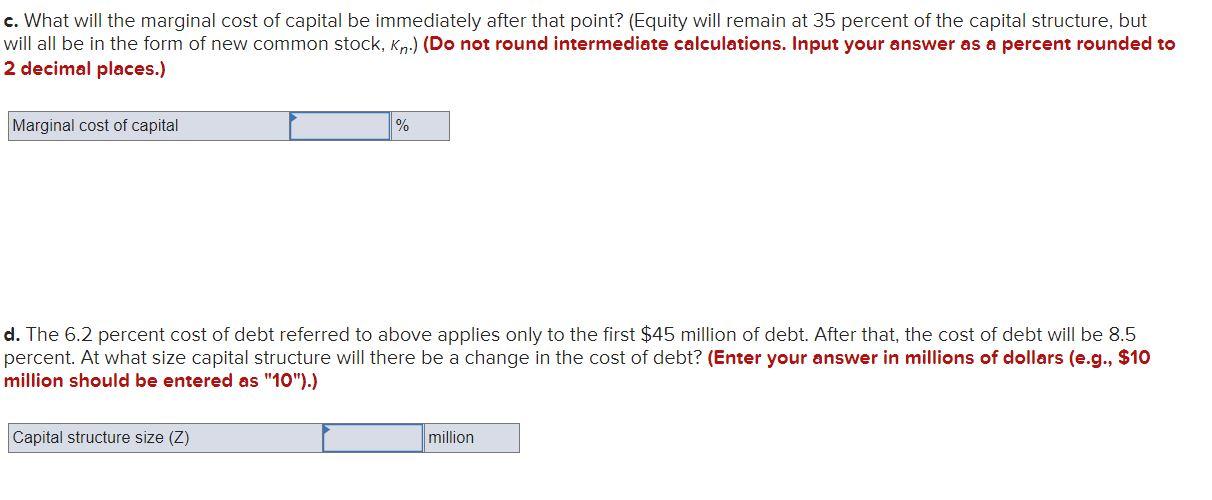

The McGee Corporation finds it is necessary to determine its marginal cost of capital. McGee's current capital structure calls for 45 percent debt, 20 percent preferred stock, and 35 percent common equity. Initially, common equity will be in the form of retained earnings (Ke) and then new common stock (Kn). The costs of the various sources of financing are as follows: debt (after-tax), 6.2 percent; preferred stock, 9.0 percent; retained earnings, 8.0 percent; and new common stock, 9.2 percent. a. What is the initial weighted average cost of capital? (Include debt, preferred stock, and common equity in the form of retained earnings, Ke.) (Do not round intermediate calculations. Input your answers as a percent rounded to 2 decimal places.) Weighted Cost % Debt Preferred stock Common equity Weighted average cost of capital % b. If the firm has $28.0 million in retained earnings, what size capital structure will the firm run out of retained earnings? (Enter your answer in millions of dollars (e.g., $10 million should be entered as "10").) Capital structure size (X) million c. What will the marginal cost of capital be immediately after that point? (Equity will remain at 35 percent of the capital structure, but will all be in the form of new common stock, kn.) (Do not round intermediate calculations. Input your answer as a percent rounded to 2 decimal places.) Marginal cost of capital % d. The 6.2 percent cost of debt referred to above applies only to the first $45 million of debt. After that, the cost of debt will be 8.5 percent. At what size capital structure will there be a change in the cost of debt? (Enter your answer in millions of dollars (e.g., $10 million should be entered as "10").) Capital structure size (Z) million e. What will the marginal cost of capital be immediately after that point? (Consider the facts in both parts cand d.) (Do not round intermediate calculations. Input your answer as a percent rounded to 2 decimal places.) Marginal cost of capital %
Step by Step Solution
There are 3 Steps involved in it

Get step-by-step solutions from verified subject matter experts
 Study Help