Question: The method been used example as Methods to increase productivity,Inventory holding and Customer perceived value based on case study Eastern gear Inc., in Philadelphia. Please
The method been used example as Methods to increase productivity,Inventory holding and Customer perceived value based on case study Eastern gear Inc., in Philadelphia.
Please explain about the company strategy based on the case study Eastern gear Inc., in Philadelphia.
Below is the case study to refer
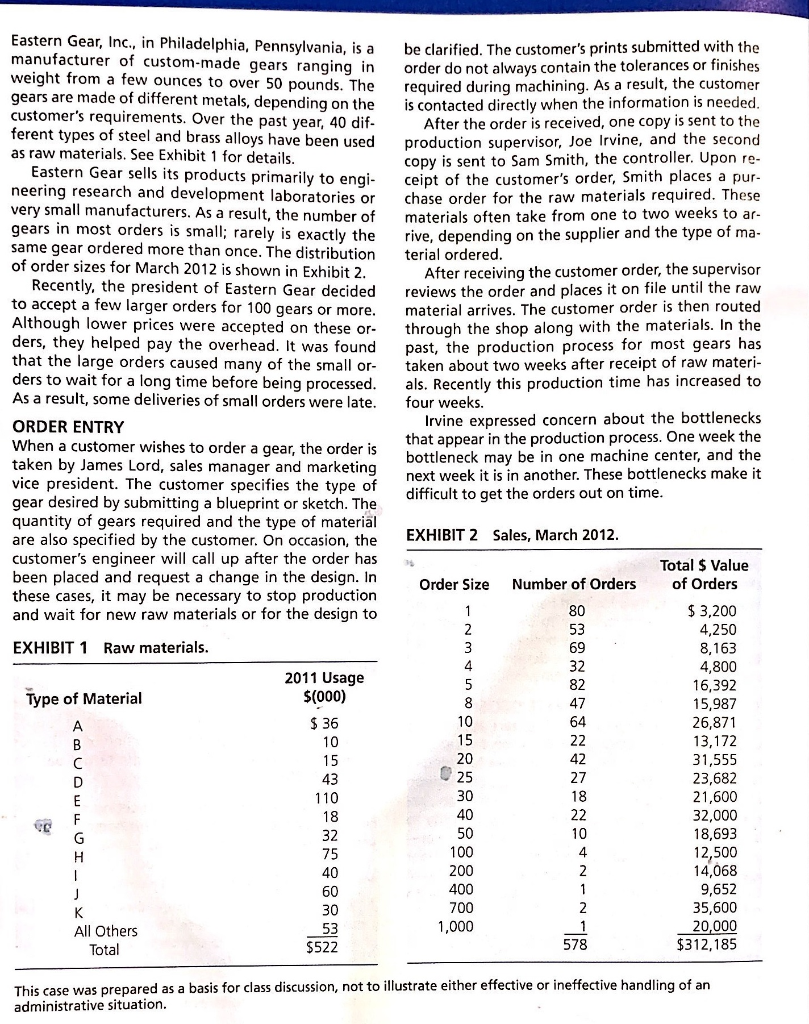
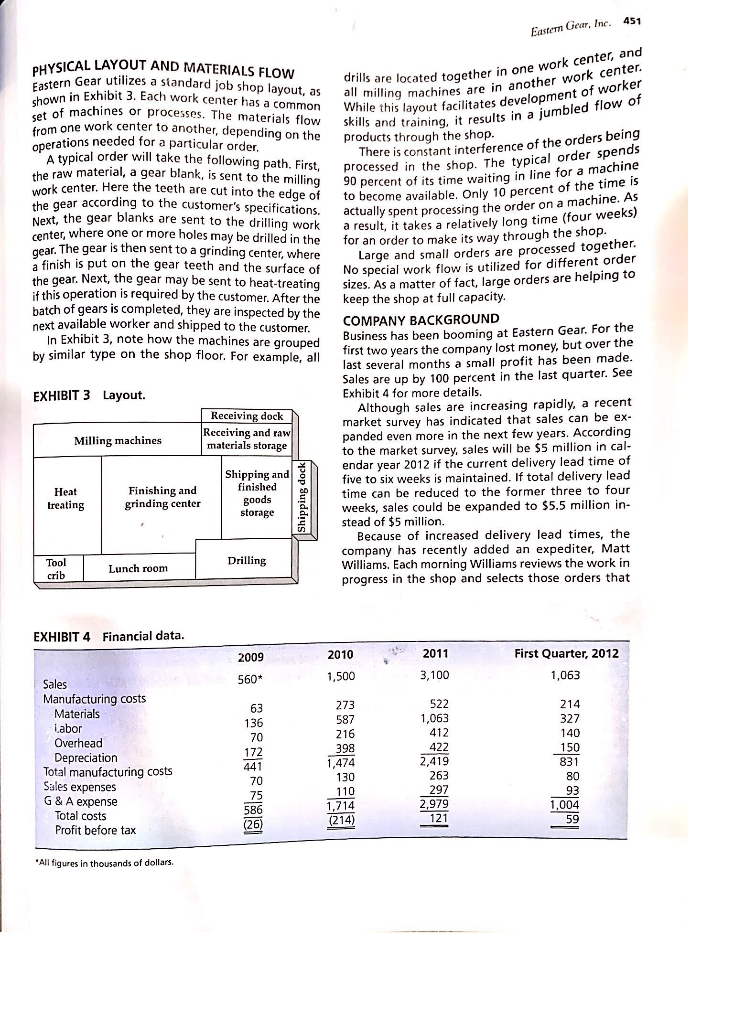
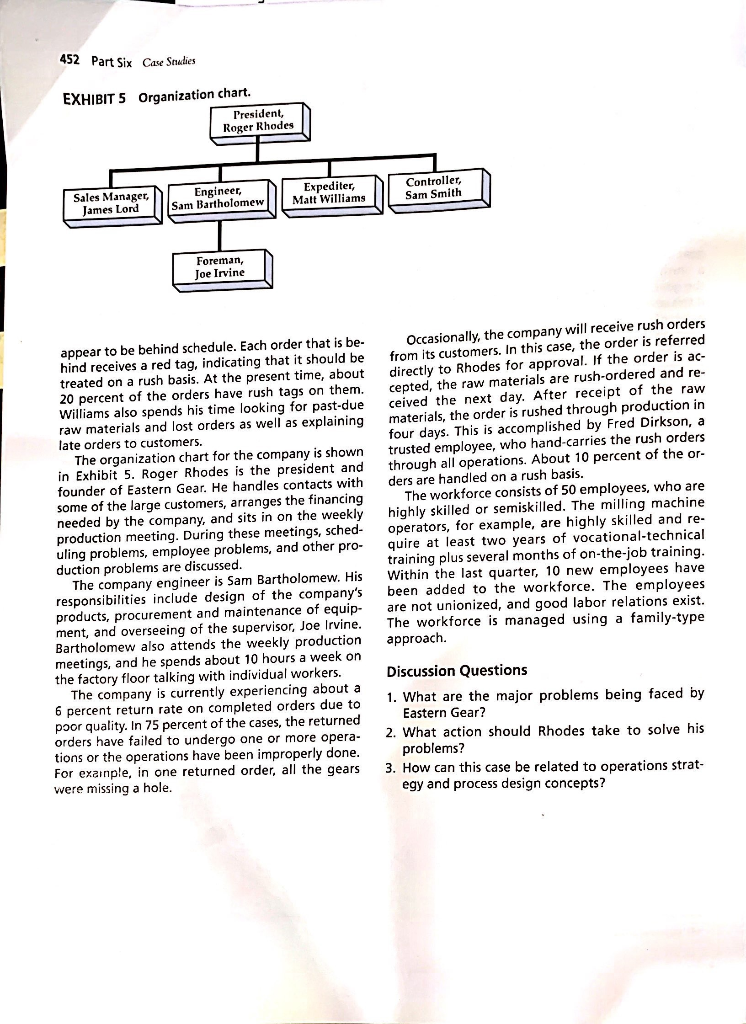
Eastern Gear, Inc., in Philadelphia, Pennsylvania, is a manufacturer of custom-made gears ranging in weight from a few ounces to over 50 pounds. The gears are made of different metals, depending on the customer's requirements. Over the past year, 40 dif- ferent types of steel and brass alloys have been used as raw materials. See Exhibit 1 for details. Eastern Gear sells its products primarily to engi- neering research and development laboratories or very small manufacturers. As a result, the number of gears in most orders is small; rarely is exactly the same gear ordered more than once. The distribution of order sizes for March 2012 is shown in Exhibit 2. Recently, the president of Eastern Gear decided to accept a few larger orders for 100 gears or more. Although lower prices were accepted on these or- ders, they helped pay the overhead. It was found that the large orders caused many of the small or- ders to wait for a long time before being processed. As a result, some deliveries of small orders were late. ORDER ENTRY When a customer wishes to order a gear, the order is taken by James Lord, sales manager and marketing vice president. The customer specifies the type of gear desired by submitting a blueprint or sketch. The quantity of gears required and the type of material are also specified by the customer. On occasion, the customer's engineer will call up after the order has been placed and request a change in the design. In these cases, it may be necessary to stop production and wait for new raw materials or for the design to be clarified. The customer's prints submitted with the order do not always contain the tolerances or finishes required during machining. As a result, the customer is contacted directly when the information is needed. After the order is received, one copy is sent to the production supervisor, Joe Irvine, and the second copy is sent to Sam Smith, the controller. Upon re- ceipt of the customer's order, Smith places a pur- chase order for the raw materials required. These materials often take from one to two weeks to ar- rive, depending on the supplier and the type of ma- terial ordered. After receiving the customer order, the supervisor reviews the order and places it on file until the raw material arrives. The customer order is then routed through the shop along with the materials. In the past, the production process for most gears has taken about two weeks after receipt of raw materi- als. Recently this production time has increased to four weeks. Irvine expressed concern about the bottlenecks that appear in the production process. One week the bottleneck may be in one machine center, and the next week it is in another. These bottlenecks make it difficult to get the orders out on time. EXHIBIT 2 Sales, March 2012. Order Size Number of Orders EXHIBIT 1 Raw materials. 2 3 4 2011 Usage $(000) Type of Material A B 8 10 15 20 25 80 53 69 32 82 47 64 22 42 27 18 22 10 4 $ 36 10 15 43 110 18 32 75 40 60 30 53 $522 Total $ Value of Orders $ 3,200 4,250 8,163 4,800 16,392 15,987 26,871 13,172 31,555 23,682 21,600 32,000 18,693 12,500 14,068 9,652 35,600 20,000 $312,185 D E F G H 40 50 100 200 2 J 400 2 K All Others Total 700 1,000 578 This case was prepared as a basis for class discussion, not to illustrate either effective or ineffective handling of an administrative situation. 451 Eastern Gear, Inc. from Eastern Gear utilizes a standard job shop layout, as drills are located together in one work center, and shown in Exhibit 3. Each work center has a common all milling machines are in another work center. While this layout facilitates development of worker skills and training, it results in a jumbled flow of the raw material, a gear blank, is sent to the milling PHYSICAL LAYOUT AND MATERIALS FLOW set of machines or processes. The materials flow work center to another, depending on the operations needed for a particular order. A typical order will take the following path. First, work center. Here the teeth are cut into the edge of the gear according to the customer's specifications. Next, the gear blanks are sent to the drilling work center, where one or more holes may be drilled in the gear. The gear is then sent to a grinding center, where a finish is put on the gear teeth and the surface of the gear. Next, the gear may be sent to heat-treating if this operation is required by the customer. After the batch of gears is completed, they are inspected by the next available worker and shipped to the customer. In Exhibit 3, note how the machines are grouped by similar type on the shop floor. For example, all products through the shop. There is constant interference of the orders being processed in the shop. The typical order spends 90 percent of its time waiting in line for a machine to become available. Only 10 percent of the time is actually spent processing the order on a machine. As a result, it takes a relatively long time (four weeks) for an order to make its way through the shop. Large and small orders are processed together. No special work flow is utilized for different order sizes. As a matter of fact, large orders are helping to keep the shop at full capacity. COMPANY BACKGROUND Business has been booming at Eastern Gear. For the first two years the company lost money, but over the last several months a small profit has been made Sales are up by 100 percent in the last quarter. See Exhibit 4 for more details. Although sales are increasing rapidly, a recent market survey has indicated that sales can be ex- panded even more in the next few years. According to the market survey, sales will be $5 million in cal- endar year 2012 if the current delivery time of five to six weeks is maintained. If total delivery lead time can be reduced to the former three to four weeks, sales could be expanded to $5.5 million in- stead of $5 million. Because of increased delivery lead times, the company has recently added an expediter, Matt Williams. Each morning Williams reviews the work in progress in the shop and selects those orders that EXHIBIT 3 Layout. Receiving dock Receiving and raw materials storage Milling machines Heat treating Finishing and grinding center Shipping and finished goods storage Drilling Tool crib Lunch room EXHIBIT 4 Financial data. 2009 2010 2011 First Quarter, 2012 1,063 560* 1,500 3,100 Sales Manufacturing costs Materials Labor Overhead Depreciation Total manufacturing costs Sales expenses G&A expense Total costs Profit before tax 63 136 70 172 441 273 587 216 398 1,474 130 110 522 1,063 412 422 2,419 263 297 2,979 121 214 327 140 150 831 80 93 1,004 59 75 1,714 (26) (214) *All figures in thousands of dollars. uling problems are discussed. 452 Part Six Case Studies EXHIBIT 5 Organization chart. President, Roger Rhodes Sales Manager, Engineer, Expediter, Controller, James Lord Sam Bartholomew Matt Williams Sam Smith Foreman, Joe Irvine appear to be behind schedule. Each order that is be Occasionally, the company will receive rush orders hind receives a red tag, indicating that it should be from its customers. In this case, the order is referred treated on a rush basis. At the present time, about directly to Rhodes for approval. If the order is ac- 20 percent of the orders have rush tags on them. cepted, the raw materials are rush-ordered and re- Williams also spends his time looking for past-due ceived the next day. After receipt of the raw raw materials and lost orders as well as explaining materials, the order is rushed through production in late orders to customers. four days. This is accomplished by Fred Dirkson, a The organization chart for the company is shown trusted employee, who hand-carries the rush orders in Exhibit 5. Roger Rhodes is the president and through all operations. About 10 percent of the or- founder of Eastern Gear. He handles contacts with ders are handled on a rush basis. some of the large customers, arranges the financing The workforce consists of 50 employees, who are needed by the company, and sits in on the weekly ghly skilled or or semiskilled. The milling machine production meeting. During these meetings, sched- uroblems, employee problems, and other pro- operators, for example, are highly skilled and re- quire at least two years of vocational-technical duction training plus several months of on-the-job training. The company engineer is Sam Bartholomew. His Within the last quarter, 10 new employees have responsibilities include design of the company's been added to the workforce. The employees products, procurement and maintenance of equip are not unionized, and good labor relations exist. ment, and overseeing of the supervisor, Joe Irvine. The workforce is managed using a family-type Bartholomew attends the weekly production approach. meetings, and he spends about 10 hours a week on the factory floor talking with individual workers. Discussion Questions The company is is currently experiencing about a 6 perc percent return turn rate on completed orders due to 1. What are the major problems being faced by poor quality. In 75 percent of the cases, the returned Eastern Gear? orders have failed to undergo one or more opera- 2. What action should Rhodes take to solve his tions or the operations have been improperly done. problems? For exainple, in one returned order, all the gears 3. How can this case be related to operations strat- were missing a hole. egy and process design concepts









 Study Help