







Question: The misinformation effect is a common memory error observed in eyewitness memory experiments. First, a person is shown an original event (like a videotape of
The misinformation effect is a common memory error observed in eyewitness memory experiments.
First,
a person is shown an original event (like a videotape of an accident),
then is given misleading post-event information about the event (for example, told that a car involved in the crash went past a stop sign, when it was actually a yield sign),
and finally asked if the car went past a stop (misleading information) or a yield (original information) sign.
Compared to someone who was not given misleading information, misinformed individuals are more likely to incorrectly choose the misleading post-event information.
The overwriting account: Loftus and colleagues (Loftus, 1979; Loftus & Loftus, 1980) argued for an overwriting account of the misinformation effect. In essence, when a person is presented with misleading information, the information becomes incorporated into the original memory and replaces the original piece of information. In this account, the original information is lost from memory. In addition, the error occurs when the person is presented with the misleading information.
The co-existing account: In contrast, McCloskey and Zaragoza (1985) found that, although they could also generate the misinformation effect, people could still remember the original information. They argued that people could remember both the original information and the misleading informationfor this reason, their account was called the coexistence hypothesis. At test, the person is presented with a choice between (a) what they believed they recalled and (b) what they recall the experimenter telling them. Thus, due to social demands, they choose the misleading information.
The source confusion account: Others have argued that the misinformation effect is due to source confusion (Johnson, Hastroudi, & Lindsay, 1993). Source memory is remembering where a person learned a piece of information. Thus, a person learned the original information as part of the first presented information and the misleading information from the experimenter later. Unfortunately, source memory is lost more rapidly than the knowledge itself. Thus, a person can remember something, but not remember when or where the information was learned. The person may then remember the misleading information, but not that it was provided after the event (i.e., the source of information).
Experiment Description
One critical difference between the overwriting and source confusion accounts is the time frame involved in the memory error.
The overwriting account predicts that the misleading information erases the original when the misleading is encoded. Thus, the misinformation effect should be observable shortly after the presentation of the misleading information.
In contrast, the source confusion account predicts that, since the error is due to the forgetting of the source over time, the errors will be more apparent after the individual has had time to forget the source.
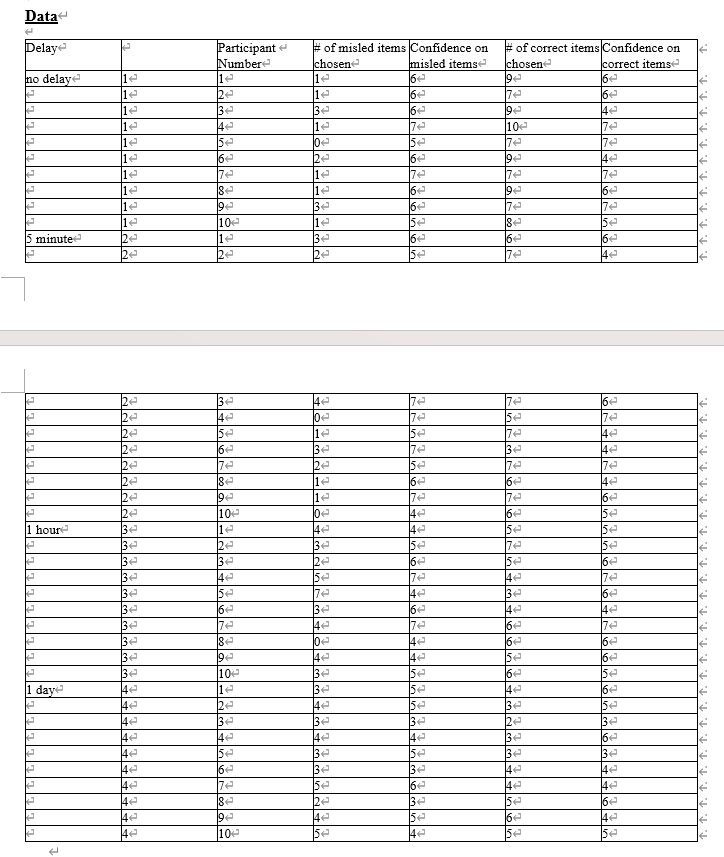
The independent variable in this study was the time since the presentation of the misleading post-event information.
All of the participants viewed a videotape of a crime occurring. Five minutes later, they were provided a written description of the videotape. For all of the participants, the post-event information included the same eight misleading suggestions.
All participants were then given a multiple-choice memory test and asked to select the item that was in the original videotape. The test included eight questions concerning the misleading itemsin these questions, the misleading information was one choice.
The test also included 10 questions concerning other items from the videotape. For each item, participants were asked to rate how confident they were in their answer on a scale from 1 (not at all confident) to 7 (completely confident).
Thus, there are 4 dependent variables:
the number of times the participants erroneously chose the misleading information (out of 8 possible),
average confidence on the questions involving misleading information
the number of times the participants chose the correct answer on the items that never involved misleading information (out of 10 possible),
average confidence on the questions that did not involve misleading information.
The test occurred either immediately after the presentation of the misleading information, five minutes later, one hour later, or one day later.
Discussion Questions
1.Finding: Please summarize the results in English.
2.Implications: What do the results tell you about the competing accounts of the misinformation effect?
3.Contributions: How do you think this experiment relates to previous work? How would you reinterpret previous research based on this experiment? Please present the studys contributions in terms of the theoretical accounts that were examined in the present study.
4.Unanswered questions in this study: What experiments would you suggest should be done next ? Please be specific by relating your suggestions to weaknesses in this design, not suggesting any experiment just because you are curious.
5.What generalizations and applications would you suggest based on this experiment?
Step 1: Please compute the appropriate statistics (descriptive statistics, hypothesis testing, and follow-up).
Step 2: Please write a results section based on the statistics obtained in Step 1.
Data Data
Step by Step Solution
There are 3 Steps involved in it

Get step-by-step solutions from verified subject matter experts
 Study Help