Question: The MM Problem Read the problem below and answer the questions. Bailey discusses a connection between the MM Theorem and the Put- Call Parity relation
The MM Problem Read the problem below and answerThe MM Problem Read the problem below and answerThe MM Problem Read the problem below and answerThe MM Problem Read the problem below and answerThe MM Problem Read the problem below and answerThe MM Problem Read the problem below and answer
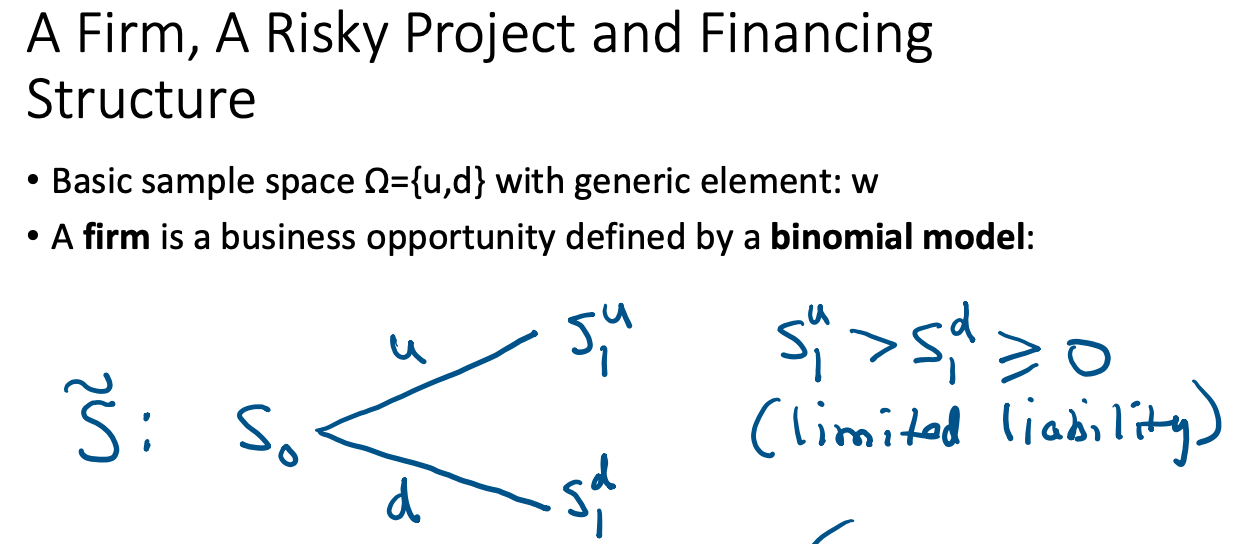
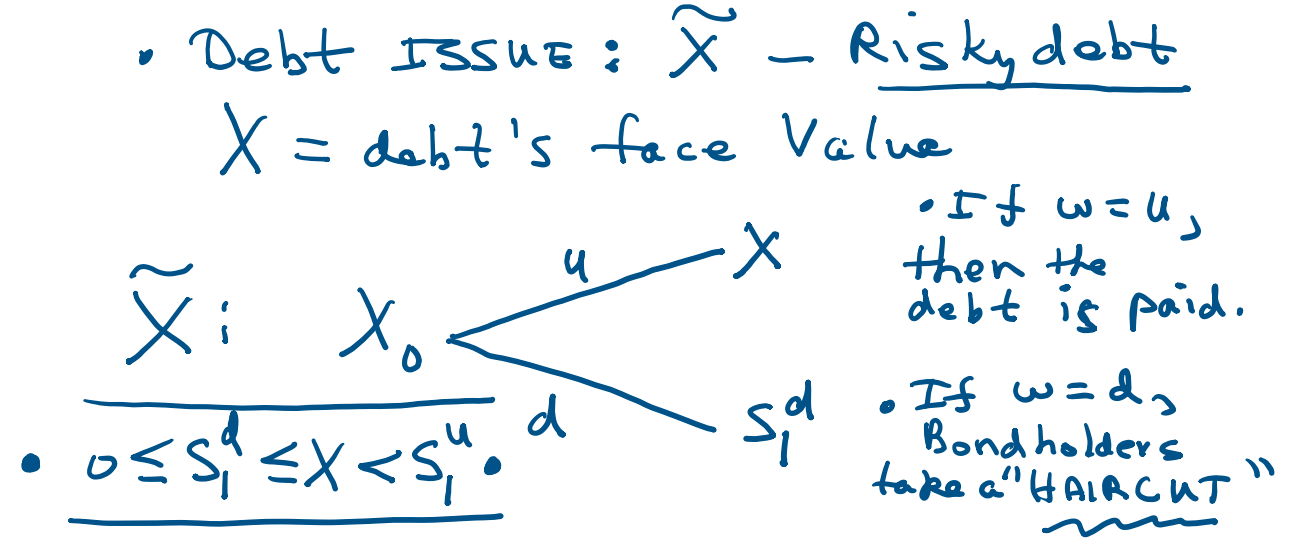
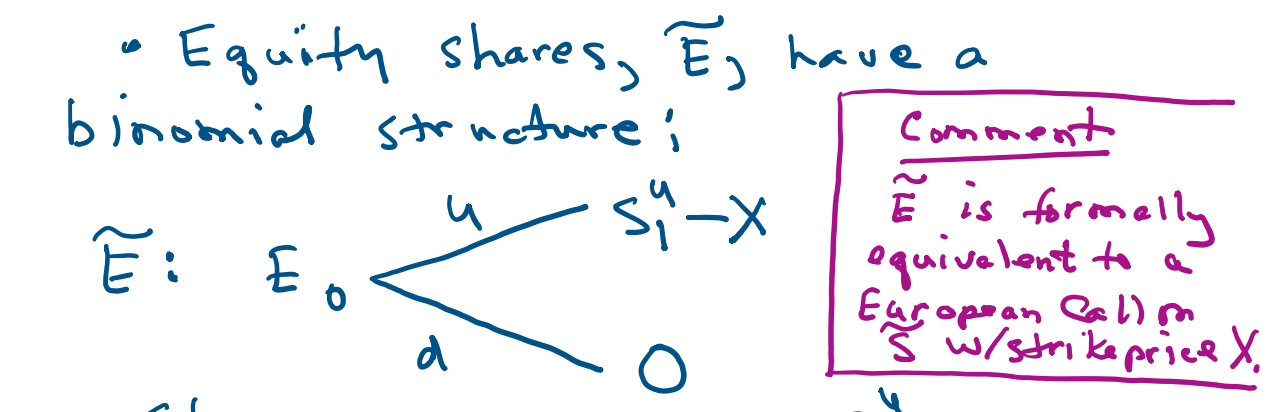
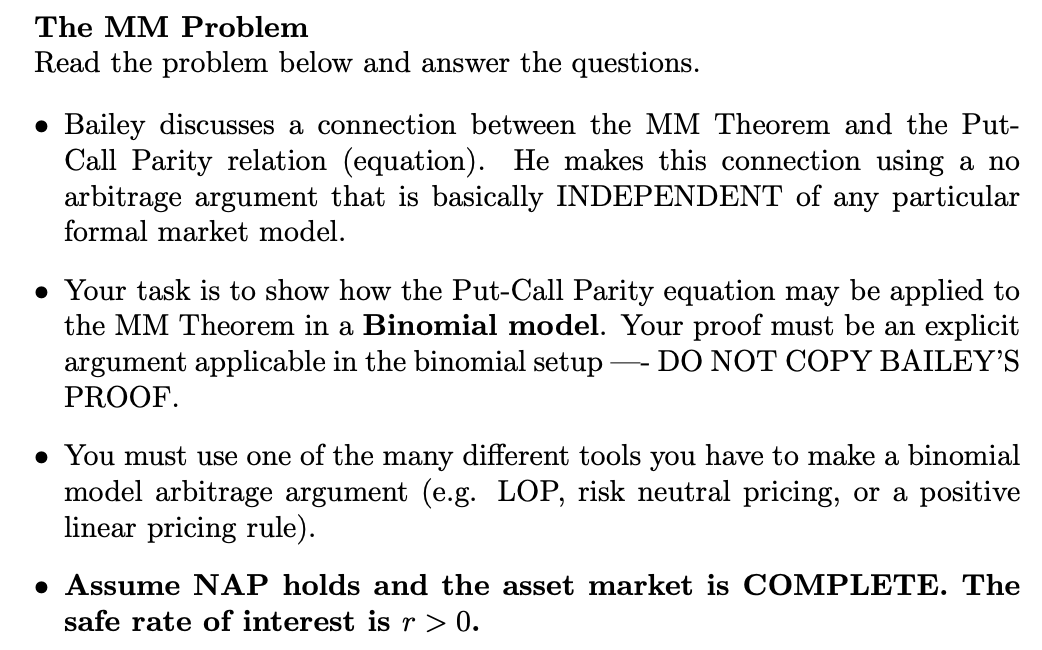
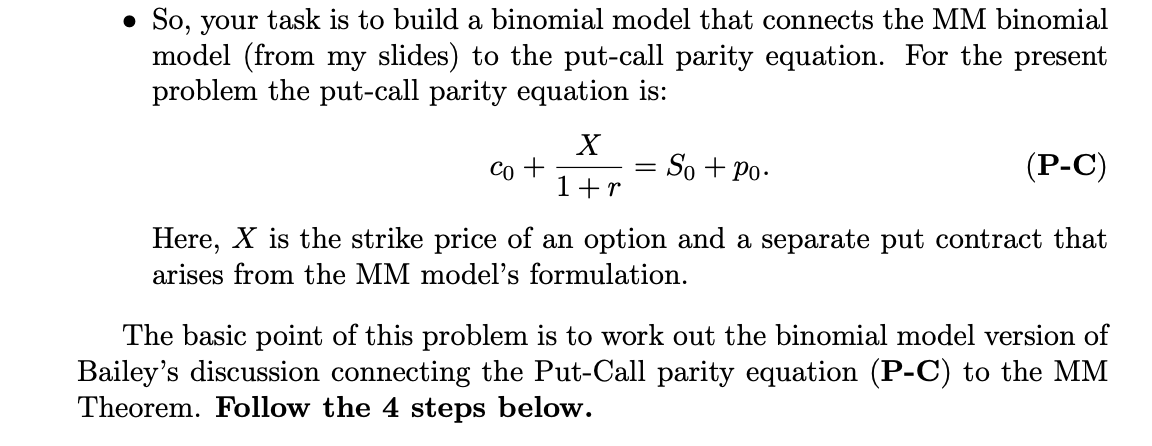
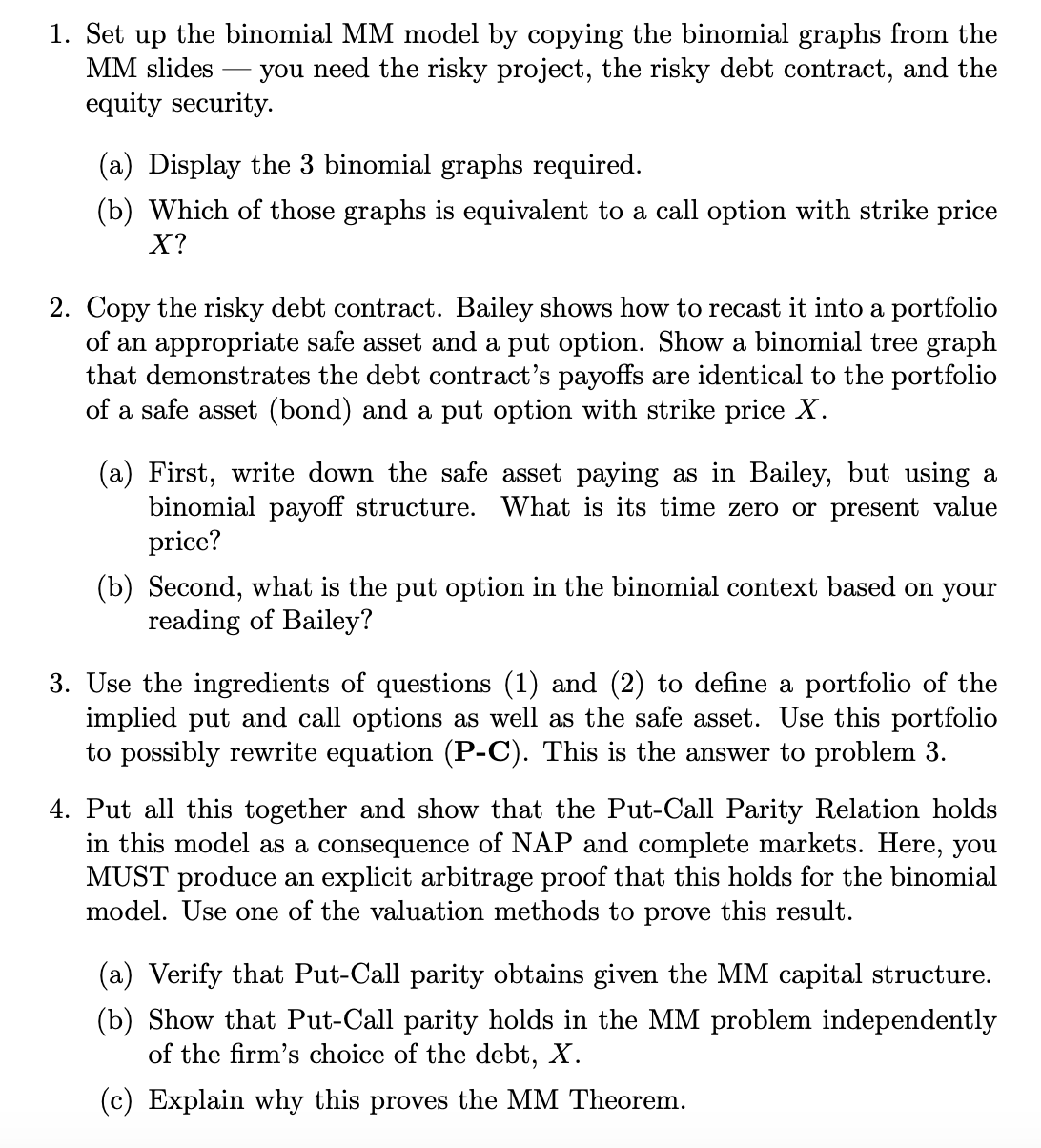
The MM Problem Read the problem below and answer the questions. Bailey discusses a connection between the MM Theorem and the Put- Call Parity relation (equation). He makes this connection using a no arbitrage argument that is basically INDEPENDENT of any particular formal market model. Your task is to show how the Put-Call Parity equation may be applied to the MM Theorem in a Binomial model. Your proof must be an explicit argument applicable in the binomial setup DO NOT COPY BAILEY'S PROOF. You must use one of the many different tools you have to make a binomial model arbitrage argument (e.g. LOP, risk neutral pricing, or a positive linear pricing rule). Assume NAP holds and the asset market is COMPLETE. The safe rate of interest is r > 0. e So, your task is to build a binomial model that connects the MM binomial model (from my slides) to the put-call parity equation. For the present problem the put-call parity equation is: X + =50+ po- P-C Tty 07 Po ( ) Here, X is the strike price of an option and a separate put contract that arises from the MM model's formulation. The basic point of this problem is to work out the binomial model version of Bailey's discussion connecting the Put-Call parity equation (P-C) to the MM Theorem. Follow the 4 steps below. 1. Set up the binomial MM model by copying the binomial graphs from the MM slides you need the risky project, the risky debt contract, and the equity security. (a) Display the 3 binomial graphs required. (b) Which of those graphs is equivalent to a call option with strike price X7? 2. Copy the risky debt contract. Bailey shows how to recast it into a portfolio of an appropriate safe asset and a put option. Show a binomial tree graph that demonstrates the debt contract's payoffs are identical to the portfolio of a safe asset (bond) and a put option with strike price X. (a) First, write down the safe asset paying as in Bailey, but using a binomial payoff structure. What is its time zero or present value price? (b) Second, what is the put option in the binomial context based on your reading of Bailey? 3. Use the ingredients of questions (1) and (2) to define a portfolio of the implied put and call options as well as the safe asset. Use this portfolio to possibly rewrite equation (P-C). This is the answer to problem 3. 4. Put all this together and show that the Put-Call Parity Relation holds in this model as a consequence of NAP and complete markets. Here, you MUST produce an explicit arbitrage proof that this holds for the binomial model. Use one of the valuation methods to prove this result. (a) Verify that Put-Call parity obtains given the MM capital structure. (b) Show that Put-Call parity holds in the MM problem independently of the firm's choice of the debt, X. (c) Explain why this proves the MM Theorem. A Firm, A Risky Project and Financing Structure . Basic sample space Q={u,d} with generic element: w . A firm is a business opportunity defined by a binomial model: u s, >sd O S : So (limited liability. d. Debt ISSUE : X - Risky debt X = debt's face Value .If WEU. X then the XI X debt is paid. 0 . If w = do . oES,EX
Step by Step Solution

There are 3 Steps involved in it

1 Expert Approved Answer
Step: 1 Unlock blur-text-image

Question Has Been Solved by an Expert!

Get step-by-step solutions from verified subject matter experts

Step: 2 Unlock
Step: 3 Unlock

Students Have Also Explored These Related Finance Questions!