







Question: The net present value for lathe A is $ (Round to the nearest cent.) The net present value for lathe B is $ (Round to
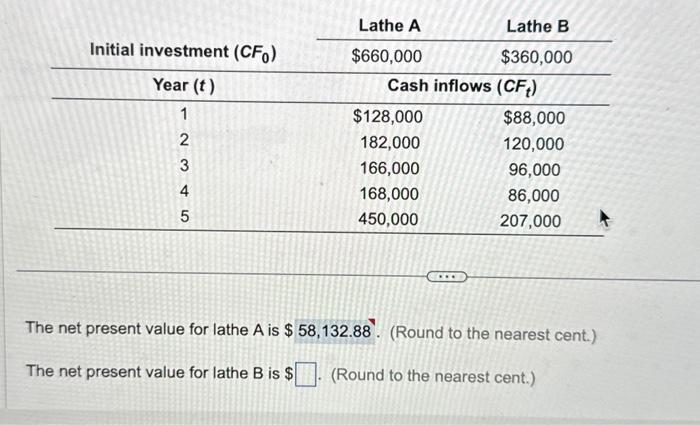

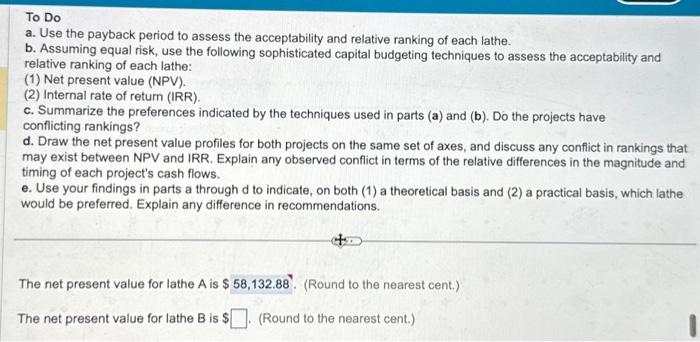
The net present value for lathe A is $ (Round to the nearest cent.) The net present value for lathe B is $ (Round to the nearest cent.) a. Use the payback period to assess the acceptability and relative ranking of each lathe. b. Assuming equal risk, use the following sophisticated capital budgeting techniques to assess the acceptability and relative ranking of each lathe: (1) Net present value (NPV). (2) Internal rate of return (IRR). c. Summarize the preferences indicated by the techniques used in parts (a) and (b). Do the projects have conflicting rankings? d. Draw the net present value profiles for both projects on the same set of axes, and discuss any conflict in rankings that may exist between NPV and IRR. Explain any observed conflict in terms of the relative differences in the magnitude and timing of each project's cash flows. e. Use your findings in parts a through d to indicate, on both (1) a theoretical basis and (2) a practical basis, which lathe would be preferred. Explain any difference in recommendations. The net present value for lathe A is s (Round to the nearest cent.) The net present value for lathe B is $ (Round to the nearest cent.) Note that Mario plans to analyze both lathes over a 5-year period. At the end of that time, the lathes would be sold, thus accounting for the large fifth-year cash inflows. Mario believes that the two lathes are equally risky and that the acceptance of either of them will not change the firm's overall risk. He therefore decides to apply the firm's 13.0% cost of capital when analyzing the lathes. Norwich Tool requires all projects to have a maximum payback period of 4.0 years. To Do a. Use the payback period to assess the acceptability and relative ranking of each lathe. b. Assuming equal risk, use the following sophisticated capital budgeting techniques to assess the acceptability and relative ranking of each lathe: (1) Net present value (NPV). (2) Internal rate of return (IRR). c. Summarize the preferences indicated by the techniques used in parts (a) ar (b). Do the projects have conflicting rankings? The net present value for lathe A is $ (Round to the nearest cent.) The net present value for lathe B is \$ (Round to the nearest cent.) The net present value for lathe A is $ (Round to the nearest cent.) The net present value for lathe B is $ (Round to the nearest cent.) a. Use the payback period to assess the acceptability and relative ranking of each lathe. b. Assuming equal risk, use the following sophisticated capital budgeting techniques to assess the acceptability and relative ranking of each lathe: (1) Net present value (NPV). (2) Internal rate of return (IRR). c. Summarize the preferences indicated by the techniques used in parts (a) and (b). Do the projects have conflicting rankings? d. Draw the net present value profiles for both projects on the same set of axes, and discuss any conflict in rankings that may exist between NPV and IRR. Explain any observed conflict in terms of the relative differences in the magnitude and timing of each project's cash flows. e. Use your findings in parts a through d to indicate, on both (1) a theoretical basis and (2) a practical basis, which lathe would be preferred. Explain any difference in recommendations. The net present value for lathe A is s (Round to the nearest cent.) The net present value for lathe B is $ (Round to the nearest cent.) Note that Mario plans to analyze both lathes over a 5-year period. At the end of that time, the lathes would be sold, thus accounting for the large fifth-year cash inflows. Mario believes that the two lathes are equally risky and that the acceptance of either of them will not change the firm's overall risk. He therefore decides to apply the firm's 13.0% cost of capital when analyzing the lathes. Norwich Tool requires all projects to have a maximum payback period of 4.0 years. To Do a. Use the payback period to assess the acceptability and relative ranking of each lathe. b. Assuming equal risk, use the following sophisticated capital budgeting techniques to assess the acceptability and relative ranking of each lathe: (1) Net present value (NPV). (2) Internal rate of return (IRR). c. Summarize the preferences indicated by the techniques used in parts (a) ar (b). Do the projects have conflicting rankings? The net present value for lathe A is $ (Round to the nearest cent.) The net present value for lathe B is \$ (Round to the nearest cent.)
Step by Step Solution
There are 3 Steps involved in it

Get step-by-step solutions from verified subject matter experts
 Study Help