







Question: The numbers given in hexadecimal below are eight bits each and represent numbers that use two's complement. (The hexadecimal number ff, for example, would be
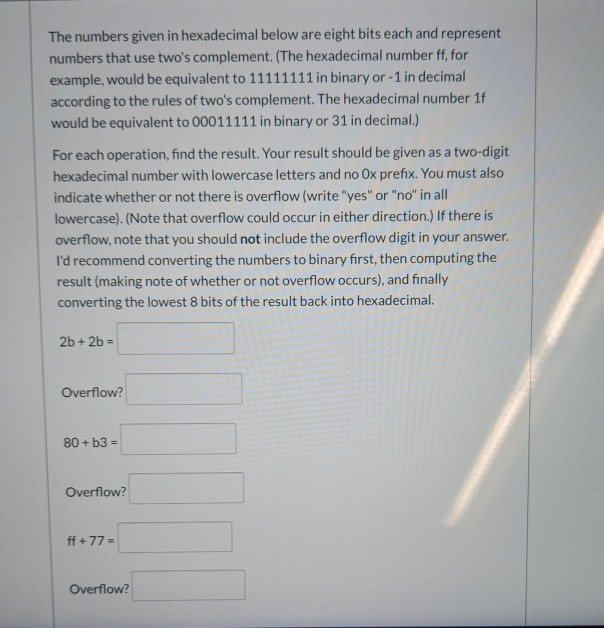
The numbers given in hexadecimal below are eight bits each and represent numbers that use two's complement. (The hexadecimal number ff, for example, would be equivalent to 11111111 in binary or -1 in decimal according to the rules of two's complement. The hexadecimal number 1f would be equivalent to 00011111 in binary or 31 in decimal.) For each operation, find the result. Your result should be given as a two-digit! hexadecimal number with lowercase letters and no Ox prefix. You must also indicate whether or not there is overflow (write "yes" or "no" in all lowercase). (Note that overflow could occur in either direction.) If there is overflow, note that you should not include the overflow digit in your answer. I'd recommend converting the numbers to binary first, then computing the result (making note of whether or not overflow occurs), and finally converting the lowest 8 bits of the result back into hexadecimal. 2b + 2b = Overflow? 80+ b3 = Overflow? ff + 77 = Overflow
Step by Step Solution
There are 3 Steps involved in it

Get step-by-step solutions from verified subject matter experts
 Study Help