







Question: the open spreadsheet : Excel Online Structured Activity: CAPM, portfolio risk, and return Consider the following information for three stocks, Stocks A, B, and C.
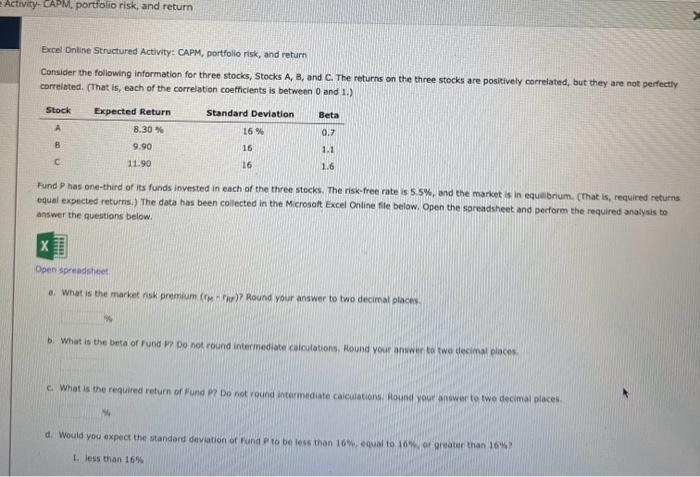
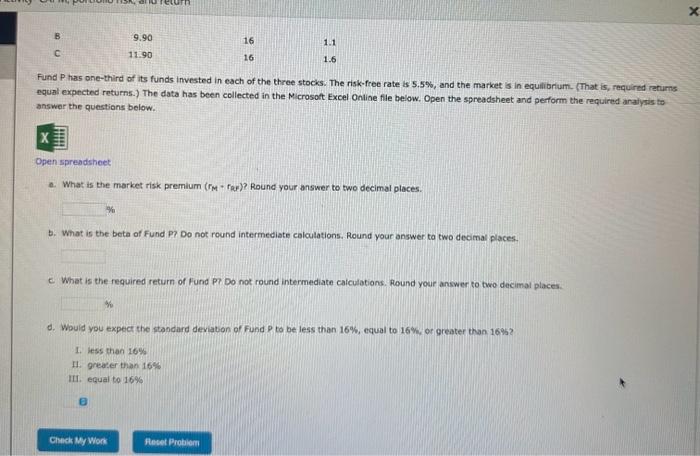
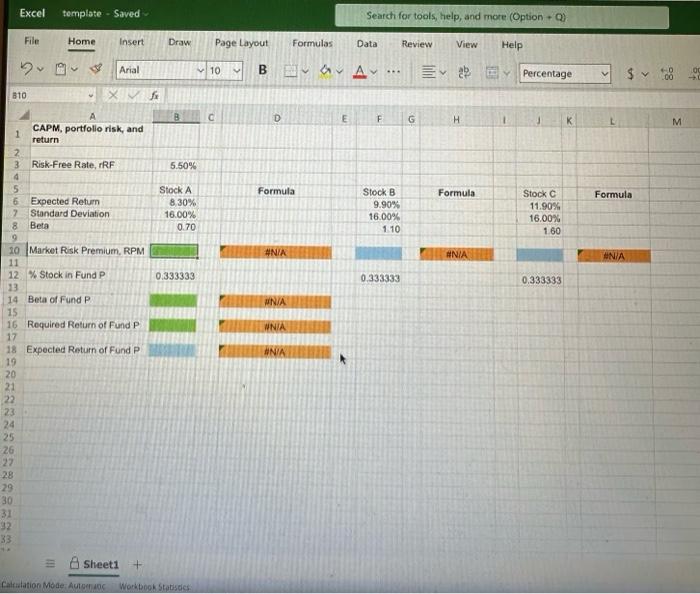
Excel Online Structured Activity: CAPM, portfolio risk, and return Consider the following information for three stocks, Stocks A, B, and C. The returns on the three stocks are positively correlated, but they are not perfectly correlated. (That is, each of the correlation coefficients is between 0 and 1. ) Fund P has one-third of its funds invested in each of the three stocks. The risk-free rate is 5.5%, and the market is in equilbrium. (That is, required returns equal expected returns.) The data has been collocted in the Microsoft Excel Online file belaw. Open the sarnadsheet and perform the required analysis to answer the questions below. Open spreadsheet e. What is the tharket nsk premium (rN/rfr) ? Round your answer to two decimal places: b. What is the beta of fund P7 Do not round intermediate caloulations. Round your answer ta two decimal places. c. What is the required return of Fund P? Do not round intermadiate caiculations. Hound your agswer to two decumal places. 4 d. Would you expect the standars deviation of fund pro be less than 16%, equal to dow. greater than 16% ? f. less than 16% Fund P has one-third of its funds invested in each of the three stocks. The risk-free rate is 5.5%, and the market is in equilibrium, (That is, required returns equal expected returns.) The data has been collected in the Microsoft Excel Online flie below. Open the spreadsheet and perform the required aralysis to answer the questions below. Open spreodsheet 1. What is the market risk premium (fM+fp) ? Round your answer to two decimal places. % b. What is the beta of Fund P? Do not round intermediate calculations. Round your answer ta two decimal places. c. What is the required return of Fund PT Do not round intermediate calculations. Round your answer to two decimal places. d. Would you expect the standard deviaton of Fund P to be less than 16%, equal to 16%, or greater than 16% ? 1. less than 16% 1. greater than 16% III. equal to 16% Excel Online Structured Activity: CAPM, portfolio risk, and return Consider the following information for three stocks, Stocks A, B, and C. The returns on the three stocks are positively correlated, but they are not perfectly correlated. (That is, each of the correlation coefficients is between 0 and 1. ) Fund P has one-third of its funds invested in each of the three stocks. The risk-free rate is 5.5%, and the market is in equilbrium. (That is, required returns equal expected returns.) The data has been collocted in the Microsoft Excel Online file belaw. Open the sarnadsheet and perform the required analysis to answer the questions below. Open spreadsheet e. What is the tharket nsk premium (rN/rfr) ? Round your answer to two decimal places: b. What is the beta of fund P7 Do not round intermediate caloulations. Round your answer ta two decimal places. c. What is the required return of Fund P? Do not round intermadiate caiculations. Hound your agswer to two decumal places. 4 d. Would you expect the standars deviation of fund pro be less than 16%, equal to dow. greater than 16% ? f. less than 16% Fund P has one-third of its funds invested in each of the three stocks. The risk-free rate is 5.5%, and the market is in equilibrium, (That is, required returns equal expected returns.) The data has been collected in the Microsoft Excel Online flie below. Open the spreadsheet and perform the required aralysis to answer the questions below. Open spreodsheet 1. What is the market risk premium (fM+fp) ? Round your answer to two decimal places. % b. What is the beta of Fund P? Do not round intermediate calculations. Round your answer ta two decimal places. c. What is the required return of Fund PT Do not round intermediate calculations. Round your answer to two decimal places. d. Would you expect the standard deviaton of Fund P to be less than 16%, equal to 16%, or greater than 16% ? 1. less than 16% 1. greater than 16% III. equal to 16%
Step by Step Solution
There are 3 Steps involved in it

Get step-by-step solutions from verified subject matter experts
 Study Help