







Question: the operand types are not the same is always real. When they are the same, the EXAMPLE 3 . 2 A Grammar for Simple Assignment
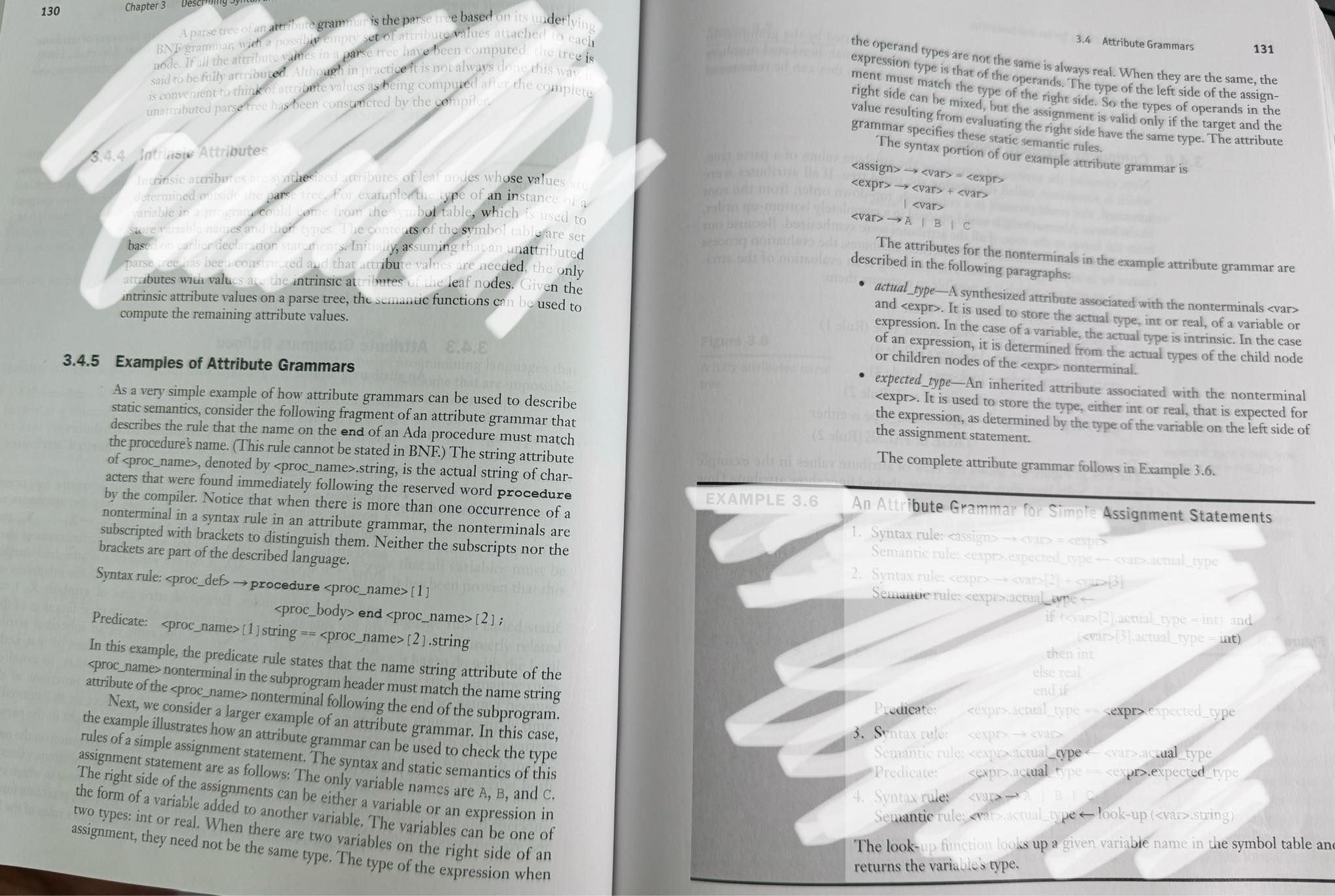
the operand types are not the same is always real. When they are the same, the EXAMPLE
A Grammar for Simple Assignment Statements
The grammar of Example describes assignment statements whose right
sides are arithmetic expressions with multiplication and addition operators and
parentheses. For example, the statement
is generated by the leftmost derivation:
assign
Write an attribute grammar whose base BNF is that of Example and
whose type rules are the same as for the assignment statement example
of Section
expression type is that of the operands. The type of the left side of the assign
ment must match the type of the right side. So the types of operands in the
right side can be mixed, but the assignment is valid only if the target and the
value resulting from evaluating the right side have the same type. The attribute
grammar specifies these static semantic rules.
The syntax pertion of our example attribute grammar is
The attributes for the nonterminals in the example attribute grammar are
described in the following paragraphs:
actualtypeA synthesized attribute associated with the nonterminals Syntax rule: procedure
end ;
Predicate: string ame string
Step by Step Solution
There are 3 Steps involved in it
1 Expert Approved Answer
Step: 1 Unlock

Question Has Been Solved by an Expert!
Get step-by-step solutions from verified subject matter experts
Step: 2 Unlock
Step: 3 Unlock
 Study Help