







Question: The operation Perm(w), applied to a string w, is all strings that can be constructed by permuting the symbols of w in any order. For
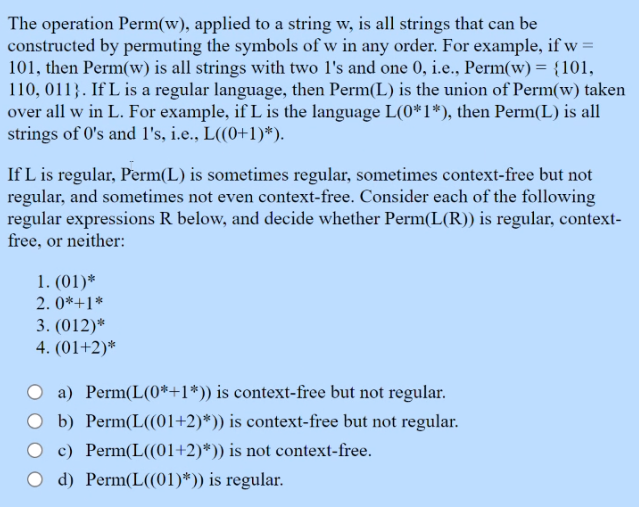
The operation Perm(w), applied to a string w, is all strings that can be constructed by permuting the symbols of w in any order. For example, if w= 101 , then Perm(w) is all strings with two 1 's and one 0 , i.e., Perm(w) ={101, 110,011}. If L is a regular language, then Perm(L) is the union of Perm(w) taken over all w in L. For example, if L is the language L(01), then Perm (L) is all strings of 0 's and 1 's, i.e., L((0+1)). If L is regular, Perm (L) is sometimes regular, sometimes context-free but not regular, and sometimes not even context-free. Consider each of the following regular expressions R below, and decide whether Perm(L(R)) is regular, contextfree, or neither: 1. (01) 2. 0+1 3. (012) 4. (01+2) a) Perm(L(0+1)) is context-free but not regular. b) Perm(L((01+2))) is context-free but not regular. c) Perm(L((01+2))) is not context-free. d) Perm(L((01))) is regular
Step by Step Solution
There are 3 Steps involved in it

Get step-by-step solutions from verified subject matter experts
 Study Help