Question: The other selection strategy is called noncompensatory. Instead of adding the scores on all of the assessments, a noncompensatory strategy establishes cutoffs for each assessment.
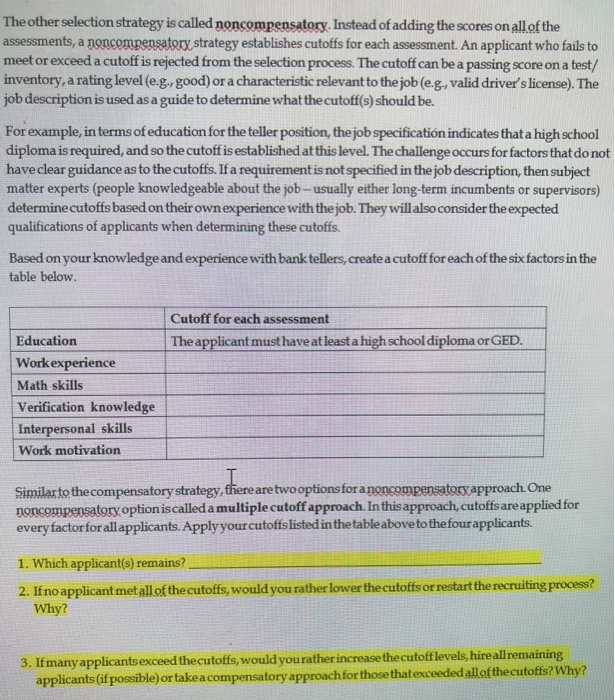
The other selection strategy is called noncompensatory. Instead of adding the scores on all of the assessments, a noncompensatory strategy establishes cutoffs for each assessment. An applicant who fails to meet or exceed a cutoff is rejected from the selection process. The cutoff can be a passing score on a test/ inventory, a rating level (e.g., good) or a characteristic relevant to the job (e.g., valid driver's license). The job description is used as a guide to determine what the cutoff(s) should be. For example, in terms of education for the teller position, the job specification indicates that a high school diploma is required, and so the cutoff is established at this level. The challenge occurs for factors that do not have clear guidance as to the cutoffs. If a requirement is not specified in the job description, then subject matter experts (people knowledgeable about the job - usually either long-term incumbents or supervisors) determine cutoffs based on their own experience with thejob. They will also consider the expected qualifications of applicants when determining these cutoffs. Based on your knowledge and experience with bank tellers, create a cutoff for each of the six factors in the table below. Cutoff for each assessment Education The applicant must have at least a high school diploma or GED. Workexperience Math skills Verification knowledge Interpersonal skills Work motivation I Similar to the compensatory strategy, there are two options fora noncompensatory approach. One noncompensatory option is called a multiple cutoff approach. In this approach, cutoffs are applied for every factor for all applicants. Apply your cutoffs listed in the table above to the four applicants. 1. Which applicant(s) remains? 2. If no applicant met all of the cutoffs, would you rather lower the cutoffs or restart the recruiting process? Why? 3. If many applicants exceed thecutoffs, would yourather increase the cutofflevels, hire all remaining applicants (if possible) or take a compensatory approach for those that exceeded allofthecutoffs? Why? The other selection strategy is called noncompensatory. Instead of adding the scores on all of the assessments, a noncompensatory strategy establishes cutoffs for each assessment. An applicant who fails to meet or exceed a cutoff is rejected from the selection process. The cutoff can be a passing score on a test/ inventory, a rating level (e.g., good) or a characteristic relevant to the job (e.g., valid driver's license). The job description is used as a guide to determine what the cutoff(s) should be. For example, in terms of education for the teller position, the job specification indicates that a high school diploma is required, and so the cutoff is established at this level. The challenge occurs for factors that do not have clear guidance as to the cutoffs. If a requirement is not specified in the job description, then subject matter experts (people knowledgeable about the job - usually either long-term incumbents or supervisors) determine cutoffs based on their own experience with thejob. They will also consider the expected qualifications of applicants when determining these cutoffs. Based on your knowledge and experience with bank tellers, create a cutoff for each of the six factors in the table below. Cutoff for each assessment Education The applicant must have at least a high school diploma or GED. Workexperience Math skills Verification knowledge Interpersonal skills Work motivation I Similar to the compensatory strategy, there are two options fora noncompensatory approach. One noncompensatory option is called a multiple cutoff approach. In this approach, cutoffs are applied for every factor for all applicants. Apply your cutoffs listed in the table above to the four applicants. 1. Which applicant(s) remains? 2. If no applicant met all of the cutoffs, would you rather lower the cutoffs or restart the recruiting process? Why? 3. If many applicants exceed thecutoffs, would yourather increase the cutofflevels, hire all remaining applicants (if possible) or take a compensatory approach for those that exceeded allofthecutoffs? Why









 Study Help