







Question: The parameter values represent a decision for which fixed costs are $ 2 5 0 , 0 0 0 . The image shows a graph
The parameter values represent a decision for which fixed costs are $
The image shows a graph of the total cost of inhouse production and the total cost of outsourcing. The fixed costs of inhouse production are $ and the variable cost per unit is $ The fixed costs of outsourcing are $ and the variable cost per unit is $
The breakeven point is the point at which the two lines intersect. At this point, the total cost of inhouse production is equal to the total cost of outsourcing. The breakeven point in this case is units.
For quantities above the breakeven point, inhouse production is less expensive. For quantities below the breakeven point, outsourcing is less expensive.
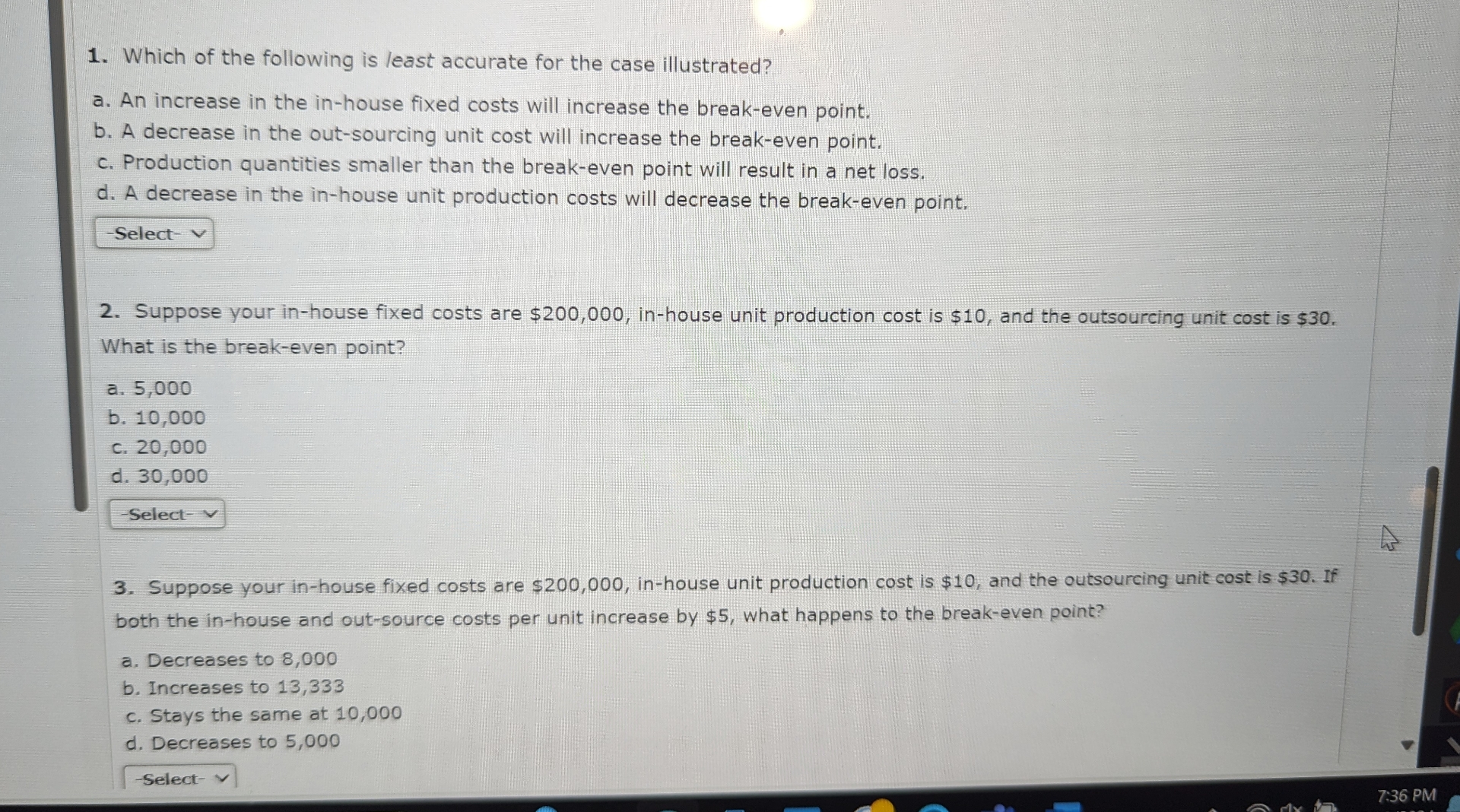
The parameter values represent a decision for which fixed costs are $ This means that the decisionmaker is considering whether to produce inhouse or outsource. If the decisionmaker believes that they will produce more than units, then they should choose to produce inhouse. If the decisionmaker believes that they will produce fewer than units, then they should choose to outsource.Which of the following is least accurate for the case illustrated?
a An increase in the inhouse fixed costs will increase the breakeven point.
b A decrease in the outsourcing unit cost will increase the breakeven point.
c Production quantities smaller than the breakeven point will result in a net loss.
d A decrease in the inhouse unit production costs will decrease the breakeven point.
Suppose your inhouse fixed costs are $ inhouse unit production cost is $ and the outsourcing unit cost is $ What is the breakeven point?
a
b
c
d
Select
Suppose your inhouse fixed costs are $ inhouse unit production cost is $ and the outsourcing unit cost is $ If both the inhouse and outsource costs per unit increase by $ what happens to the breakeven point?
a Decreases to
b Increases to
c Stays the same at
d Decreases to
Step by Step Solution
There are 3 Steps involved in it
1 Expert Approved Answer
Step: 1 Unlock

Question Has Been Solved by an Expert!
Get step-by-step solutions from verified subject matter experts
Step: 2 Unlock
Step: 3 Unlock
 Study Help