







Question: The pendulum oscillation is described by the initial - value problem consisting of the equation of motion with initial conditions: + g L s i
The pendulum oscillation is described by the initialvalue problem consisting of the equation of motion
with initial conditions:
Here, is the length of the pendulum, acceleration due to gravity, the angle the pendulum makes
with the vertical, the initial angular displacement, and the initial angular velocity.
a Transform the secondorder initialvalue problem into a system of firstorder initialvalue
problems.
b Compute the angular displacement and angular velocity using the forward
Euler method with step size Use rad, and
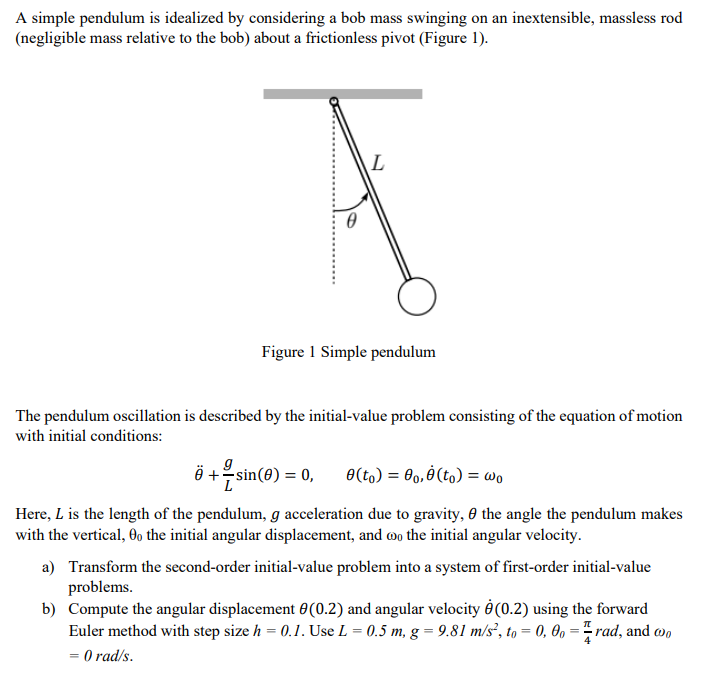
help please A simple pendulum is idealized by considering a bob mass swinging on an inextensible, massless rod negligible mass relative to the bob about a frictionless pivot Figure Figure Simple pendulum The pendulum oscillation is described by the initialvalue problem consisting of the equation of motion with initial conditions:
theta gLsin theta theta ttheta theta tomega
Here, L is the length of the pendulum, g acceleration due to gravity, theta the angle the pendulum makes with the vertical, theta the initial angular displacement, and omega the initial angular velocity. a Transform the secondorder initialvalue problem into a system of firstorder initialvalue problems. b Compute the angular displacement theta and angular velocity theta using the forward Euler method with step size h Use Lm gm s ttheta pi r a d and omega rad s
Step by Step Solution
There are 3 Steps involved in it
1 Expert Approved Answer
Step: 1 Unlock

Question Has Been Solved by an Expert!
Get step-by-step solutions from verified subject matter experts
Step: 2 Unlock
Step: 3 Unlock
 Study Help