







Question: - The percentage utilization for the sequence developed using the FCFS rule = __% (enter your response as a percentage rounded to two decimal places).
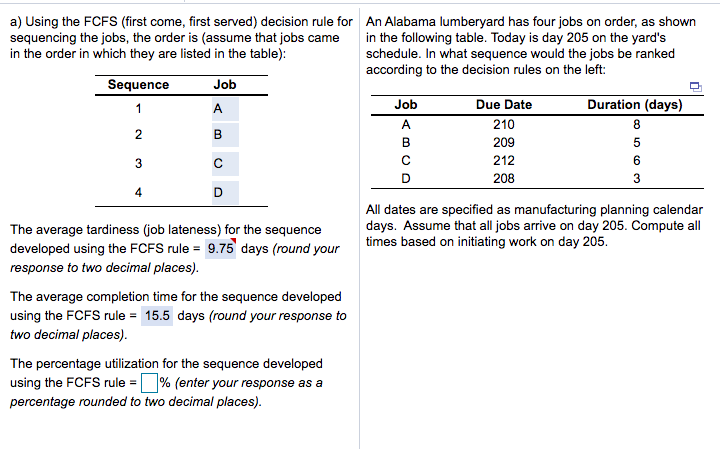
- The percentage utilization for the sequence developed using the FCFS rule = __%
(enter your response as a percentage rounded to two decimal places).
- The average number of jobs in the system for the sequence developed using the FCFS rule = ___ jobs
(round your response to two decimal places).
- The average tardiness (job lateness) for the sequence developed using the FCFS rule =____ days
(round your response to two decimal places).
b) Using the EDD (earliest due date) decision rule for sequencing the jobs, the order is (to resolve a tie, use the order in which the jobs were received):
The total flow time for the sequence developed using the EDD rule = ___ days (round your response to two decimal places).
- The percentage utilization for the sequence developed using the EDD rule = ______ %
(enter your response as a percentage rounded to two decimal places).
- The average number of jobs in the system for the sequence developed using the EDD rule = ___jobs (round your response to two decimal places).
- The average tardiness (job lateness) for the sequence developed using the EDD rule = _____ days (round your response to two decimal places).
c) Using the SPT (shortest processing time) decision rule for sequencing the jobs, the order is (to resolve atie, use the order in which the jobs were received):
- The total flow time for the sequence developed using the SPT rule = ____ days (round your response to two decimal places).
- The percentage utilization for the sequence developed using the SPT rule = _____%
(enter your response as a percentage rounded to two decimal places).
- The average number of jobs in the system for the sequence developed using the SPT rule = ____ jobs (round your response to two decimal places).
- The average tardiness (job lateness) for the sequence developed using the SPT rule = _____ days (round your response to two decimal places).
d) Using the LPT (longest processing time) decision rule for sequencing the jobs, the order is (to resolve atie, use the order in which the jobs were received):
- The total flow time for the sequence developed using the LPT rule = ___ days (round your response to two decimal places).
- The percentage utilization for the sequence developed using the LPT rule = ____%
(enter your response as a percentage rounded to two decimal places).
- The average number of jobs in the system for the sequence developed using the LPT rule = _____ jobs (round your response to two decimal places).
2 B 8 5 B 3 C a) Using the FCFS (first come, first served) decision rule for An Alabama lumberyard has four jobs on order, as shown sequencing the jobs, the order is (assume that jobs came in the following table. Today is day 205 on the yard's in the order in which they are listed in the table): schedule. In what sequence would the jobs be ranked according to the decision rules on the left: Sequence Job 1 Job Due Date Duration (days) 210 209 212 6 D 208 3 D All dates are specified as manufacturing planning calendar The average tardiness (job lateness) for the sequence days. Assume that all jobs arrive on day 205. Compute all developed using the FCFS rule = 9.75 days (round your times based on initiating work on day 205. response to two decimal places). The average completion time for the sequence developed using the FCFS rule = 15.5 days (round your response to two decimal places). The percentage utilization for the sequence developed using the FCFS rule =% (enter your response as a percentage rounded to two decimal places)Step by Step Solution
There are 3 Steps involved in it

Get step-by-step solutions from verified subject matter experts
 Study Help