







Question: the perceptual process prospective. Case Study Case 3.1: Space Utilization Mr. Sherman Adder, assistant plant manager for Frame Manufacturing Company, is chairperson of the
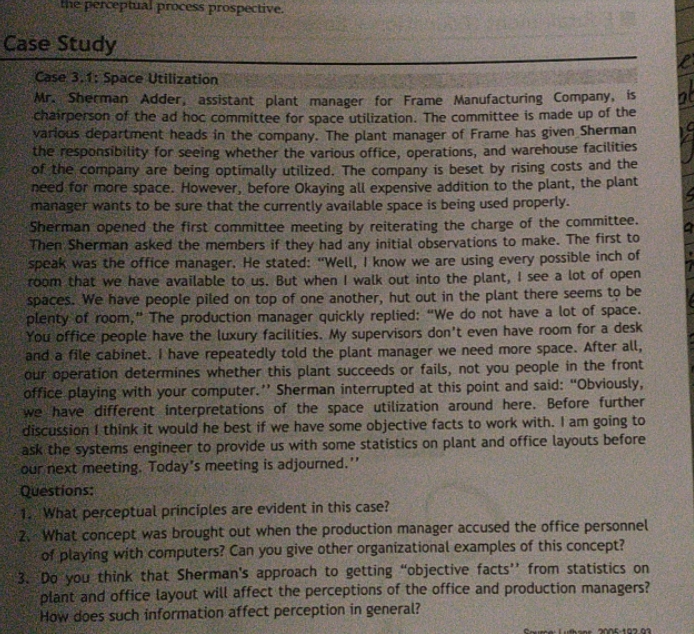
the perceptual process prospective. Case Study Case 3.1: Space Utilization Mr. Sherman Adder, assistant plant manager for Frame Manufacturing Company, is chairperson of the ad hoc committee for space utilization. The committee is made up of the various department heads in the company. The plant manager of Frame has given Sherman the responsibility for seeing whether the various office, operations, and warehouse facilities of the company are being optimally utilized. The company is beset by rising costs and the need for more space. However, before Okaying all expensive addition to the plant, the plant manager wants to be sure that the currently available space is being used properly. Sherman opened the first committee meeting by reiterating the charge of the committee. Then Sherman asked the members if they had any initial observations to make. The first to speak was the office manager. He stated: "Well, I know we are using every possible inch of room that we have available to us. But when I walk out into the plant, I see a lot of open spaces. We have people piled on top of one another, hut out in the plant there seems to be plenty of room," The production manager quickly replied: "We do not have a lot of space. You office people have the luxury facilities. My supervisors don't even have room for a desk and a file cabinet. I have repeatedly told the plant manager we need more space. After all, our operation determines whether this plant succeeds or fails, not you people in the front office playing with your computer." Sherman interrupted at this point and said: "Obviously, we have different interpretations of the space utilization around here. Before further discussion I think it would he best if we have some objective facts to work with. I am going to ask the systems engineer to provide us with some statistics on plant and office layouts before our next meeting. Today's meeting is adjourned." Questions: 1. What perceptual principles are evident in this case? 2. What concept was brought out when the production manager accused the office personnel of playing with computers? Can you give other organizational examples of this concept? 3. Do you think that Sherman's approach to getting "objective facts" from statistics on plant and office layout will affect the perceptions of the office and production managers? How does such information affect perception in general? one 2005-102.03
Step by Step Solution
There are 3 Steps involved in it

Get step-by-step solutions from verified subject matter experts
 Study Help