



Question: The points possible in the individual questions in this assignment add to 20 points. Your total earned points for this assignment will be converted to
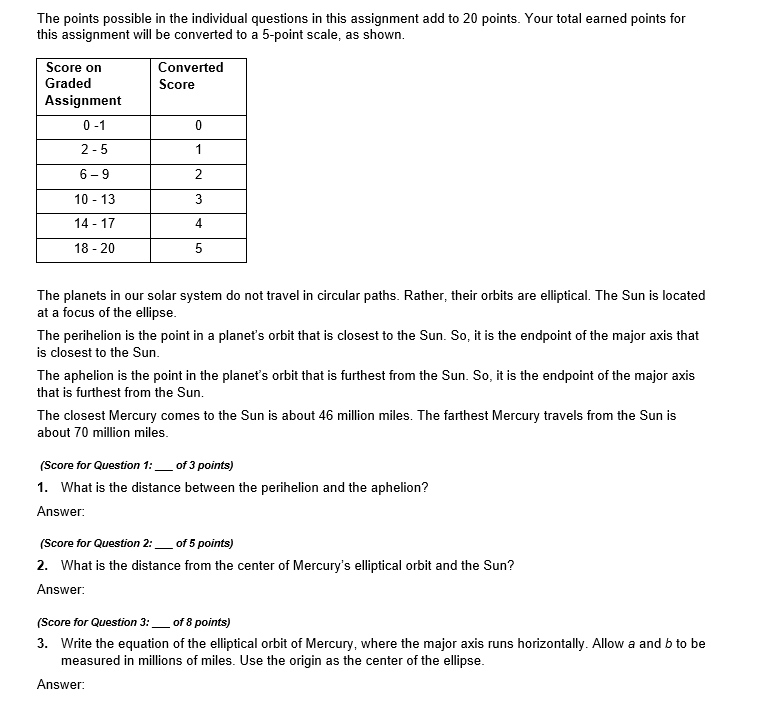
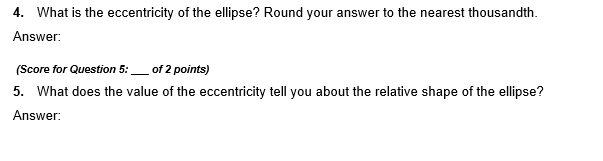
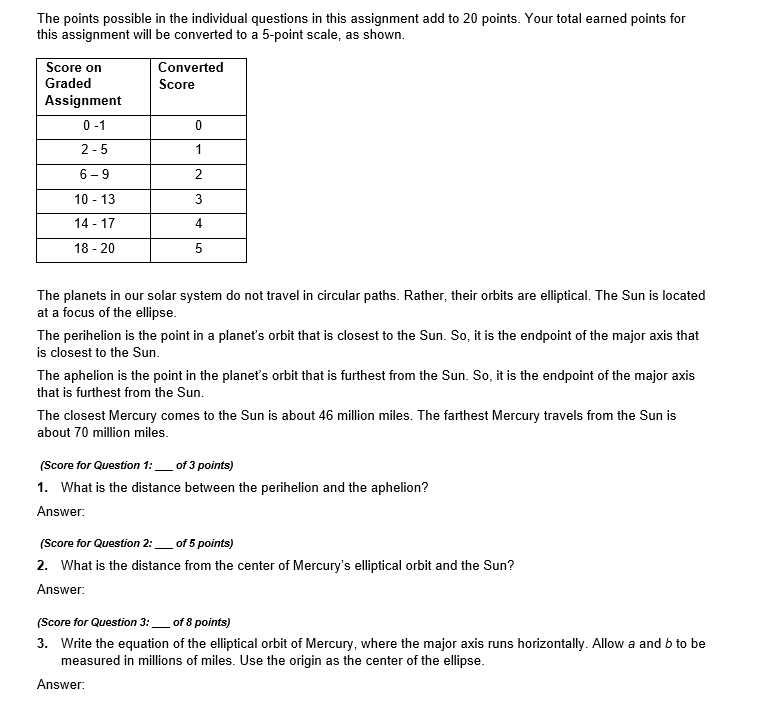
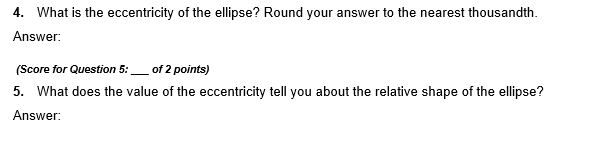
The points possible in the individual questions in this assignment add to 20 points. Your total earned points for this assignment will be converted to a 5-point scale, as shown. Score on Converted Graded Score Assignment 0-1 0 2 -5 1 6 -9 2 10 - 13 3 14 - 17 4 18 - 20 5 The planets in our solar system do not travel in circular paths. Rather, their orbits are elliptical. The Sun is located at a focus of the ellipse. The perihelion is the point in a planet's orbit that is closest to the Sun. So, it is the endpoint of the major axis that is closest to the Sun. The aphelion is the point in the planet's orbit that is furthest from the Sun. So, it is the endpoint of the major axis that is furthest from the Sun. The closest Mercury comes to the Sun is about 46 million miles. The farthest Mercury travels from the Sun is about 70 million miles. (Score for Question 1: _ of 3 points) 1. What is the distance between the perihelion and the aphelion? Answer: (Score for Question 2: _ of 5 points) 2. What is the distance from the center of Mercury's elliptical orbit and the Sun? Answer: (Score for Question 3: _ of 8 points) 3. Write the equation of the elliptical orbit of Mercury, where the major axis runs horizontally. Allow a and b to be measured in millions of miles. Use the origin as the center of the ellipse. Answer:4. What is the eccentricity of the ellipse? Round your answer to the nearest thousandth. Answer. (Score for Question 5: _ of 2 points) 5. What does the value of the eccentricity tell you about the relative shape of the ellipse
Step by Step Solution
There are 3 Steps involved in it

Get step-by-step solutions from verified subject matter experts