



Question: (The primal-dual algorithm for congestion control) Consider the following congestion control algorithm: xr=r(xrwrqr),pl=hl(ylcl)Pl+, where qr=l:lerpl,yl=r:lerxr, and r and hl are positive constants. This algorithm is
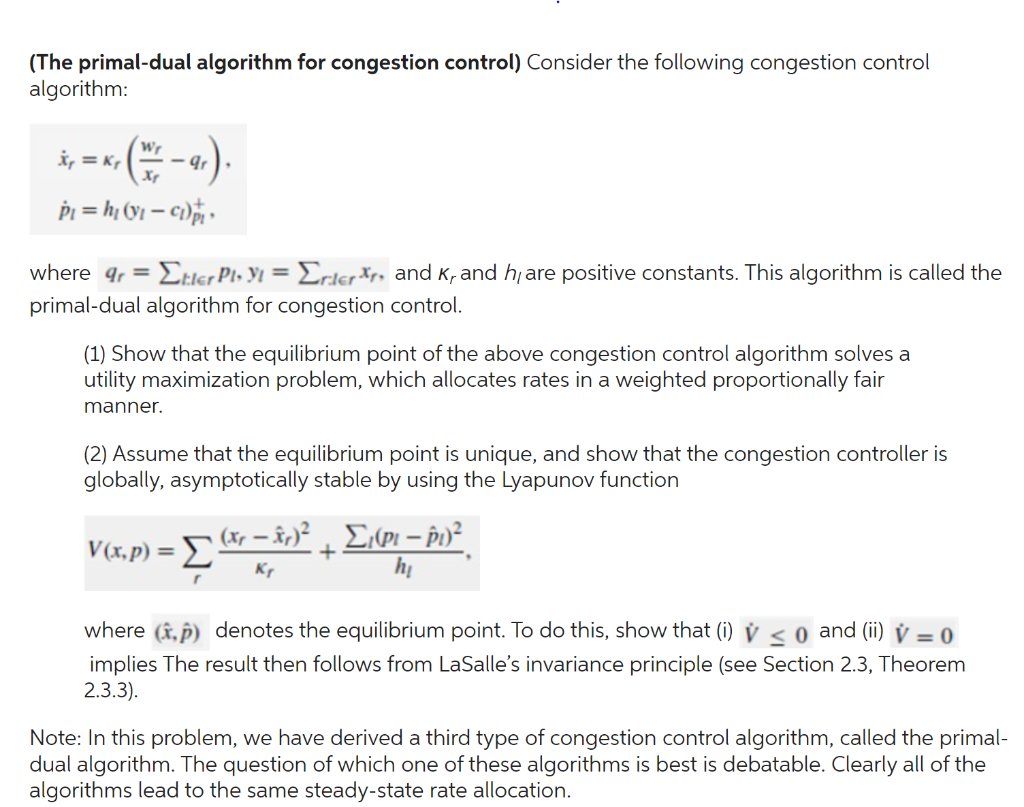
(The primal-dual algorithm for congestion control) Consider the following congestion control algorithm: xr=r(xrwrqr),pl=hl(ylcl)Pl+, where qr=l:lerpl,yl=r:lerxr, and r and hl are positive constants. This algorithm is called the primal-dual algorithm for congestion control. (1) Show that the equilibrium point of the above congestion control algorithm solves a utility maximization problem, which allocates rates in a weighted proportionally fair manner. (2) Assume that the equilibrium point is unique, and show that the congestion controller is globally, asymptotically stable by using the Lyapunov function V(x,p)=rr(xrx^r)2+hll(plp^l)2, where (x^,p^) denotes the equilibrium point. To do this, show that (i) V0 and (ii) V=0 implies The result then follows from LaSalle's invariance principle (see Section 2.3, Theorem 2.3.3). Note: In this problem, we have derived a third type of congestion control algorithm, called the primal dual algorithm. The question of which one of these algorithms is best is debatable. Clearly all of the algorithms lead to the same steady-state rate allocation
Step by Step Solution
There are 3 Steps involved in it

Get step-by-step solutions from verified subject matter experts