







Question: The primary keys I have included Works , Best_works , Memeber_museums , Artists , Country , Master_list , Loan_item , loan_report , and Appraisal .
The primary keys I have included Works, Best_works, Memeber_museums, Artists, Country, Master_list, Loan_item, loan_report, and Appraisal. not sure if I have identified all of them correctly. Still, I would appreciate some assistance on how to go about doing this. Thank you!
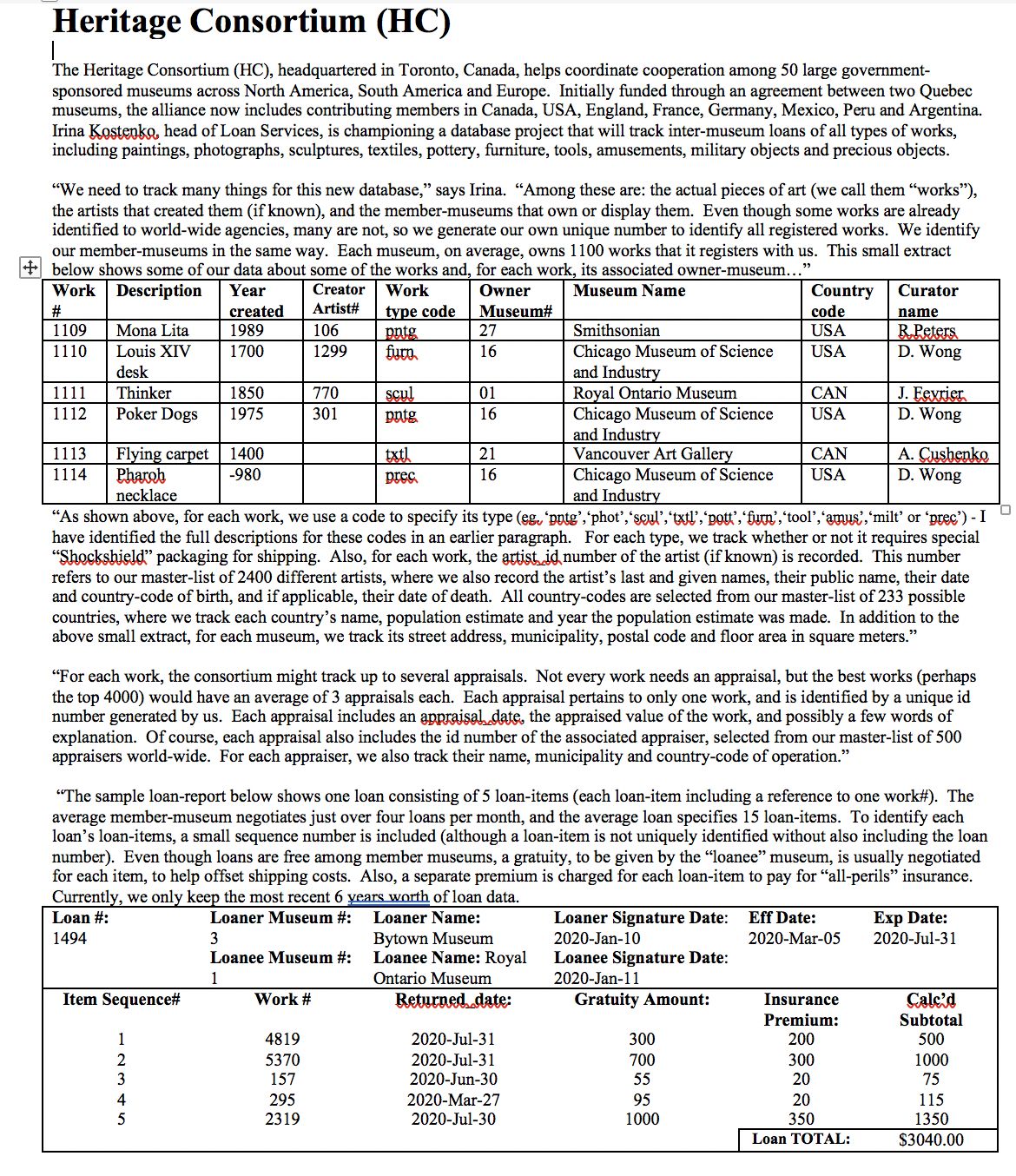
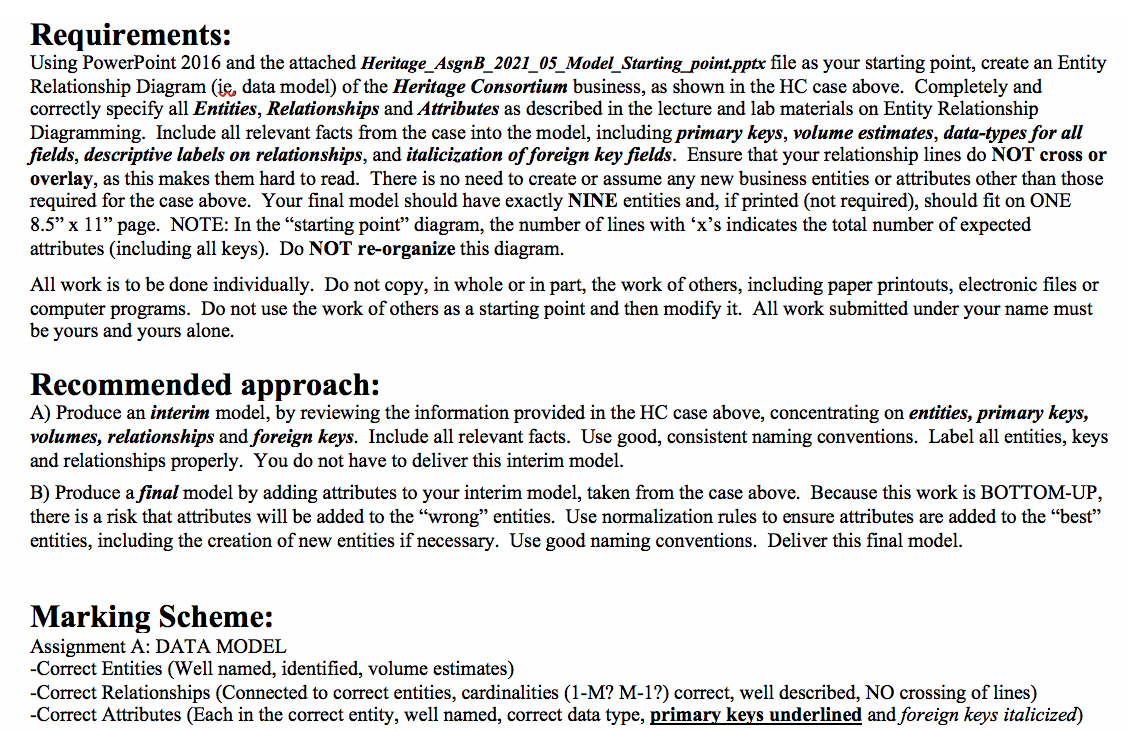
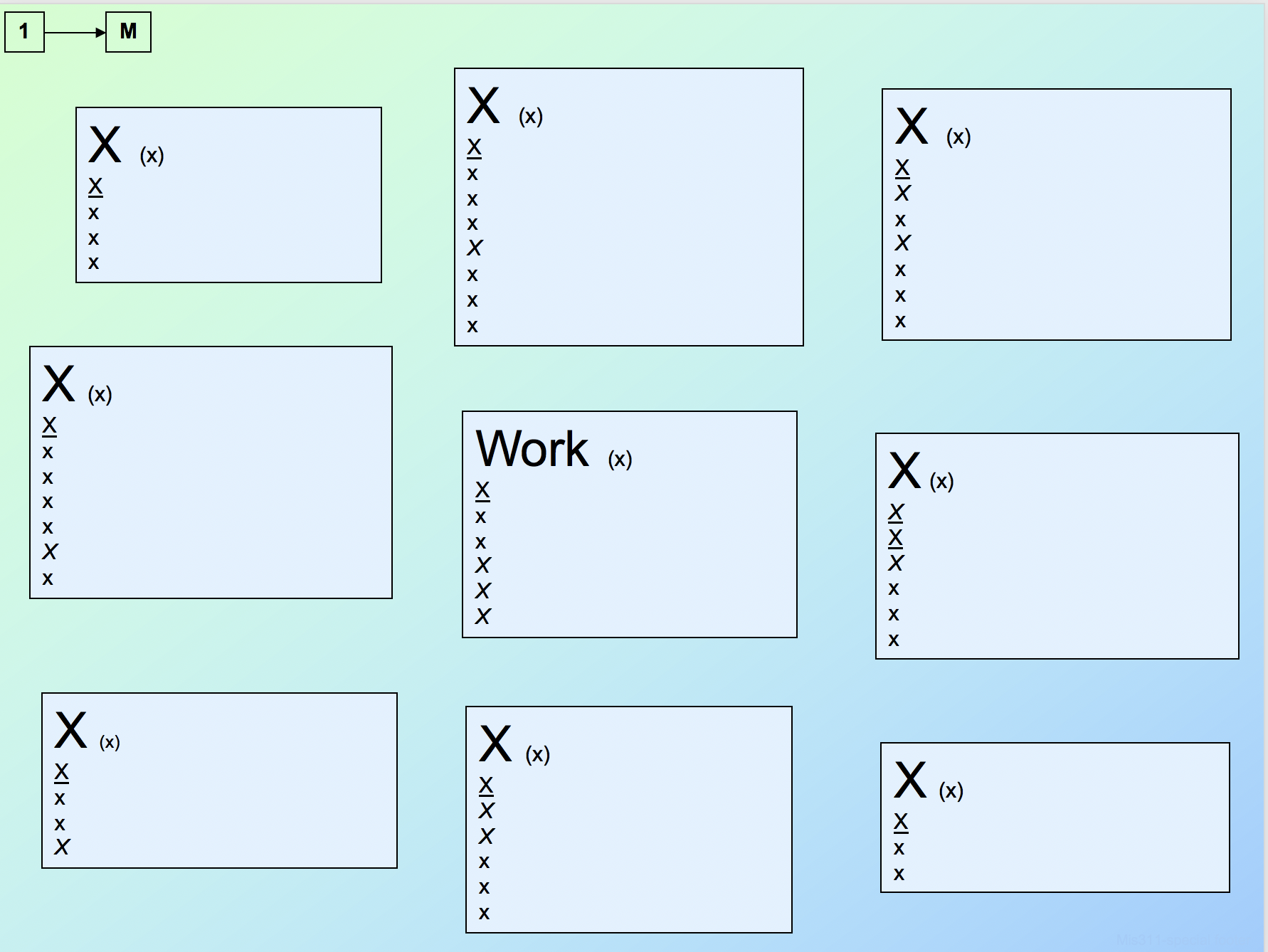
Heritage Consortium (HC) The Heritage Consortium (HC), headquartered in Toronto, Canada, helps coordinate cooperation among 50 large government- sponsored museums across North America, South America and Europe. Initially funded through an agreement between two Quebec museums, the alliance now includes contributing members in Canada, USA, England, France, Germany, Mexico, Peru and Argentina. Irina Kostenko, head of Loan Services, is championing a database project that will track inter-museum loans of all types of works, including paintings, photographs, sculptures, textiles, pottery, furniture, tools, amusements, military objects and precious objects. "We need to track many things for this new database," says Irina. "Among these are: the actual pieces of art (we call them "works"), the artists that created them (if known), and the member-museums that own or display them. Even though some works are already identified to world-wide agencies, many are not, so we generate our own unique number to identify all registered works. We identify our member-museums in the same way. Each museum, on average, owns 1100 works that it registers with us. This small extract below shows some of our data about some of the works and, for each work, its associated owner-museum... Work Description Year Creator Work Owner Museum Name Country Curator # created Artist# type code Museum# code name 1109 Mona Lita 1989 106 ontg 27 Smithsonian USA R Peters 1110 Louis XIV 1700 1299 16 Chicago Museum of Science USA D. Wong desk and Industry 1111 Thinker 1850 770 scul 01 Royal Ontario Museum CAN J. Fexrier 1112 Poker Dogs 1975 301 16 Chicago Museum of Science USA D. Wong and Industry 1113 Flying carpet | 1400 txtl 21 Vancouver Art Gallery CAN A. Cushenko 1114 Pharob 980 preC 16 Chicago Museum of Science USA D. Wong necklace and Industry "As shown above, for each work, we use a code to specify its type (eg. 'putg', phot', 'scul', "tal', pott', fun', tool', "amus', milt' or "prec') - I have identified the full descriptions for these codes in an earlier paragraph. For each type, we track whether or not it requires special "Shockshield" packaging for shipping. Also, for each work, the artist id number of the artist (if known) is recorded. This number refers to our master-list of 2400 different artists, where we also record the artist's last and given names, their public name, their date and country-code of birth, and if applicable, their date of death. All country-codes are selected from our master-list of 233 possible countries, where we track each country's name, population estimate and year the population estimate was made. In addition to the above small extract, for each museum, we track its street address, municipality, postal code and floor area in square meters." "For each work, the consortium might track up to several appraisals. Not every work needs an appraisal, but the best works (perhaps the top 4000) would have an average of 3 appraisals each. Each appraisal pertains to only one work, and is identified by a unique id number generated by us. Each appraisal includes an appraisal date, the appraised value of the work, and possibly a few words of explanation. Of course, each appraisal also includes the id number of the associated appraiser, selected from our master-list of 500 appraisers world-wide. For each appraiser, we also track their name, municipality and country-code of operation." "The sample loan-report below shows one loan consisting of 5 loan-items (each loan-item including a reference to one work#). The average member-museum negotiates just over four loans per month, and the average loan specifies 15 loan-items. To identify each loan's loan-items, a small sequence number is included (although a loan-item is not uniquely identified without also including the loan number). Even though loans are free among member museums, a gratuity, to be given by the "loanee" museum, is usually negotiated for each item, to help offset shipping costs. Also, a separate premium is charged for each loan-item to pay for "all-perils" insurance. Currently, we only keep the most recent 6 years worth of loan data. Loan #: Loaner Museum #: Loaner Name: Loaner Signature Date: Eff Date: Exp Date: 1494 3 Bytown Museum 2020-Jan-10 2020-Mar-05 2020-Jul-31 Loanee Museum #: Loanee Name: Royal Loanee Signature Date: Ontario Museum 2020-Jan-11 Item Sequence# Work # Returned date: Gratuity Amount: Insurance Calc'd Premium: Subtotal 4819 2020-Jul-31 300 200 500 5370 2020-Jul-31 700 300 1000 UAWNE 157 2020-Jun-30 55 20 75 295 2020-Mar-27 95 20 115 2319 2020-Jul-30 1000 $50 1350 Loan TOTAL: $3040.00Requirements: Using PowerPoint 2016 and the attached Hen'tage_AsgnB_2021_ 05_Model_Stnrting_pointppoc le as your starting point, create an Entity Relationship Diagram (ie, data model) of the Heritage Consortium business, as shown in the HC case above. Completely and correctly specify all Entities, Relationships and Attributes as described in the lecture and lab materials on Entity Relationship Diagramming. Include all relevant facts from the case into the model, including primary keys, volume estimates, data-types for all fields, descriptive labels on relationships, and italicization of foreign key elds. Ensure that your relationship lines do NOT cross or overlay, as this makes th' hard to read. There is no need to create or assume any new business entities or attributes other than those required for the case above. Your nal model should have exactly NINE entities and, if printed (not required), should t on ONE 8.5\" x 1 1\" page. NOTE: In the \"starting point\" diagram, the number of lines with 'x's indicates the total number of expected attributes (including all keys). Do NOT rte-organize this diagram. All work is to be done individually. Do not copy, in whole or in part, the work of others, including paper printouts, electronic les or computer programs. Do not use the work of others as a starting point and then modify it. All work submitted under your name must be yours and yours alone. Recommended approach: A) Produce an interim model, by reviewing the information provided in the HC case above, concentrating on entities, primary keys, volumes, relationships and foreign keys. Include all relevant facts. Use good, consistent naming conventions. Label all entities, keys and relationships properly. You do not have to deliver this interim model. B) Produce a final model by adding attributes to your interim model, taken from the case above. Because this work is BOTTOM-UP, there is a risk that attributes will be added to the \"wrong\" entities. Use normalization rules to ensure attributes are added to the \"best\" entities, including the creation of new entities if necessary. Use good naming conventions. Deliver this final model. Marking Scheme: Assignment A: DATA MODEL -Correct Entities (W ell named, identied, volume estimates) -Correct Relationships (Connected to correct entities, cardinalities (l-M? M-l?) correct, well described, NO crossing of lines) -Correct Attributes (Each in the correct entity, well named, correct data type, prima_ry kgys underlined and foreign keys italicized) M 1 X ( x) X ( x) X ( x ) XXX XX XIX XXXXXXX IX XX X IX X ( x) Work (x) X X X XIXIX XXXXXXIX XXXXXIX X (x) X (x) X X IX X X X XXXX XX X IX
Step by Step Solution
There are 3 Steps involved in it

Get step-by-step solutions from verified subject matter experts
 Study Help