







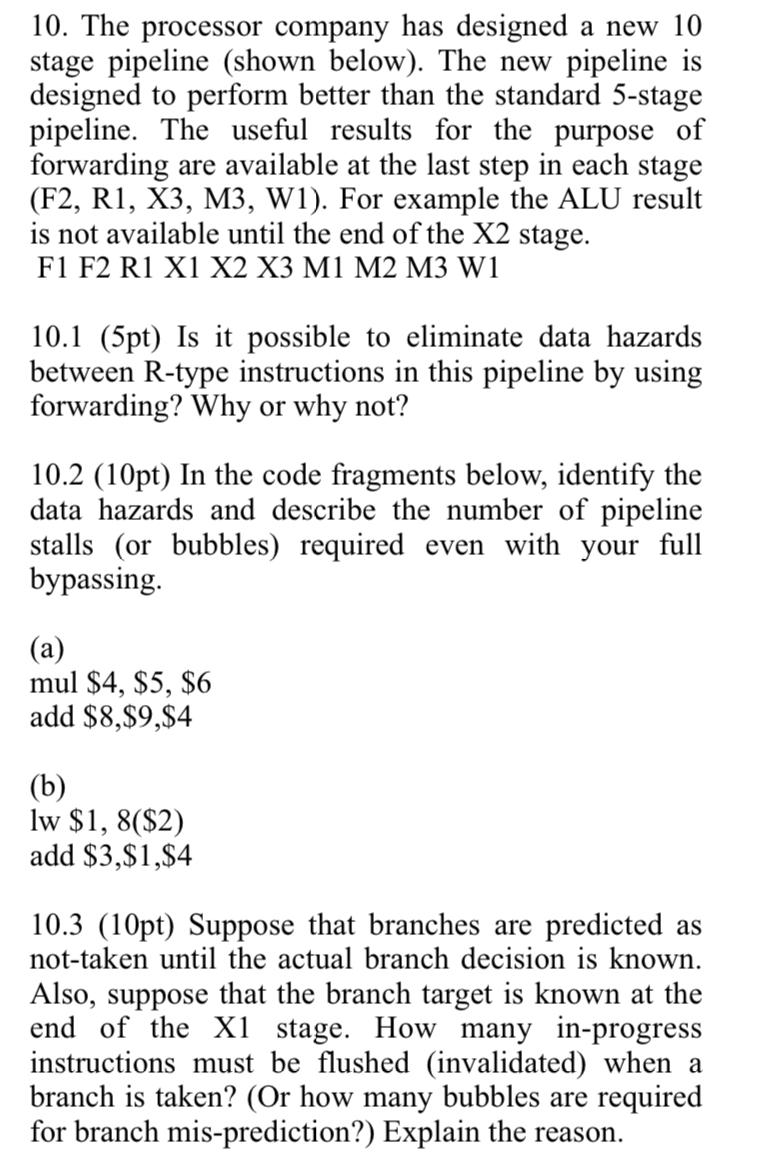
Question: The processor company has designed a new 1 0 stage pipeline ( shown below ) . The new pipeline is designed to perform better than
The processor company has designed a new
stage pipeline shown below The new pipeline is
designed to perform better than the standard stage
pipeline. The useful results for the purpose of
forwarding are available at the last step in each stage
F R X M W For example the ALU result
is not available until the end of the stage.
F F R X X X M M M W
pt Is it possible to eliminate data hazards
between Rtype instructions in this pipeline by using
forwarding? Why or why not?
pt In the code fragments below, identify the
data hazards and describe the number of pipeline
stalls or bubbles required even with your full
bypassing.
a
mul $$$
add $$$
b
lw $$
add $$$
pt Suppose that branches are predicted as
nottaken until the actual branch decision is known.
Also, suppose that the branch target is known at the
end of the X stage. How many inprogress
instructions must be flushed invalidated when a
branch is taken? Or how many bubbles are required
for branch misprediction? Explain the reason.
Step by Step Solution
There are 3 Steps involved in it
1 Expert Approved Answer
Step: 1 Unlock

Question Has Been Solved by an Expert!
Get step-by-step solutions from verified subject matter experts
Step: 2 Unlock
Step: 3 Unlock
 Study Help