







Question: the program thr_atomic.c that it is referring to is below. i only need help with the first part which is above thr_reduce.c this is all
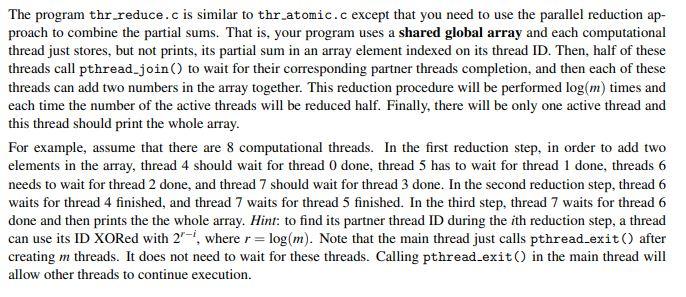
the program "thr_atomic.c" that it is referring to is below. i only need help with the first part which is above "thr_reduce.c"
this is all that was provided
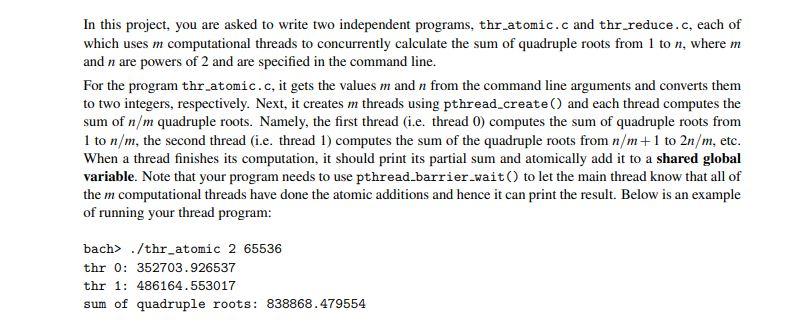
The program thr reduce.c is similar to thr_atomic.c except that you need to use the parallel reduction ap- proach to combine the partial sums. That is, your program uses a shared global array and each computational thread just stores, but not prints, its partial sum in an array element indexed on its thread ID. Then, half of these threads call pthread_join() to wait for their corresponding partner threads completion, and then each of these threads can add two numbers in the array together. This reduction procedure will be performed log(m) times and each time the number of the active threads will be reduced half. Finally, there will be only one active thread and this thread should print the whole array. For example, assume that there are 8 computational threads. In the first reduction step, in order to add two elements in the array, thread 4 should wait for thread 0 done, thread 5 has to wait for thread 1 done, threads 6 needs to wait for thread 2 done, and thread 7 should wait for thread 3 done. In the second reduction step, thread 6 waits for thread 4 finished, and thread 7 waits for thread 5 finished. In the third step, thread 7 waits for thread 6 done and then prints the the whole array. Hint: to find its partner thread ID during the ith reduction step, a thread can use its ID XORed with 2-1, where r = log(m). Note that the main thread just calls pthread.exit() after creating m threads. It does not need to wait for these threads. Calling pthread.exit() in the main thread will allow other threads to continue execution. In this project, you are asked to write two independent programs, thr_atomic.c and thr_reduce.c, each of which uses m computational threads to concurrently calculate the sum of quadruple roots from 1 to n, where m and n are powers of 2 and are specified in the command line. For the program thr_atomic.c, it gets the values m and n from the command line arguments and converts them to two integers, respectively. Next, it creates m threads using pthread_create() and each thread computes the sum of n/m quadruple roots. Namely, the first thread (i.e. thread O) computes the sum of quadruple roots from 1 to n/m, the second thread (i.e. thread 1) computes the sum of the quadruple roots from n/m + 1 to 2n/m, etc. When a thread finishes its computation, it should print its partial sum and atomically add it to a shared global variable. Note that your program needs to use pthread_barrier_wait() to let the main thread know that all of the m computational threads have done the atomic additions and hence it can print the result. Below is an example of running your thread program: bach> ./thr_atomic 2 65536 thr 0: 352703.926537 thr 1: 486164.553017 sum of quadruple roots: 838868.479554 The program thr reduce.c is similar to thr_atomic.c except that you need to use the parallel reduction ap- proach to combine the partial sums. That is, your program uses a shared global array and each computational thread just stores, but not prints, its partial sum in an array element indexed on its thread ID. Then, half of these threads call pthread_join() to wait for their corresponding partner threads completion, and then each of these threads can add two numbers in the array together. This reduction procedure will be performed log(m) times and each time the number of the active threads will be reduced half. Finally, there will be only one active thread and this thread should print the whole array. For example, assume that there are 8 computational threads. In the first reduction step, in order to add two elements in the array, thread 4 should wait for thread 0 done, thread 5 has to wait for thread 1 done, threads 6 needs to wait for thread 2 done, and thread 7 should wait for thread 3 done. In the second reduction step, thread 6 waits for thread 4 finished, and thread 7 waits for thread 5 finished. In the third step, thread 7 waits for thread 6 done and then prints the the whole array. Hint: to find its partner thread ID during the ith reduction step, a thread can use its ID XORed with 2-1, where r = log(m). Note that the main thread just calls pthread.exit() after creating m threads. It does not need to wait for these threads. Calling pthread.exit() in the main thread will allow other threads to continue execution. In this project, you are asked to write two independent programs, thr_atomic.c and thr_reduce.c, each of which uses m computational threads to concurrently calculate the sum of quadruple roots from 1 to n, where m and n are powers of 2 and are specified in the command line. For the program thr_atomic.c, it gets the values m and n from the command line arguments and converts them to two integers, respectively. Next, it creates m threads using pthread_create() and each thread computes the sum of n/m quadruple roots. Namely, the first thread (i.e. thread O) computes the sum of quadruple roots from 1 to n/m, the second thread (i.e. thread 1) computes the sum of the quadruple roots from n/m + 1 to 2n/m, etc. When a thread finishes its computation, it should print its partial sum and atomically add it to a shared global variable. Note that your program needs to use pthread_barrier_wait() to let the main thread know that all of the m computational threads have done the atomic additions and hence it can print the result. Below is an example of running your thread program: bach> ./thr_atomic 2 65536 thr 0: 352703.926537 thr 1: 486164.553017 sum of quadruple roots: 838868.479554
Step by Step Solution
There are 3 Steps involved in it

Get step-by-step solutions from verified subject matter experts
 Study Help