Question: THE PROJECT SCOPE STATEMENT AND WORK BREAKDOWN STRUCTURE IS GIVEN AS PER PMBOK GUIDELINES. THEY PROVIDE GOOD TEMPLATES AS A STARTING POINT FOR DEVELOPING THESE
THE PROJECT SCOPE STATEMENT AND WORK BREAKDOWN STRUCTURE IS GIVEN AS PER PMBOK GUIDELINES. THEY PROVIDE GOOD TEMPLATES AS A STARTING POINT FOR DEVELOPING THESE DOCUMENTS FOR OTHER PROJECTS. USING THESE TEMPLATES, PREPARE PROJECT SCOPE STATEMENT AND WORK BREAKDOWN STRUCTURE OF THE LAST PROJECT YOU WORKED ON.
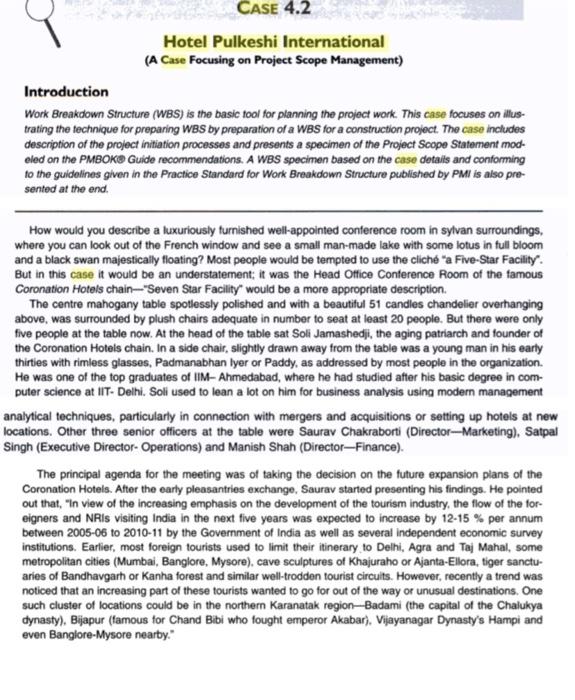
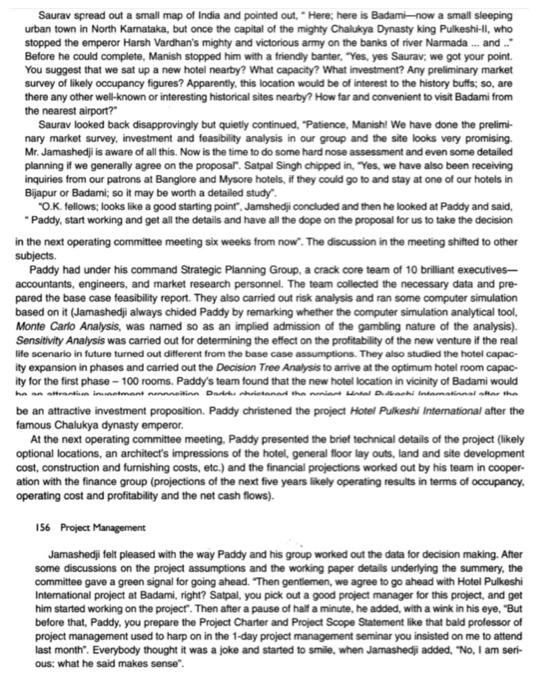
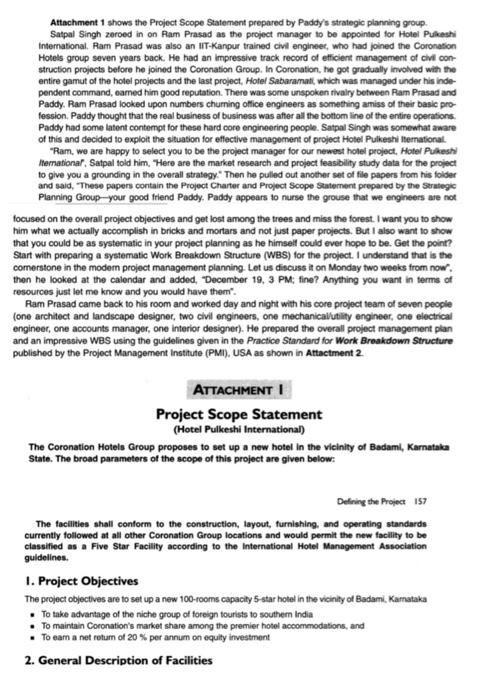
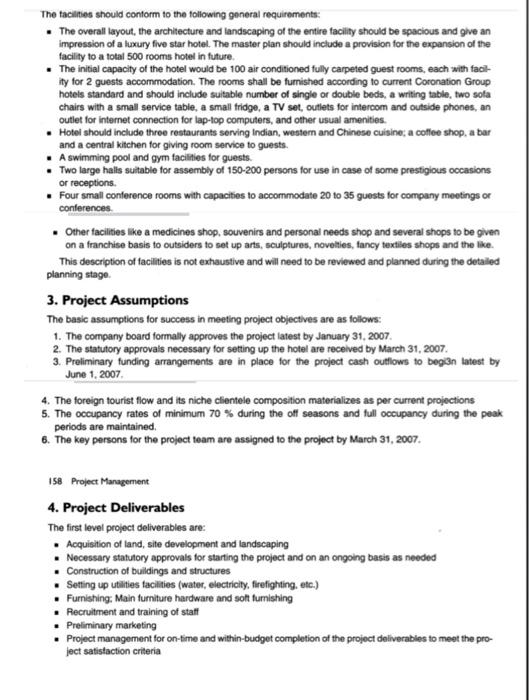
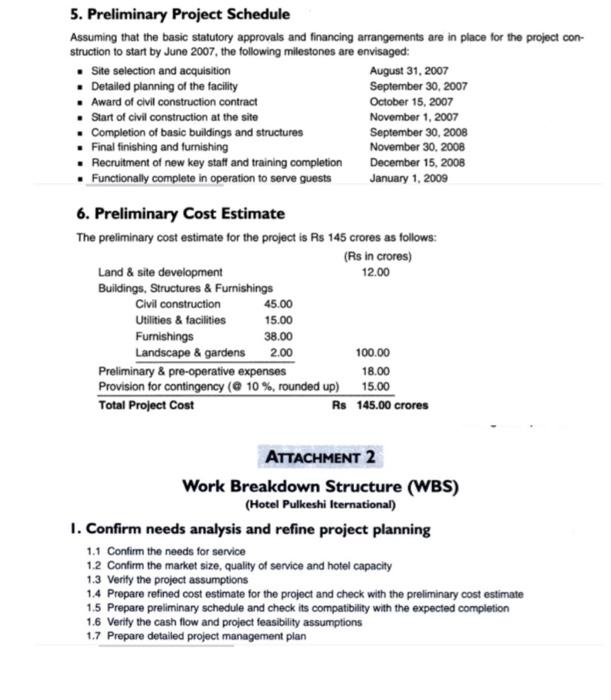
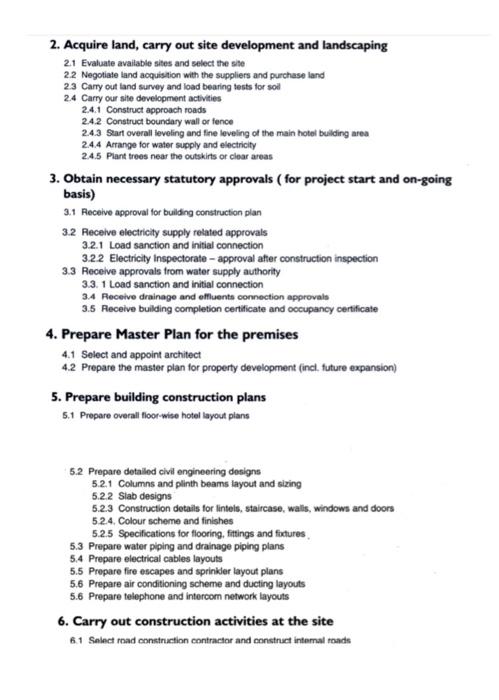
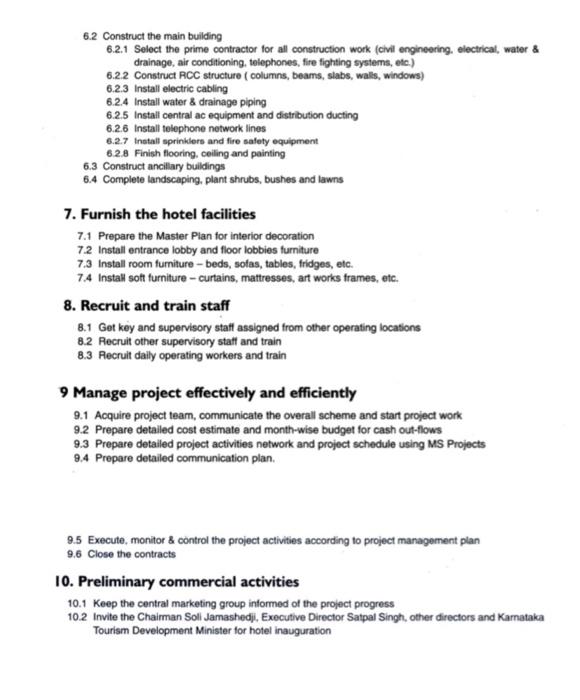
CASE 4.2 Hotel Pulkeshi International (A Case Focusing on Project Scope Management) Introduction Work Breakdown Structure (WBS) is the basic tool for planning the project work. This case focuses on illus- trating the technique for preparing WBS by preparation of a WBS for a construction project. The case includes description of the project initiation processes and presents a specimen of the Project Scope Statement mod- eled on the PMBOK Guide recommendations. A WBS specimen based on the case details and conforming to the guidelines given in the Practice Standard for Work Breakdown Structure published by PMI is also pre- sented at the end. How would you describe a luxuriously turnished well-appointed conference room in sylvan surroundings, where you can look out of the French window and see a small man-made lake with some lotus in full bloom and a black swan majestically floating? Most people would be tempted to use the clich "a Five-Star Facility But in this case it would be an understatement; it was the Head Office Conference Room of the famous Coronation Hotels chain-"Seven Star Facility would be a more appropriate description. The centre mahogany table spotlessly polished and with a beautiful 51 candles chandelier overhanging above, was surrounded by plush chairs adequate in number to seat at least 20 people. But there were only five people at the table now. At the head of the table sat Soli Jamashedji, the aging patriarch and founder of the Coronation Hotels chain. In a side chair, slightly drawn away from the table was a young man in his early thirties with rimless glasses, Padmanabhan lyer or Paddy, as addressed by most people in the organization. He was one of the top graduates of IIM-Ahmedabad, where he had studied after his basic degree in com- puter science at IIT-Delhi. Soli used to lean a lot on him for business analysis using modern management analytical techniques, particularly in connection with mergers and acquisitions or setting up hotels at new locations. Other three senior officers at the table were Saurav Chakraborti (Director --Marketing), Satpal Singh (Executive Director- Operations) and Manish Shah (Director-Finance). The principal agenda for the meeting was of taking the decision on the future expansion plans of the Coronation Hotels. After the early pleasantries exchange, Saurav started presenting his findings. He pointed out that, "In view of the increasing emphasis on the development of the tourism industry, the flow of the for- eigners and NRIs visiting India in the next five years was expected to increase by 12-15% per annum between 2005-06 to 2010-11 by the Government of India as well as several independent economic Survey institutions. Earlier, most foreign tourists used to limit their itinerary to Delhi, Agra and Taj Mahal, some metropolitan cities (Mumbai, Banglore, Mysore), cave sculptures of Khajuraho or Ajanta-Ellora, tiger sanctu- aries of Bandhavgarh or Kanha forest and similar well-trodden tourist circuits. However, recently a trend was noticed that an increasing part of these tourists wanted to go for out of the way or unusual destinations. One such cluster of locations could be in the northern Karanatak region-Badami (the capital of the Chalukya dynasty), Bijapur (famous for Chand Bibi who fought emperor Akabar). Vijayanagar Dynasty's Hampi and even Banglore-Mysore nearby." Saurav spread out a small map of India and pointed out," Here; here is Badaminow a small sleeping urban town in North Karnataka, but once the capital of the mighty Chalukya Dynasty king Pulkeshill, who stopped the emperor Harsh Vardhan's mighty and victorious army on the banks of river Narmada ... and .. Before he could complete, Manish stopped him with a friendly banter . "Yes, yes Saurav, we got your point. You suggest that we sat up a new hotel nearby? What capacity? What investment? Any preliminary market survey of likely occupancy figures? Apparently, this location would be of interest to the history butts, so, are there any other well-known or interesting historical sites nearby? How far and convenient to visit Badami from the nearest airport? Saurav looked back disapprovingly but quietly continued. "Patience, Manish! We have done the prelimi- nary market survey, investment and feasibility analysis in our group and the site looks very promising Mr. Jamashedji is aware of all this. Now is the time to do some hard nose assessment and even some detailed planning it we generally agree on the proposal". Satpal Singh chipped in. Yes, we have also been receiving inquiries from our patrons at Banglore and Mysore hotels, if they could go to and stay at one of our hotels in Bijapur or Badami; so it may be worth a detailed study O.K. fellows; looks like a good starting point", Jamshedji concluded and then he looked at Paddy and said, *Paddy, start working and get all the details and have all the dope on the proposal for us to take the decision in the next operating committee meeting six weeks from now. The discussion in the meeting shifted to other subjects. Paddy had under his command Strategic Planning Group, a crack core team of 10 brilliant executives, accountants, engineers, and market research personnel. The team collected the necessary data and pre- pared the base case feasibility report. They also carried out risk analysis and ran some computer simulation based on it (Jamashedji always chided Paddy by remarking whether the computer simulation analytical tool. Monte Carlo Analysis, was named so as an implied admission of the gambling nature of the analysis). Sensitivity Analysis was carried out for determining the effect on the profitability of the new venture if the real life scenario in future turned out different from the base case assumptions. They also studied the hotel capac- ity expansion in phases and carried out the Decision Tree Analysis to arrive at the optimum hotel room capac- ity for the first phase - 100 rooms. Paddy's team found that the new hotel location in vicinity of Badami would hon attention in memant nonnitinn Darlet heritannst the most het Dodachi Intamatinnal for the be an attractive investment proposition. Paddy christened the project Hotel Pulkeshi International after the famous Chalukya dynasty emperor. At the next operating committee meeting, Paddy presented the brief technical details of the project (likely optional locations, an architect's impressions of the hotel, general floor layouts, land and site development cost, construction and furnishing costs, etc.) and the financial projections worked out by his team in cooper- ation with the finance group (projections of the next five years likely operating results in terms of occupancy. operating cost and profitability and the net cash flows). 156 Project Management Jamashedji felt pleased with the way Paddy and his group worked out the data for decision making. After some discussions on the project assumptions and the working paper details underlying the summery, the committee gave a green signal for going ahead. Then gentlemen, we agree to go ahead with Hotel Pulkeshi International project at Badami, right? Satpal , you pick out a good project manager for this project, and get him started working on the project. Then after a pause of half a minute, he added, with a wink in his eye, "But before that, Paddy, you prepare the Project Charter and Project Scope Statement like that bald professor of project management used to harp on in the 1-day project management seminar you insisted on me to attend last month". Everybody thought it was a joke and started to smile, when Jamashedji added, "No, I am seri- ous: what he said makes sense". Attachment 1 shows the Project Scope Statement prepared by Paddy's strategic planning group Satpal Singh zeroed in on Ram Prasad as the project manager to be appointed for Hotel Pukeshi International. Ram Prasad was also an IIT-Kanpur trained civil engineer, who had joined the Coronation Hotels group seven years back. He had an impressive track record of efficient management of Civil con struction projects before he joined the Coronation Group, In Coronation, he got gradually involved with the entire gamut of the hotel projects and the last project, Hotel Sabarama, which was managed under his inde pendent command, camed him good reputation. There was some unspoken rivalry between Ram Prasad and Paddy Ram Prasad looked upon numbers churning office engineers as something amiss of their basic pro fession, Paddy thought that the real business of business was after all the bottom line of the entire operations Paddy had some latent contempt for these hard core engineering people. Satpal Singh was somewhat aware of this and decided to exploit the situation for effective management of project Hotel Pulkeshilternational "Ram, we are happy to select you to be the project manager for our newest hotel project, Hotel Pukesh Hernational, Satpal told him. Here are the market research and project feasibility study data for the project to give you a grounding in the overall strategy. Then he pulled out another set of file papers from his folder and said, "These papers contain the Project Charter and Project Scope Statement prepared by the Strategic Planning Group-your good friend Paddy Paddy appears to nurse the grouse that we engineers are not focused on the overall project objectives and get lost among the trees and miss the forest. I want you to show him what we actually accomplish in bricks and mortars and not just paper projects. But I also want to show that you could be as systematic in your project planning as he himself could ever hope to be. Get the point? Start with preparing a systematic Work Breakdown Structure (WBS) for the project. I understand that is the comerstone in the modern project management planning. Let us discuss it on Monday two weeks from now then he looked at the calendar and added, December 19, 3 PM; tine? Anything you want in terms of resources just let me know and you would have them". Ram Prasad came back to his room and worked day and night with his core project team of seven people (one architect and landscape designer, two civil engineers, one mechanical utility engineer, one electrical engineer, one accounts manager, one Interior designer). He prepared the overall project management plan and an impressive Wes using the guidelines given in the Practice Standard for Work Breakdown Structure published by the Project Management Institute (PMI), USA as shown in Attactment 2 ATTACHMENT Project Scope Statement (Hotel Pulkeshi International) The Coronation Hotels Group proposes to set up a new hotel in the vicinity of Badami, Karnataka State. The broad parameters of the scope of this project are given below: Defining the Project 157 The facilities shall conform to the construction, layout, furnishing, and operating standards currently followed at all other Coronation Group locations and would permit the new facility to be classified as a Five Star Facility according to the International Hotel Management Association guidelines. 1. Project Objectives The project objectives are to set up a new 100-rooms capacity 5 star hotel in the vicinity of Badami. Karnataka To take advantage of the niche group of foreign tourists to southern India To maintain Coronation's market share among the premier hotel accommodations, and To earn a net retum of 20 % per annum on equity investment 2. General Description of Facilities The facilities should conform to the following general requirements: . The overall layout, the architecture and landscaping of the entire facility should be spacious and give an impression of a luxury five star hotel. The master plan should include a provision for the expansion of the facility to a total 500 rooms hotel in future . The initial capacity of the hotel would be 100 air conditioned fully carpeted guest rooms, each with facil ity for 2 guests accommodation. The rooms shall be furnished according to current Coronation Group hotels standard and should include suitable number of single or double beds, a writing table, two sofa chairs with a small service table, a small fridge, a TV set outlets for intercom and outside phones, an outlet for internet connection for lap-top computers, and other usual amenities . Hotel should include three restaurants serving Indian, western and Chinese cuisine, a coffee shop, a bar and a central kitchen for giving room service to guests. . A swimming pool and gym facilities for guests. . Two large halls suitable for assembly of 150-200 persons for use in case of some prestigious occasions or receptions. . Four small conference rooms with capacities to accommodate 20 to 35 guests for company meetings or conferences Other facilities like a medicines shop, souvenirs and personal needs shop and several shops to be given on a franchise basis to outsiders to set up arts, sculptures, novelties, tancy textiles shops and the like. This description of facilities is not exhaustive and will need to be reviewed and planned during the detailed planning stage 3. Project Assumptions The basic assumptions for success in meeting project objectives are as follows: 1. The company board formally approves the project latest by January 31, 2007 2. The statutory approvals necessary for setting up the hotel are received by March 31, 2007 3. Preliminary funding arrangements are in place for the project cash outflows to begi3n latest by June 1, 2007 4. The foreign tourist flow and its niche clientele composition materializes as per current projections 5. The occupancy rates of minimum 70 % during the off seasons and full occupancy during the peak periods are maintained 6. The key persons for the project team are assigned to the project by March 31, 2007 158 Project Management 4. Project Deliverables The first level project deliverables are: . Acquisition of land, site development and landscaping Necessary statutory approvals for starting the project and on an ongoing basis as needed Construction of buildings and structures Setting up utilities facilities (water, electricity, firefighting, etc.) . Furnishing: Main furniture hardware and soft fumishing Recruitment and training of staff Preliminary marketing . Project management for on-time and within budget completion of the project deliverables to meet the pro- ject satisfaction criteria 5. Preliminary Project Schedule Assuming that the basic statutory approvals and financing arrangements are in place for the project con- struction to start by June 2007, the following milestones are envisaged: Site selection and acquisition August 31, 2007 Detailed planning of the facility September 30, 2007 Award of civil construction contract October 15, 2007 Start of civil construction at the site November 1, 2007 Completion of basic buildings and structures September 30, 2008 Final finishing and furnishing November 30, 2008 . Recruitment of new key staff and training completion December 15, 2008 Functionally complete in operation to serve guests January 1, 2009 6. Preliminary Cost Estimate The preliminary cost estimate for the project is Rs 145 crores as follows: (Rs in crores) Land & site development 12.00 Buildings, Structures & Furnishings Civil construction 45.00 Utilities & facilities 15.00 Furnishings 38.00 Landscape & gardens 2.00 100.00 Preliminary & pre-operative expenses 18.00 Provision for contingency (@10%, rounded up) 15.00 Total Project Cost Rs 145.00 crores ATTACHMENT 2 Work Breakdown Structure (WBS) (Hotel Pulkeshi Iternational) I. Confirm needs analysis and refine project planning 1.1 Confirm the needs for service 1.2 Confirm the market size, quality of service and hotel capacity 1.3 Verify the project assumptions 1.4 Prepare refined cost estimate for the project and check with the preliminary cost estimate 1.5 Prepare preliminary schedule and check its compatibility with the expected completion 1.6 Verity the cash flow and project feasibility assumptions 1.7 Prepare detailed project management plan 2. Acquire land, carry out site development and landscaping 21 Evaluate available sites and select the site 22 Negotiate and acquisition with the suppliers and purchase land 23 Carry out and survey and load bearing tests for soil 24 Carry our site development activities 2.4.1 Construct approach roads 24.2 Construct boundary wall or fence 24.3 Sart overall teveling and fine leveling of the main hotel building area 24.4 Arrange for water supply and electricity 24.5 Plant trees near the outskirts or clear areas 3. Obtain necessary statutory approvals (for project start and on-going basis) 3.1 Receive approval for building construction plan 3.2 Receive electricity supply related approvals 3.2.1 Load sanction and initial connection 322 Electricity Inspectorate - approval after construction inspection 3.3 Receive approvals from water supply authority 3.3.1 Load sanction and initial connection 34 Receive drainage and offluents connection approval 3.5 Receive building completion certificate and occupancy certificate 4. Prepare Master Plan for the premises 4.1 Select and appoint architect 4.2 Prepare the master plan for property development (incl. future expansion) 5. Prepare building construction plans 5.1 Prepare overall floor-wise hotel layout plans 5.2 Prepare detailed civil engineering designs 5.2.1 Columns and plinth beams layout and sizing 5.22 Slab designs 5.2.3 Construction details for lintels, staircase, walls, windows and doors 524. Colour scheme and finishes 5.25 Specifications for flooring, fittings and fixtures 5.3 Prepare water piping and drainage piping plans 5.4 Prepare electrical cables layouts 5.5 Prepare fire escapes and sprinkler layout plans 5.6 Prepare air conditioning scheme and ducting layouts 5.6 Prepare telephone and intercom network layouts 6. Carry out construction activities at the site 61 Select mad construction contractor and construct intamal roads 6.2 Construct the main building 6.2.1 Select the prime contractor for all construction work (civil engineering, electrical, water & drainage, air conditioning, telephones, fire fighting systems, etc.) 6.2.2 Construct RCC structure (columns, beams, slabs, walls, windows) 6.2.3 Install electric cabling 6.2.4 Install water & drainage piping 6.2.5 Install central ac equipment and distribution ducting 6.2.6 Install telephone network lines 6.2.7 Install sprinklers and fire safety equipment 6.2.8 Finish flooring, ceiling and painting 6.3 Construct ancillary buildings 6.4 Complete landscaping, plant shrubs, bushes and lawns 7. Furnish the hotel facilities 7.1 Prepare the Master Plan for interior decoration 7.2 Install entrance lobby and floor lobbies furniture 7.3 Install room furniture - beds, sofas, tables, fridges, etc. 7.4 Install soft furniture - curtains, mattresses, art works frames, etc. 8. Recruit and train staff 8.1 Get key and supervisory staff assigned from other operating locations 8.2 Recruit other supervisory staff and train 8.3 Recruit daily operating workers and train 9 Manage project effectively and efficiently 9.1 Acquire project team, communicate the overall scheme and start project work 9.2 Prepare detailed cost estimate and month-wise budget for cash out-flows 9.3 Prepare detailed project activities network and project schedule using MS Projects 9.4 Prepare detailed communication plan. 9.5 Execute, monitor & control the project activities according to project management plan 9.6 Close the contracts 10. Preliminary commercial activities 10.1 Keep the central marketing group informed of the project progress 10.2 Invite the Chairman Soli Jamashedji, Executive Director Satpal Singh, other directors and Karnataka Tourism Development Minister for hotel inauguration









 Study Help