







Question: The pull down menu options are exporting, turnkey projects, licensing, franchising, joint ventures, and wholly owned subsidiaries. Selecting an Entry Mode A firm contemplating foreign
The pull down menu options are exporting, turnkey projects, licensing, franchising, joint ventures, and wholly owned subsidiaries.
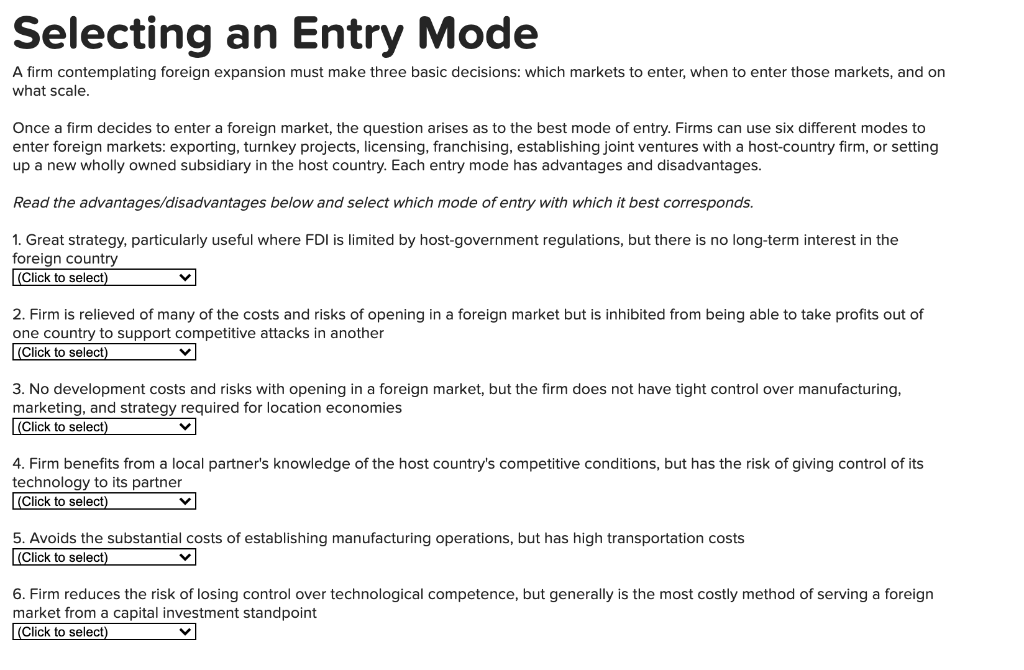
Selecting an Entry Mode A firm contemplating foreign expansion must make three basic decisions: which markets to enter, when to enter those markets, and on what scale. Once a firm decides to enter a foreign market, the question arises as to the best mode of entry. Firms can use six different modes to enter foreign markets: exporting, turnkey projects, licensing, franchising, establishing joint ventures with a host-country firm, or setting up a new wholly owned subsidiary in the host country. Each entry mode has advantages and disadvantages. Read the advantages/disadvantages below and select which mode of entry with which it best corresponds. 1. Great strategy, particularly useful where FDI is limited by host-government regulations, but there is no long-term interest in the foreign country Click to select) 2. Firm is relieved of many of the costs and risks of opening in a foreign market but is inhibited from being able to take profits out of one country to support competitive attacks in another (Click to select) 3. No development costs and risks with opening in a foreign market, but the firm does not have tight control over manufacturing, marketing, and strategy required for location economies (Click to select) 4. Firm benefits from a local partner's knowledge of the host country's competitive conditions, but has the risk of giving control of its technology to its partner (Click to select) 5. Avoids the substantial costs of establishing manufacturing operations, but has high transportation costs Click to select) 6. Firm reduces the risk of losing control over technological competence, but generally is the most costly method of serving a foreign market from a capital investment standpoint (Click to select) Selecting an Entry Mode A firm contemplating foreign expansion must make three basic decisions: which markets to enter, when to enter those markets, and on what scale. Once a firm decides to enter a foreign market, the question arises as to the best mode of entry. Firms can use six different modes to enter foreign markets: exporting, turnkey projects, licensing, franchising, establishing joint ventures with a host-country firm, or setting up a new wholly owned subsidiary in the host country. Each entry mode has advantages and disadvantages. Read the advantages/disadvantages below and select which mode of entry with which it best corresponds. 1. Great strategy, particularly useful where FDI is limited by host-government regulations, but there is no long-term interest in the foreign country Click to select) 2. Firm is relieved of many of the costs and risks of opening in a foreign market but is inhibited from being able to take profits out of one country to support competitive attacks in another (Click to select) 3. No development costs and risks with opening in a foreign market, but the firm does not have tight control over manufacturing, marketing, and strategy required for location economies (Click to select) 4. Firm benefits from a local partner's knowledge of the host country's competitive conditions, but has the risk of giving control of its technology to its partner (Click to select) 5. Avoids the substantial costs of establishing manufacturing operations, but has high transportation costs Click to select) 6. Firm reduces the risk of losing control over technological competence, but generally is the most costly method of serving a foreign market from a capital investment standpoint (Click to select)Step by Step Solution
There are 3 Steps involved in it
1 Expert Approved Answer
Step: 1 Unlock

Question Has Been Solved by an Expert!
Get step-by-step solutions from verified subject matter experts
Step: 2 Unlock
Step: 3 Unlock
 Study Help