







Question: The question is asking to take the program and than translate it to .word declarations in assembly program and than take these from .text segment
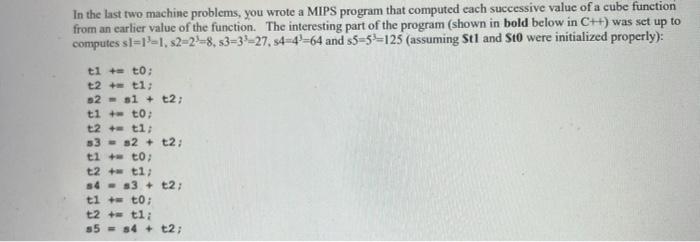


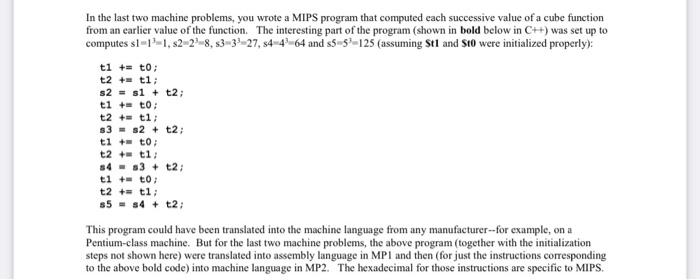
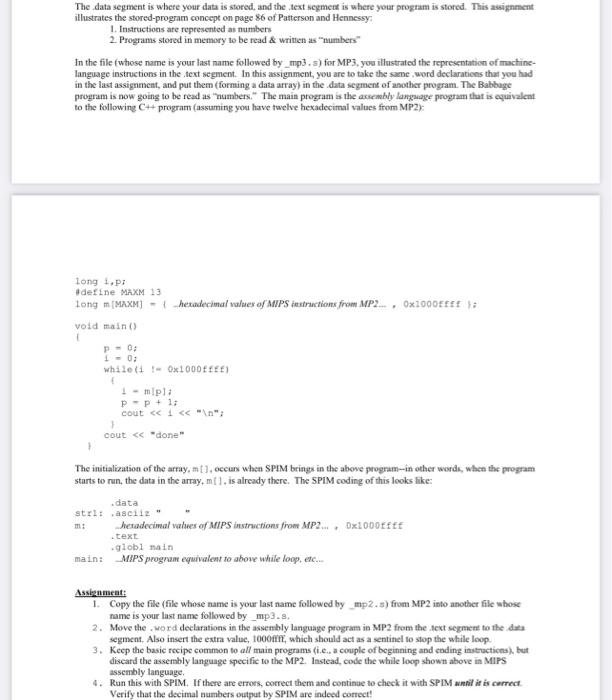
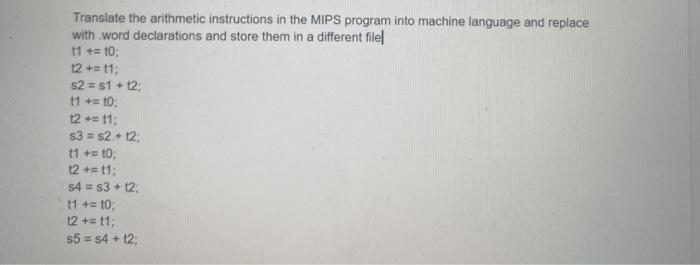
In the last two machine problems, you wrote a MIPS program that computed each successive value of a cube function from an earlier value of the function. The interesting part of the program (shown in bold below in C++) was set up to computes sl=1:-1, s2-2-8, 53=39-27, 84-4)=64 and 55=59=125 (assuming Stl and Sto were initialized properly): ti + to: t2 + tl; 52 - 5l + t2; ti + to: t2 + ti 33 = 32 + t2: tito t2 + 1; 54-53 + t2; ti + to; t2 + ti s5 = 54 + t2; In the file (whose name is your last name followed by _mp3..) for MP3, you illustrated the representation of machine language instructions in the text segment. In this assignment, you are to take the same word declarations that you had in the last assignment, and put them (forming a data array) in the data segment of another program. The Babbage program is now going to be read as "numbers. The main program is the assembly language program that is equivalent to the following C++ program (assuming you have twelve hexadecimal values from MP2): 2. Move the word declarations in the assembly language program in MP2 from the text segment to the data segment. Also insert the extra value, 1000m, which should act as a sentinel to stop the while loop. 3. Keep the basic recipe common to all main programs (i.e., a couple of beginning and ending instructions), but discard the assembly language specific to the MP2. Instead, code the while loop shown above in MIPS assembly language. 4. Run this with SPIM. If there are crrors, correct them and continue to check it with SPIM until it is correct. Verify that the decimal numbers output by SPIM are indeed correct! In the last two machine problems, you wrote a MIPS program that computed cach successive value of a cube function from an earlier value of the function. The interesting part of the program (shown in bold below in C++) was set up to computes sl-1-1,52-22-8, 53-39-27, 54-464 and 55-125 (assuming $t1 and Sto were initialized properly): ti += to; t2 += t; s2 = sl + t2; ti + to: t2 + tl: s3 = s2 + t2: ti to t2 + ti: 34 33 + t2; tl + to t2 + ti: 55 - 54 + t2: This program could have been translated into the machine language from any manufacturer--for example, on a Pentium-class machine. But for the last two machine problems, the above program (together with the initialization steps not shown here) were translated into assembly language in MPI and then (for just the instructions corresponding to the above bold code) into machine language in MP2. The hexadecimal for those instructions are specific to MIPS. The data segment is where your data is stored, and the text segment is where your program is stored. This assignment illustrates the stored-program concept on page 86 of Patterson and Hennessy 1. Instructions are represented as numbers 2. Programs stored in memory to be read & written as "numbers In the file (whose name is your last name followed by_mp3.s) for MP3, you illustrated the representation of machine language instructions in the text segment. In this assignment, you are to take the same word declarations that you had in the last assignment, and put them (forming a data array) in the data segment of another program. The Babbage program is now going to be read as "numbers. The main program is the assembly language program that is equivalent to the following C++ program (assuming you have twelve hexadecimal values from MP2) long 1.pi #define MAXM 13 long [MAXM) - thetadecimal values of MIPS instructions from MP2.... 0x1000f80f): void main() 1 - 0; whileti - Ox10001) Impli P-P+1; cout
Step by Step Solution
There are 3 Steps involved in it

Get step-by-step solutions from verified subject matter experts
 Study Help