



Question: the question is : Outcomes and the Type I and Type II Errors. *you can find the answer from these pages 9.2 | Outcomes and
the question is :
Outcomes and the Type I and Type II Errors.
*you can find the answer from these pages
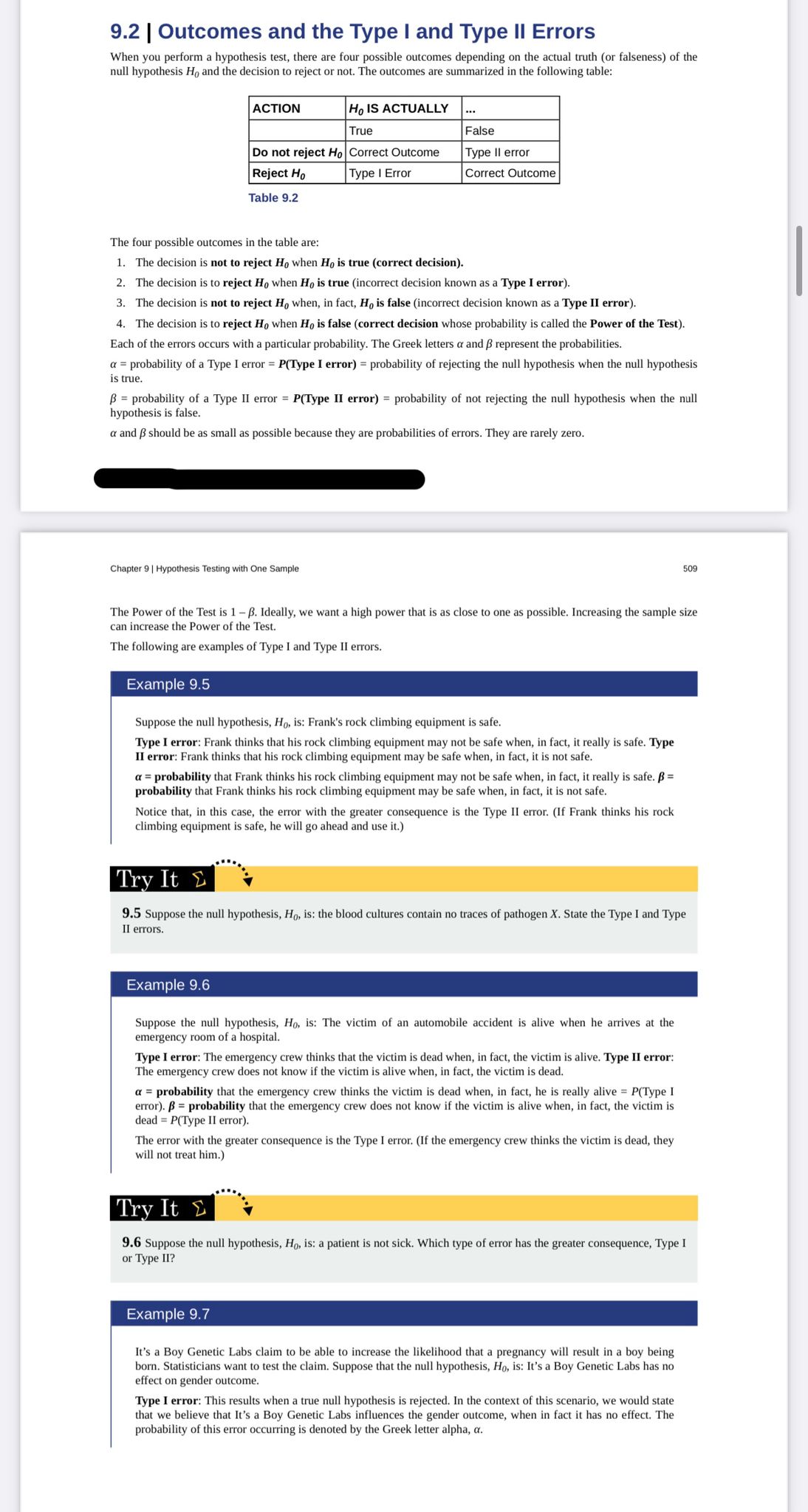
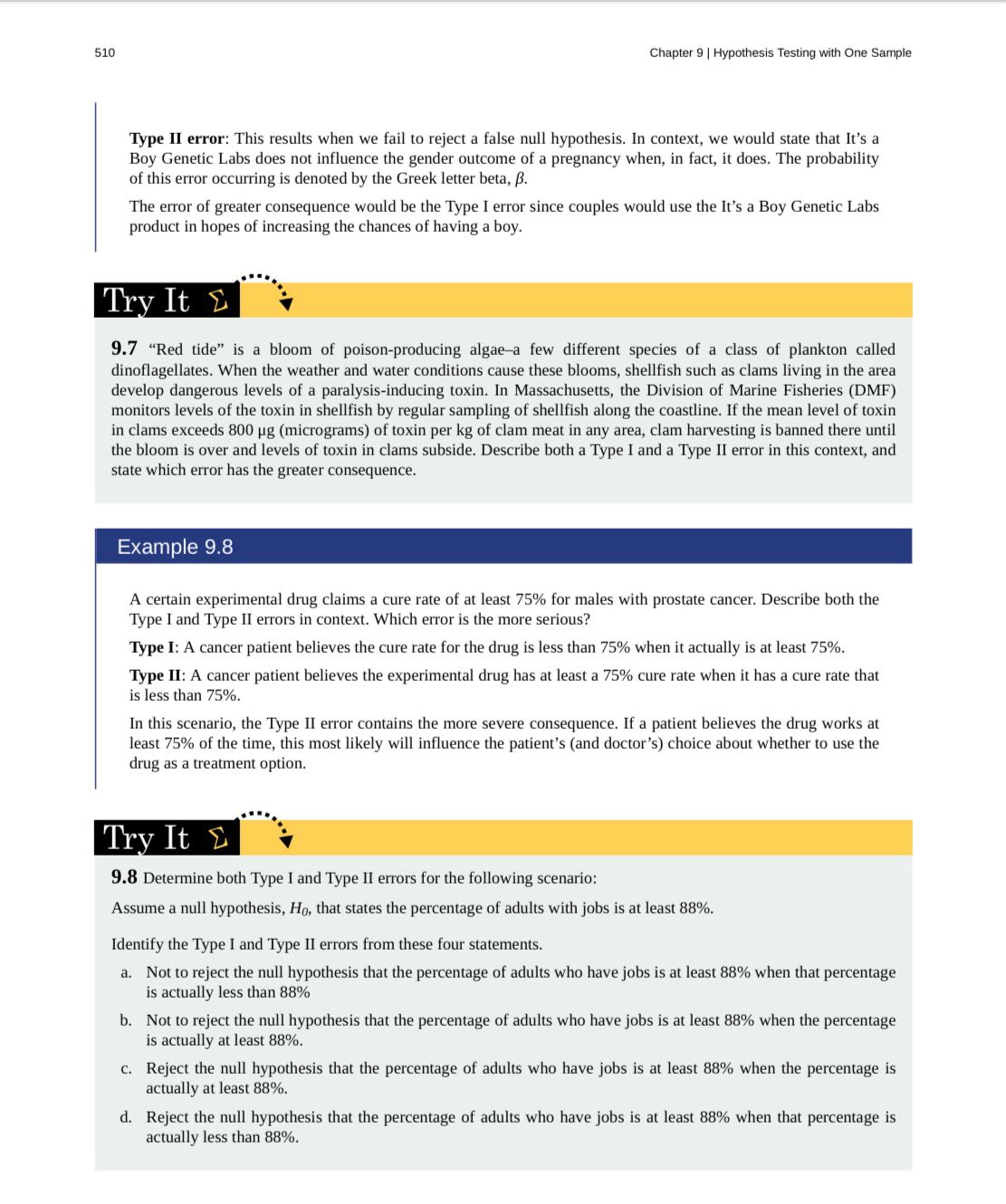
9.2 | Outcomes and the Type | and Type II Errors When you perform a hypothesis test, there are four possible outcomes depending on the actual truth (or falseness) of the null hypothesis H and the decision to reject or not. The outcomes are summarized in the following table: ACON Ha rs ACTUALLY _ _ Reject H9 Type E Error Correct Outcome Table 9.2 The four possible outcomes in the table are: l. The decision is not to reject Hg when Hg is true (correct decision). 2. The decision is to reject Hg when He is true (incon'ect decision known as a Type I error). 3. The decision is not to reject H9 when. in fact. B, Is [we (incorrect decision known as a Type II error). 4. The decision is to reject Ha when H. is [alse (correct decision whose probability is called the Power of the rst]. Each of the errors occtus with a particular probability. The Greek letters it and .3 represent the probabilities. a = probability of a Type I error = P(Type I error) = probability of rejecting the null hypothesis when the null hypothesis is true. 8 = probability of a Type II error = P(Type II error) = probability of not rejecting the null hypothesis when the null hypothesis is false. a and should be as small as possible because they are probabilities of errors. They are rarely zero. Chomr'il Hypothesis Testing with one Sample 509 The Power of the Test is 1 B. Ideally, we want a high power that Is as close to one as possible. Increasing the sample size can Increase the Power of the Test. The following are examples of Type I and Type II errors. Suppose the null hypothesis. Hg. is: Frank's rock climbing equipment is safe. Type I error: Frank thinks that his rock climbing equipment may not be sale when. in fact, it really is safe. Type I"! error: Franlt thinks that his rock climbing equipment may be safe when. in fact. it is not safe. a = probability that Frank thinks his malt climbing equipment may not be safe when, in fact. it really is safe. a = probability that Frank thinks his rock climbing equipment may be safe when, in fact. it is not. sate. Notice that, in this case, the error with the greater consequence is the Type II error. (if Frank thinks his rock climbing equipment is safe. he will go ahead and use it.) I'll. 'I Try It v 9.5 Suppose the null hypothesis. Hg, is: the blood cultures contain no traces of pathogen X. State the Type] and Type ti errors. Suppose the null hypothesis, Hg, is: The victim of an automobile accident Is alive when he arrives at the emergency room of a hospital. Type I error: The emergency crew tltinks that the victim is dead when. in fact. the vicLim is alive. Type 11 error: The emergency crew does not know it the victim is alive when, in tact. the victim is dead tr = probability that the emergency crew thinks the victim is dead when. in fact, he is really alive : \"Time 1 error). = probabillly that the emergency crew does not know if the victim is alive when. in fact. the victim is dead = Pflype ll error). The error with the greater consequence is the Type I error. (if the emergency crew thinks the victim is dead. they will nol treat him.) Try It it 9.6 Suppose the null hypothesis. H9. is: a patient is not sick. which type of error has the greater consequence, Type! or Type Ii? it's a Boy Genetic Labs claim to be able to increase the likelihood that a pregnancy will result in a boy being born. Statisticians want to test the claim. Suppose that the null hypothesis. H9. is: It's a Boy Genetic Labs has no effect on gender outcome. Type 1 error; This results when a true null hypothesis is rejected. In the context of this scenario. we would state that we believe that It's a Boy Genetic Labs influences the gender outcome, when in fact it has no effect. The probability of this error occurring is denoted by the Greek letter alpha, n. 510 Chapter 9 l Hypothesis Testing with One Sample Type II error: This results when we fail to reject a false null hypothesis. In context, we would state that It's a Boy Genetic Labs does not influence the gender outcome of a pregnancy when, in fact, it does. The probability of this error occurring is denoted by the Greek letter beta, ,9. The error of greater consequence would be the Type I error since couples would use the It's a Boy Genetic Labs product in hopes of increasing the chances of having a boy. 9.7 \"Red tide\" is a bloom of poison-producing algae-a few different species of a class of plankton called dinoagellates. When the weather and water conditions cause these blooms, shellfish such as clams living in the area develop dangerous levels of a paralysis-inducing toxin. In Massachusetts, the Division of Marine Fisheries (DMF) monitors levels of the toxin in shellfish by regular sampling of shellfish along the coastline. If the mean level of toxin in clams exceeds 800 pg (micrograms) of toxin per kg of clam meat in any area, clam harvesting is banned there until the bloom is over and levels of toxin in clams subside. Describe both a Type I and a Type 11 error in this context, and state which error has the greater consequence. A certain experimental drug claims a cure rate of at least 75% for males with prostate cancer. Describe both the Type I and Type II errors in context. Which error is the more serious? Type I: A cancer patient believes the cure rate for the drug is less than 75% when it actually is at least 75%. Type II: A cancer patient believes the experimental drug has at least a 75% cure rate when it has a cure rate that is less than 75%. In this scenario, the Type II error contains the more severe consequence. If a patient believes the drug works at least 75% of the time, this most likely will influence the patient's (and doctor's) choice about whether to use the drug as a treatment option. 9.3 Determine both Type I and Type II errors for the following scenario: Assume a null hypothesis, Ha, that states the percentage of adults with jobs is at least 88%. Identify the Type I and Me II errors from these four statements. a. Not to reject the null hypothesis that the percentage of adults who have jobs is at least 88% when that percentage is actually less than 88% I). Not to reject the null hypothesis that the pementage of adults who have jobs is at least 88% when the percentage is actually at least 88%. c. Reject the null hypothesis that the percentage of adults who have jobs is at least 88% when the percentage is actually at least 88%. d. Reject the null hypothesis that the percentage of adults who have jobs is at least 88% when that percentage is actually less than 88%
Step by Step Solution
There are 3 Steps involved in it

Get step-by-step solutions from verified subject matter experts