







Question: The question is prepare a summary or reflection on the performance of your project finance team preparation of this assessment. this reflection should be no
The question is prepare a summary or reflection on the performance of your project finance team preparation of this assessment. this reflection should be no more than 300 words
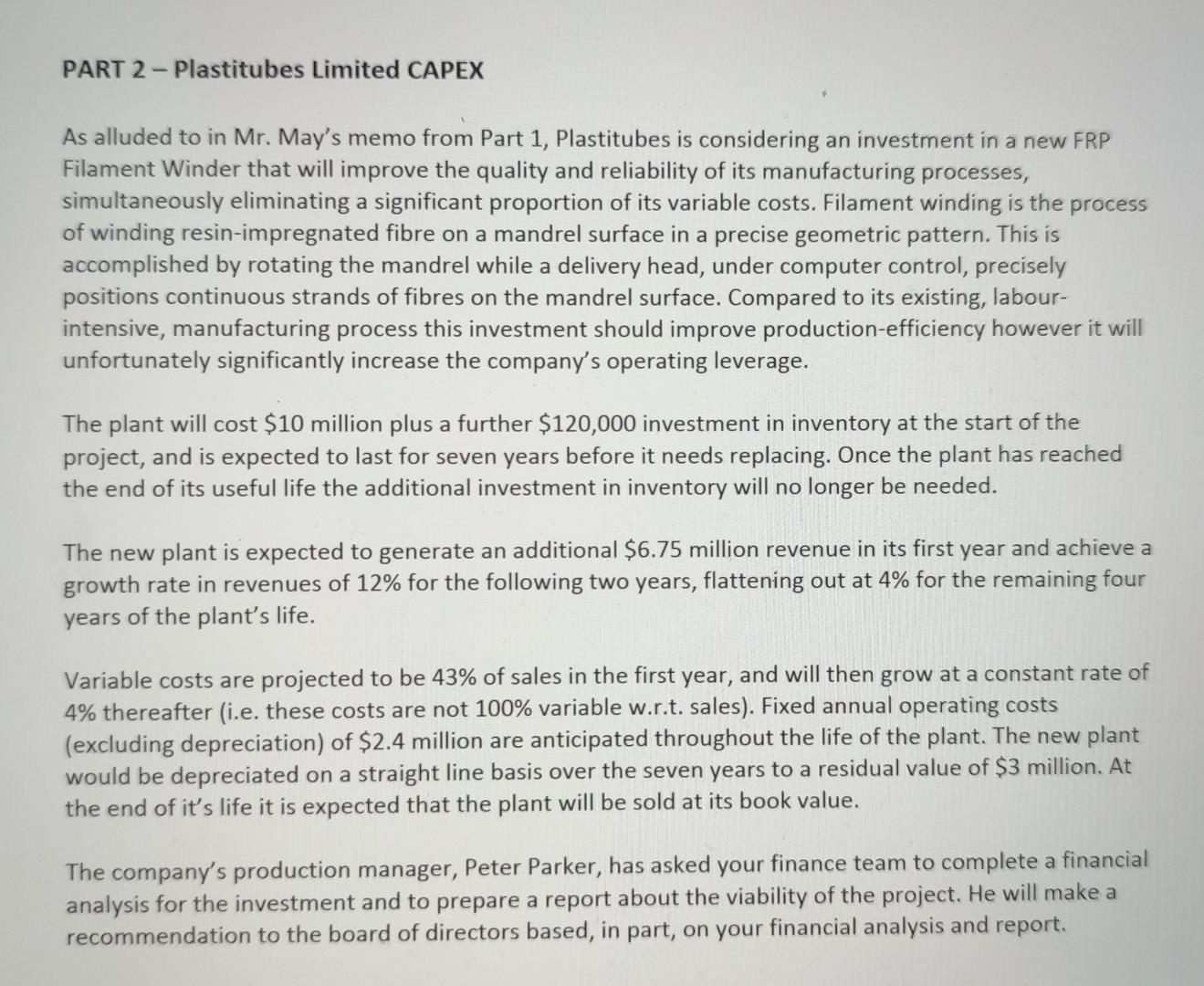
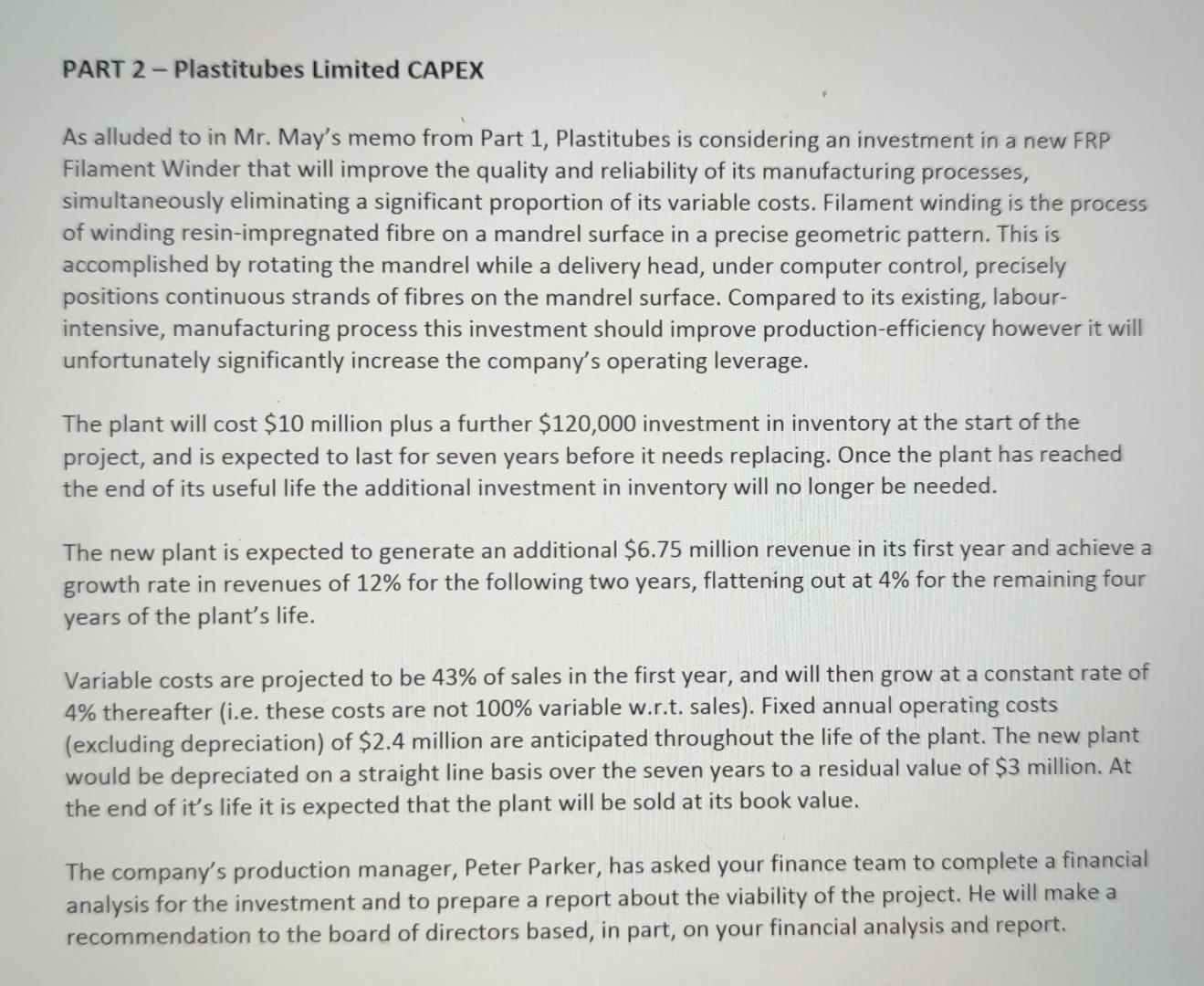
PART 2 - Plastitubes Limited CAPEX As alluded to in Mr. May's memo from Part 1, Plastitubes is considering an investment in a new FRP Filament Winder that will improve the quality and reliability of its manufacturing processes, simultaneously eliminating a significant proportion of its variable costs. Filament winding is the process of winding resin-impregnated fibre on a mandrel surface in a precise geometric pattern. This is accomplished by rotating the mandrel while a delivery head, under computer control, precisely positions continuous strands of fibres on the mandrel surface. Compared to its existing, labour- intensive, manufacturing process this investment should improve production-efficiency however it will unfortunately significantly increase the company's operating leverage. The plant will cost $10 million plus a further $120,000 investment in inventory at the star of the project, and is expected to last for seven years before it needs replacing. Once the plant has reached the end of its useful life the additional investment in inventory will no longer be needed. The new plant is expected to generate an additional $6.75 million revenue in its first year and achieve a growth rate in revenues of 12% for the following two years, flattening out at 4% for the remaining four years of the plant's life. Variable costs are projected to be 43% of sales in the first year, and will then grow at a constant rate of 4% thereafter (i.e. these costs are not 100% variable w.r.t. sales). Fixed annual operating costs (excluding depreciation) of $2.4 million are anticipated throughout the life of the plant. The new plant would be depreciated on a straight line basis over the seven years to a residual value of $3 million. At the end of it's life it is expected that the plant will be sold at its book value. The company's production manager, Peter Parker, has asked your finance team to complete a financial analysis for the investment and to prepare a report about the viability of the project. He will make a recommendation to the board of directors based, in part, on your financial analysis and report. PART 2 - Plastitubes Limited CAPEX As alluded to in Mr. May's memo from Part 1, Plastitubes is considering an investment in a new FRP Filament Winder that will improve the quality and reliability of its manufacturing processes, simultaneously eliminating a significant proportion of its variable costs. Filament winding is the process of winding resin-impregnated fibre on a mandrel surface in a precise geometric pattern. This is accomplished by rotating the mandrel while a delivery head, under computer control, precisely positions continuous strands of fibres on the mandrel surface. Compared to its existing, labour- intensive, manufacturing process this investment should improve production-efficiency however it will unfortunately significantly increase the company's operating leverage. The plant will cost $10 million plus a further $120,000 investment in inventory at the star of the project, and is expected to last for seven years before it needs replacing. Once the plant has reached the end of its useful life the additional investment in inventory will no longer be needed. The new plant is expected to generate an additional $6.75 million revenue in its first year and achieve a growth rate in revenues of 12% for the following two years, flattening out at 4% for the remaining four years of the plant's life. Variable costs are projected to be 43% of sales in the first year, and will then grow at a constant rate of 4% thereafter (i.e. these costs are not 100% variable w.r.t. sales). Fixed annual operating costs (excluding depreciation) of $2.4 million are anticipated throughout the life of the plant. The new plant would be depreciated on a straight line basis over the seven years to a residual value of $3 million. At the end of it's life it is expected that the plant will be sold at its book value. The company's production manager, Peter Parker, has asked your finance team to complete a financial analysis for the investment and to prepare a report about the viability of the project. He will make a recommendation to the board of directors based, in part, on your financial analysis and report. PART 2 - Plastitubes Limited CAPEX As alluded to in Mr. May's memo from Part 1, Plastitubes is considering an investment in a new FRP Filament Winder that will improve the quality and reliability of its manufacturing processes, simultaneously eliminating a significant proportion of its variable costs. Filament winding is the process of winding resin-impregnated fibre on a mandrel surface in a precise geometric pattern. This is accomplished by rotating the mandrel while a delivery head, under computer control, precisely positions continuous strands of fibres on the mandrel surface. Compared to its existing, labour- intensive, manufacturing process this investment should improve production-efficiency however it will unfortunately significantly increase the company's operating leverage. The plant will cost $10 million plus a further $120,000 investment in inventory at the star of the project, and is expected to last for seven years before it needs replacing. Once the plant has reached the end of its useful life the additional investment in inventory will no longer be needed. The new plant is expected to generate an additional $6.75 million revenue in its first year and achieve a growth rate in revenues of 12% for the following two years, flattening out at 4% for the remaining four years of the plant's life. Variable costs are projected to be 43% of sales in the first year, and will then grow at a constant rate of 4% thereafter (i.e. these costs are not 100% variable w.r.t. sales). Fixed annual operating costs (excluding depreciation) of $2.4 million are anticipated throughout the life of the plant. The new plant would be depreciated on a straight line basis over the seven years to a residual value of $3 million. At the end of it's life it is expected that the plant will be sold at its book value. The company's production manager, Peter Parker, has asked your finance team to complete a financial analysis for the investment and to prepare a report about the viability of the project. He will make a recommendation to the board of directors based, in part, on your financial analysis and report. PART 2 - Plastitubes Limited CAPEX As alluded to in Mr. May's memo from Part 1, Plastitubes is considering an investment in a new FRP Filament Winder that will improve the quality and reliability of its manufacturing processes, simultaneously eliminating a significant proportion of its variable costs. Filament winding is the process of winding resin-impregnated fibre on a mandrel surface in a precise geometric pattern. This is accomplished by rotating the mandrel while a delivery head, under computer control, precisely positions continuous strands of fibres on the mandrel surface. Compared to its existing, labour- intensive, manufacturing process this investment should improve production-efficiency however it will unfortunately significantly increase the company's operating leverage. The plant will cost $10 million plus a further $120,000 investment in inventory at the star of the project, and is expected to last for seven years before it needs replacing. Once the plant has reached the end of its useful life the additional investment in inventory will no longer be needed. The new plant is expected to generate an additional $6.75 million revenue in its first year and achieve a growth rate in revenues of 12% for the following two years, flattening out at 4% for the remaining four years of the plant's life. Variable costs are projected to be 43% of sales in the first year, and will then grow at a constant rate of 4% thereafter (i.e. these costs are not 100% variable w.r.t. sales). Fixed annual operating costs (excluding depreciation) of $2.4 million are anticipated throughout the life of the plant. The new plant would be depreciated on a straight line basis over the seven years to a residual value of $3 million. At the end of it's life it is expected that the plant will be sold at its book value. The company's production manager, Peter Parker, has asked your finance team to complete a financial analysis for the investment and to prepare a report about the viability of the project. He will make a recommendation to the board of directors based, in part, on your financial analysis and report. PART 2 - Plastitubes Limited CAPEX As alluded to in Mr. May's memo from Part 1, Plastitubes is considering an investment in a new FRP Filament Winder that will improve the quality and reliability of its manufacturing processes, simultaneously eliminating a significant proportion of its variable costs. Filament winding is the process of winding resin-impregnated fibre on a mandrel surface in a precise geometric pattern. This is accomplished by rotating the mandrel while a delivery head, under computer control, precisely positions continuous strands of fibres on the mandrel surface. Compared to its existing, labour- intensive, manufacturing process this investment should improve production-efficiency however it will unfortunately significantly increase the company's operating leverage. The plant will cost $10 million plus a further $120,000 investment in inventory at the star of the project, and is expected to last for seven years before it needs replacing. Once the plant has reached the end of its useful life the additional investment in inventory will no longer be needed. The new plant is expected to generate an additional $6.75 million revenue in its first year and achieve a growth rate in revenues of 12% for the following two years, flattening out at 4% for the remaining four years of the plant's life. Variable costs are projected to be 43% of sales in the first year, and will then grow at a constant rate of 4% thereafter (i.e. these costs are not 100% variable w.r.t. sales). Fixed annual operating costs (excluding depreciation) of $2.4 million are anticipated throughout the life of the plant. The new plant would be depreciated on a straight line basis over the seven years to a residual value of $3 million. At the end of it's life it is expected that the plant will be sold at its book value. The company's production manager, Peter Parker, has asked your finance team to complete a financial analysis for the investment and to prepare a report about the viability of the project. He will make a recommendation to the board of directors based, in part, on your financial analysis and report
Step by Step Solution
There are 3 Steps involved in it

Get step-by-step solutions from verified subject matter experts
 Study Help