







Question: the question is shown below Question 3 Consider this special class of the production function, called the Leontief production function: Q = min { K,
the question is shown below
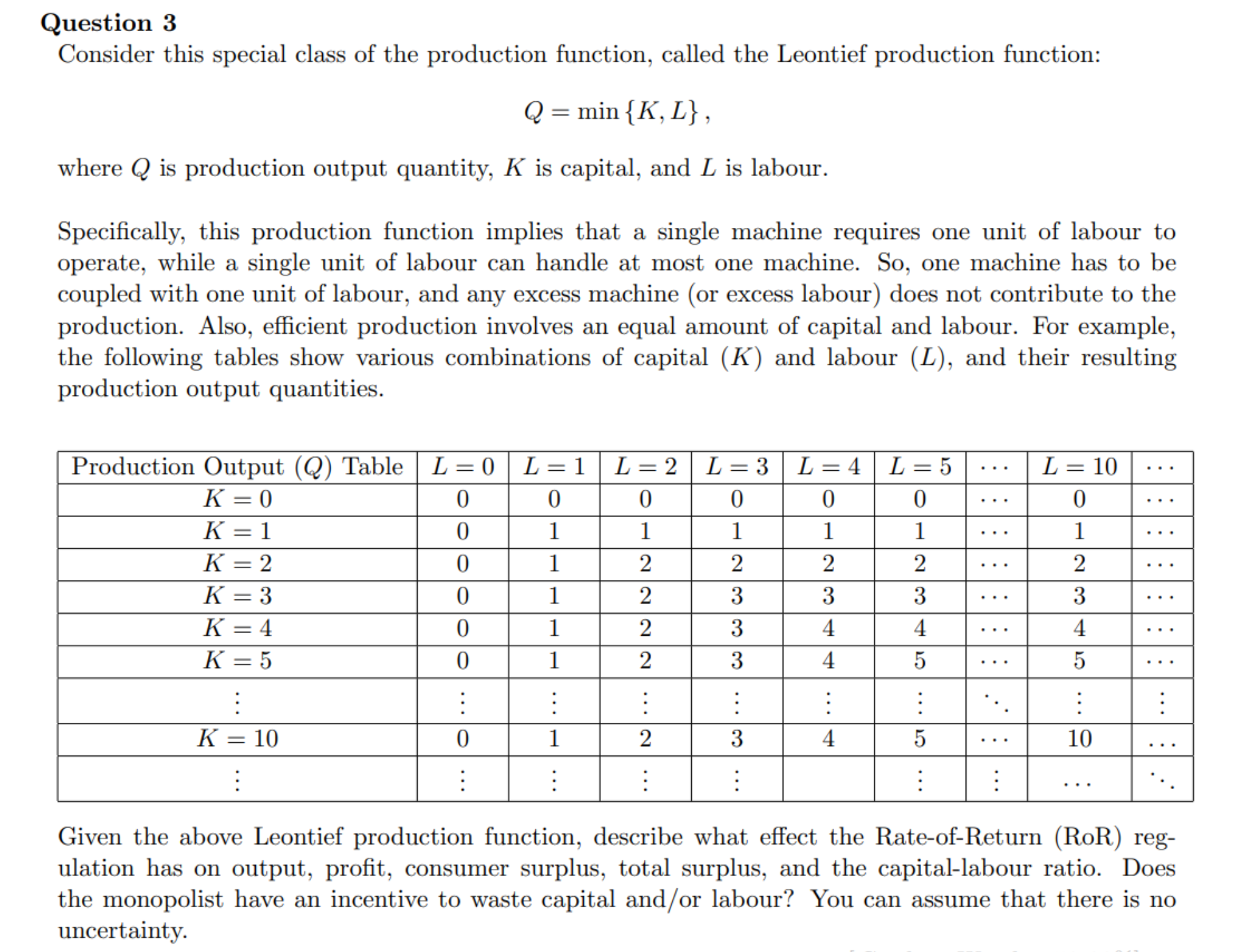
Question 3 Consider this special class of the production function, called the Leontief production function: Q = min { K, L} , where Q is production output quantity, K is capital, and L is labour. Specifically, this production function implies that a single machine requires one unit of labour to operate, while a single unit of labour can handle at most one machine. So, one machine has to be coupled with one unit of labour, and any excess machine (or excess labour) does not contribute to the production. Also, efficient production involves an equal amount of capital and labour. For example, the following tables show various combinations of capital (K) and labour (L), and their resulting production output quantities. Production Output (Q) Table L =0|L =1 |L=2 |L=3 L=4 L=5 . . . L = 10 . . . K = 0 0 0 0 0 0 0 . . . 0 . . . K =1 0 1 1 . . . 1 . . . K = 2 0 CO N H 2 . . . 2 . . K =3 0 3 . . . 3 NNNNK . . K = 4 0 . . . . . A K = 5 0 . . . 5 . . . . . . . . . . . . . . . . . K = 10 0 NO 3 4 5 . 10 . . . . . . . . . . . . . . . . . . Given the above Leontief production function, describe what effect the Rate-of-Return (RoR) reg- ulation has on output, profit, consumer surplus, total surplus, and the capital-labour ratio. Does the monopolist have an incentive to waste capital and/or labour? You can assume that there is no uncertainty
Step by Step Solution
There are 3 Steps involved in it

Get step-by-step solutions from verified subject matter experts
 Study Help